The evidence: AI-native pipelines are already displacing studio output
The AI-native creative pipeline has moved from pilot to production faster than most studios expected. In the first half of 2026, measurable evidence accumulated that AI-generated creative is not merely supplementing human output - it is structurally displacing it, reshaping how commercial video gets made and who gets paid for it.
The numbers are specific. According to data published in June 2026 by WARC and the consultancy Ebiquity, brands that shifted more than 40 percent of their display and social creative production to AI-native pipelines - end-to-end generation with tools such as Adobe Firefly Enterprise, Google Imagen, and purpose-built platforms - reported average creative production cost reductions of 58 percent year over year, while testing 340 percent more creative variants in the same window and lifting click-through rates by an average of 19 percent across Meta and Google inventory. The proximate cause is a compute-cost collapse: the price to generate a broadcast-quality 30-second video asset fell roughly 71 percent between the first quarters of 2025 and 2026, per IDC pricing benchmarks.
Quality is no longer the obvious differentiator it was. In studies run by Kantar and Nielsen in early 2026, consumer research panels could not reliably distinguish AI-generated video ads from human-produced ones in 62 percent of tested categories. A June 2026 meta-analysis by Analytic Partners across 1,400 brand campaigns found AI creative landed within 7 percent of human work on short-term revenue ROI and beat it in 31 percent of cases - mostly because of the volume advantage in variant testing.
Adoption has crossed the experimental line. In Jasper's 2026 State of AI in Marketing survey of 1,400 marketers, 91 percent said they now use AI in their work, up from 63 percent a year earlier - but only 41 percent can prove its ROI, and brand, legal, and compliance review is the single biggest scaling challenge. The experiment is over; the operating question is how to run the pipeline well, not whether to adopt one.
The disruption is not uniform. Independent agencies with billings between 10 million and 100 million dollars saw production-related revenue per client fall 31 percent in the 4A's 2026 Agency Compensation Survey, while holding-company networks reframed AI as a margin tool - WPP reported a 210-basis-point production-margin improvement from AI-assisted workflows in Q1 2026. The structural implication is that durable advantage now comes from data depth and brand clarity, not from generative capability itself, which is commoditizing rapidly.
What an AI-native creative pipeline actually looks like
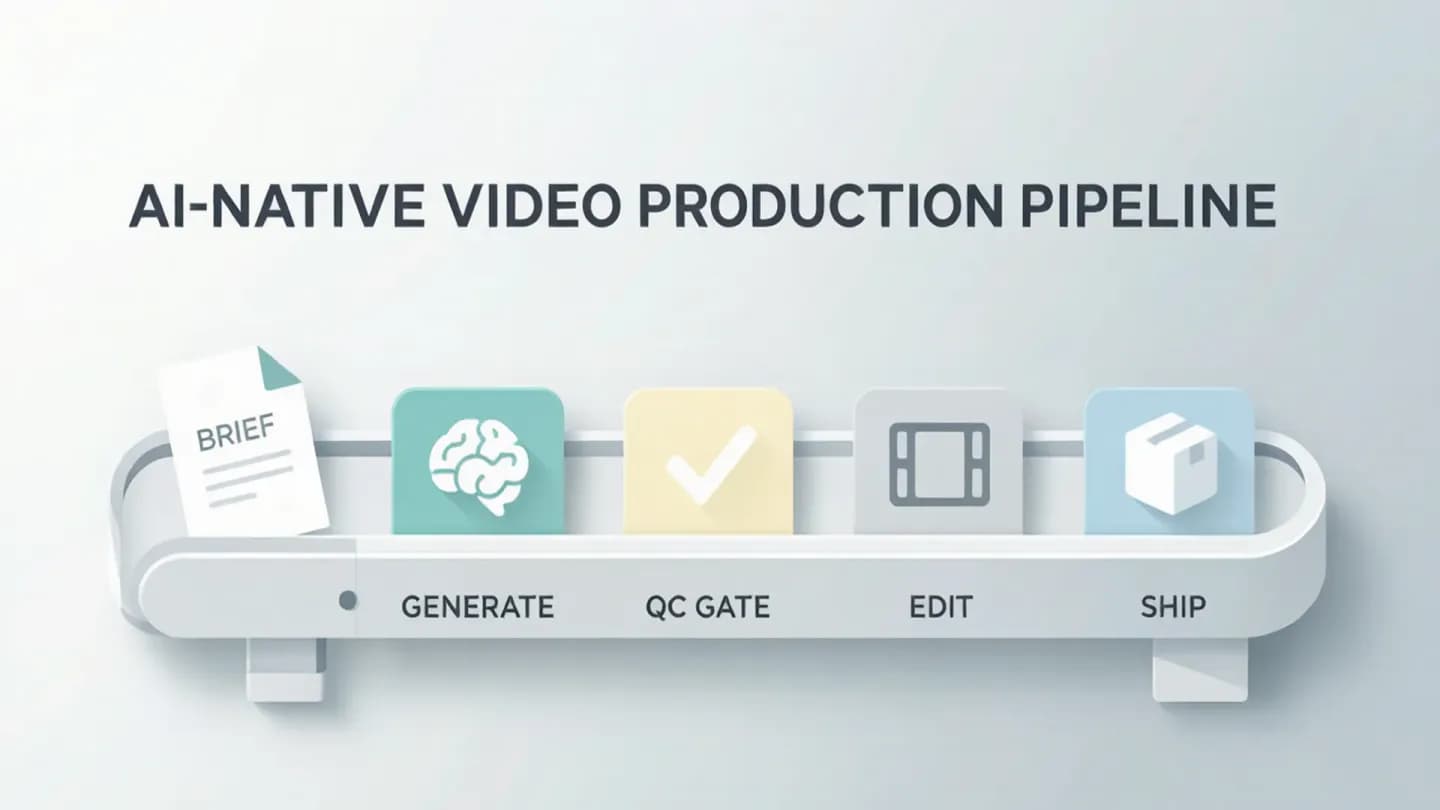
An AI-native creative pipeline is a continuous loop, not a one-shot generator. It starts with a tight brief, moves into generation against that brief, runs a quality gate, edits the survivors, assembles them into a finished cut, and ships - then feeds performance data back into the next brief. The difference from a traditional studio is that every stage is software-shaped: the brief is structured data, generation is batchable, and the gate is a checklist you can automate.
Generation is the easy part now. A single model pass can return dozens of variants from one brief, and longer single-pass clips - 30 seconds and up from Seedance 2.5, Wan3.0, and MiniMax H3 - mean more of the story is decided in the prompt than in the edit. That shift moves shot planning upstream and lets a small team out-produce a much larger traditional crew on high-volume, variant-heavy performance work.
The edit stage is where loose clips become a commercial. Generation gives you raw material; assembly rebuilds continuity, sound, and look across clips that were dreamed up in isolation. Treat the edit as the craft layer that separates a usable cut from a pile of promising fragments, and resist the urge to ship the first acceptable take.
Even inside a fully AI-native stack, the producer-led operating model keeps one owner accountable for the entire pipeline from brief to ship.

Where the human stays: brand judgment and the equity gap
Displacement is real but uneven. Concepting, brand strategy, and culturally nuanced long-form storytelling still command a human premium, while high-volume performance creative is being automated fastest. The danger is optimizing the volume game so hard that you starve the brand-building game.
The data shows the equity cost. Analytic Partners found AI creative trailed human work by an average of 23 percent on brand-distinctiveness, emotional-resonance, and unaided-recall metrics - the compounding assets that lower acquisition cost over years. Les Binet of adam&eveDDB framed it at the IPA Effectiveness Summit in May 2026: use AI for the volume game, but protect the human creative investment for the work that builds long-term brand memory. Brands that over-optimize for short-term performance creative at the expense of brand equity tend to face customer-acquisition-cost inflation 18 to 36 months later.
The brands that hold their ground treat a repeatable model-selection workflow as the rule for the work that builds long-term memory.

The QC gate moves earlier, not away
A common failure mode at scale is quality instability: faces that morph, hands that break, text that burns into the frame, captions that drift from the voiceover. Generation is cheap, which tempts teams to ship the first acceptable clip - but the cost of a bad clip is a compliance incident or a brand hit, not a render fee.
Quality instability is the most common failure mode at scale, so a pre-ship QC checklist has to run before anything reaches a client.
Because generation is the cheap stage, the gate should run on raw output, not on the finished cut. Catch identity drift, broken anatomy, and provenance gaps at the clip level, and you protect the downstream edit from garbage-in. The discipline is the same one traditional production applied to rushes - continuity, identity, audio, provenance, and delivery - just moved from the end of the line to the start, where a rejected clip costs a generation rather than a reshoot.
Automating the gate is what makes the volume sustainable. A checklist that scores every clip on the five gates turns a bottleneck into a batch job, so the human reviewer spends time on judgment calls - is this on brand, does it build memory - instead of hunting for melted hands frame by frame.

Disclosure and provenance ride along the pipeline
Automation does not suspend the rules. An AI-generated ad still has to be truthful, and in many markets it has to be labeled. YouTube's recommended upload spec - MP4 container, H.264 video, AAC-LC, Opus, or Eclipsa audio - applies to AI-generated uploads exactly as it does to traditionally shot footage, so delivery has not changed just because the source did. The EU AI Act's transparency rules require synthetic content to be marked as artificially generated, and those obligations travel with the asset wherever it ships.
Provenance should be attached at generation, not bolted on at legal review. C2PA's Content Credentials embed origin and edit-history metadata into the file itself, so platforms and viewers can verify whether media is AI-generated or altered - effectively a nutrition label for digital content. Stamping credentials at the pipeline stage means a compliant asset arrives at the gate already traceable, instead of triggering a scramble when a regulator or platform asks.
This is where the disclosure and rights work from earlier playbooks still applies: keep claims substantiated, keep likeness and music cleared, and keep the label visible. The pipeline just makes it cheaper to do that consistently across thousands of variants, which is exactly when it matters most.
Stand up your AI-native creative pipeline: tooling, cost, and operating model
Standing one up this quarter is less about buying a model and more about wiring the loop. Pick a generation layer, a QC layer, a provenance layer, and an owner. The owner is the load-bearing part - without one, generation sprawls and nothing ships accountably.
Routing each job to the right engine starts with the real cost-per-finished-video math rather than defaulting every brief to the same flagship model.
Before committing to a tool stack, pressure-test the human-core, AI-scaled model against the briefs you actually ship.
The real driver is cost per usable clip, not sticker price: a model that needs five generations to land one good take costs more per finished second than a pricier model that nails it in two. Draft cheap, finish expensive, and keep a free tier in the mix for throwaway tests. For enterprise work, platforms such as Adobe Firefly Enterprise win on IP indemnification, while governance-focused tools such as Typeface keep brand rules consistent across high-volume generation and performance-native tools such as Pencil rank variants before they ever reach the market.
Operationally, the teams that survive the shift are not the fastest generators - they are the ones with the richest first-party performance data and the clearest brand positioning to constrain the generative space. Generation is now a commodity; judgment is the scarce resource. Build the pipeline so the human who owns it spends time on brief, gate, and brand, and lets the machines handle the volume.
Put the framework into production
These related pages connect the article’s planning advice to a specific commercial scope.
References
- The Synthetic Creative Reckoning: How AI Is Replacing the Ad StudioAd-Times
Brands that moved more than 40% of display and social creative to AI-native pipelines reported 58% lower production cost year over year and tested 340% more variants with a 19% average CTR lift (WARC and Ebiquity, June 2026); broadcast-quality 30s video generation cost fell ~71% Q1 2025 to Q1 2026 (IDC); Kantar and Nielsen panels could not distinguish AI from human video ads in 62% of tested categories (early 2026).
- The State of AI in Marketing 2026Jasper
91% of marketers now use AI in their work (up from 63% a year earlier), but only 41% can prove its ROI, and brand, legal, and compliance review is the top scaling challenge (survey of 1,400 marketers, 2026).
- C2PA - Verifying Media Content SourcesC2PA
C2PA Content Credentials attach origin and edit-history metadata to a file so platforms and viewers can verify whether media is AI-generated or altered - a transparency standard for digital content.
- YouTube recommended upload encoding settingsYouTube Help
YouTube's recommended upload spec - MP4 container, H.264 video, AAC-LC, Opus, or Eclipsa audio - applies to all uploaded video including AI-generated uploads.