
The 2026 ad auction is a creative auction
On Meta in 2026, the auction is decided far more by the creative than by your bid. AI-generated UGC creative has become the format that feeds it best, because it blends into the feed and can be produced at the volume the algorithm now rewards.
The mechanism underneath is a creative bandit. Meta's own guidance frames Advantage+ Shopping Campaigns as rewarding accounts that ship 30 to 200 active variants per ad set with steady throughput, across multiple hooks, formats, and aspect ratios. A handful of polished brand films refreshed once a quarter simply starves the algorithm. The creative has to be native, plentiful, and constantly turning over.
This is a structural change, not a tactic. In 2024 the differentiator was a single great hero film; in 2026 the differentiator is a system that can out-produce the testing velocity of the auction. Teams that treat creative as a fixed monthly deliverable will keep losing impression share to accounts that treat it as a continuously refreshed pipeline, and the gap widens every quarter the bandit runs.

Why human-shot UGC can't supply the volume
User-generated-style creative is the right format. It blends into the feed, it converts, and it earns lower CPCs than polished brand video in most DTC verticals. The problem is supply. Briefing, shooting, and editing creator UGC at the scale a 2026 auction demands is slow and expensive, and most in-house teams cap out at a few assets a month.
The refresh math makes it worse. Variants past about 28 days decay sharply on Meta, so a healthy account is replacing its top variant set every two to four weeks. Multiplying that cadence by 30 to 200 live variants means sourcing and editing hundreds of distinct cuts a month, a workload no creator pipeline sustains without either blowing the budget or collapsing the review queue.
Smaller advertisers feel this most acutely. They rarely have an agency retainer or an in-house studio, so every additional creator video is a sourcing project with its own negotiation, shoot, and edit. The result is a thin variant set that the bandit algorithm quickly exhausts, after which performance quietly decays while the spend stays flat and nobody can pinpoint why.
What AI-generated UGC creative actually changes
AI-generated UGC creative collapses the per-cut cost. Industry reporting from 2026 puts AI-generated UGC-style variants at roughly three to five dollars each, against one hundred fifty dollars or more for a creator-shot equivalent, a 20 to 30x drop that turns 200 variants from impossible to routine. The same analyses estimate AI now supplies 70 to 90 percent of variant volume for teams running this model, with creator footage reserved for hero spots.
The point is not to replace humans but to change where they sit. Pair the variant library with a disciplined {{link}} so winning angles get expanded, not just generated. You still need a human to set the brand templates, judge the outputs, and decide which cuts ship; AI just removes the production bottleneck that used to cap how many you could test. Because a new hook variant can be spun in hours rather than weeks, the team finally matches the cadence the auction expects.
Quality still has a human gate. Not every AI variant is worth shipping, and the risk at volume is sameness: dozens of near-identical cuts that the algorithm reads as one idea. The human reviewer's job shifts from making assets to curating them, killing the redundant 80 percent and promoting the few that show a genuinely distinct angle worth scaling.
Pair the variant library with a disciplined AI UGC testing system for paid social so winning angles get expanded, not just generated.
Build a hybrid production workflow
A workable setup locks three to five brand templates on an AI UGC platform, one per concept bucket: problem-aware, founder or trust, product demo, and social proof. From those templates you generate 60 to 100 variants a week and push them into bundled Advantage+ campaigns, letting Dynamic Creative Optimization assemble the winning combinations automatically.
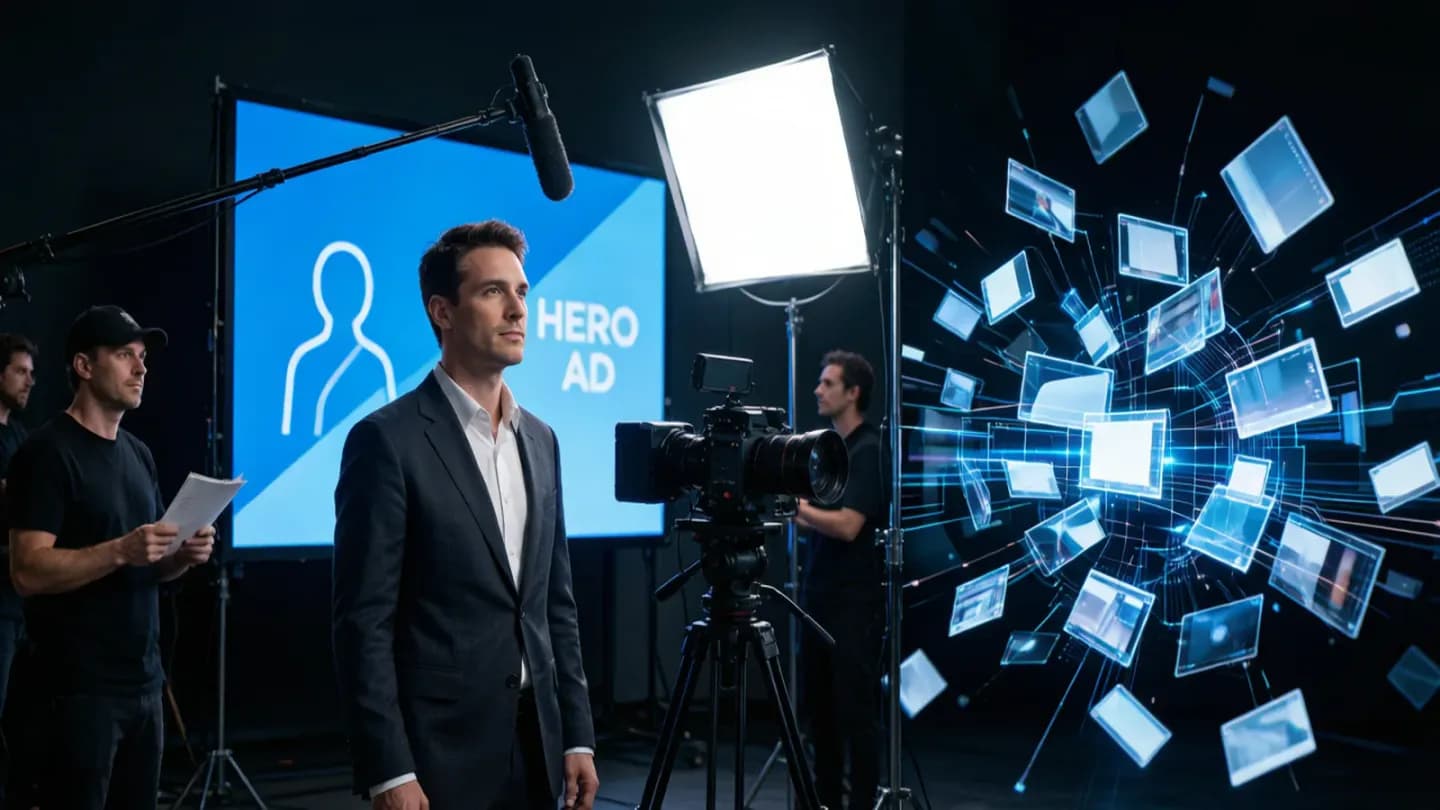
Reserve your creator budget for two to four hero spots per quarter, the founder or trust-led films that anchor the library and become source material for AI variants. The economics are stark: AI UGC runs a few dollars per cut where {{link}} once ran into hundreds, so the hybrid model spends creator money only where a real human performance earns it. Localization becomes a one-day project too, because an AI voice swap can re-version a winning cut for three to five markets without reshooting.
Tag every variant with a creative-source label, AI, creator, hero, or social proof, so you can pull contribution-margin breakdowns by source and reallocate budget toward the cut type that actually converts. Without that tagging, 100 variants become an unreadable pile and the auction's own reporting cannot tell you what worked, which defeats the entire point of generating them.
The economics are stark: AI UGC runs a few dollars per cut where traditional AI video production cost once ran into hundreds, so the hybrid model spends creator money only where a real human performance earns it.
Keep AI UGC commercially safe
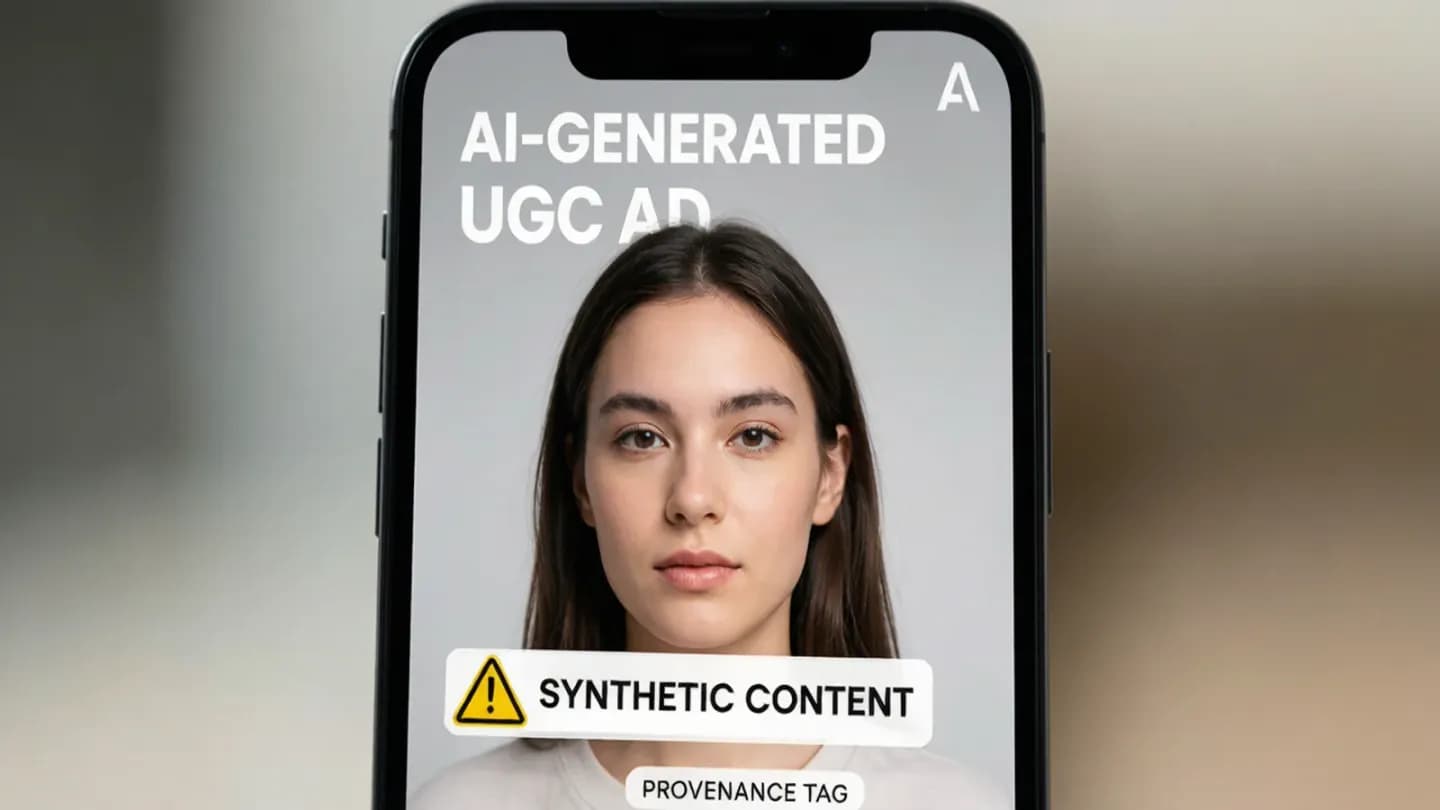
Volume multiplies risk as fast as it multiplies output. A synthetic spokesperson or voice that looks real must be disclosed, and YouTube now requires creators to label realistic altered or synthetic content or face penalties. Treat synthetic spokespeople and voices like any other disclosure obligation — {{link}} now covers the 2026 labeling rules across the EU, New York, and India, and the same label discipline applies to paid social.
Provenance is the second guardrail. Buyers increasingly want an audit trail showing which model generated an asset, who approved it, and what changed between versions, and IAB's 2026 research puts that demand at 36 percent of video buyers. Stamp a content-credentials or version tag on every variant so a winning cut is traceable from brief to live ad, and brand control stays with the human reviewer rather than the prompt.
Brand consistency is the third guardrail. At volume, a loose prompt drifts, and a hundred minor deviations from approved colors, fonts, or claims add up to a brand that looks inconsistent across the feed. Lock the brand kit into the templates so the AI variants stay inside the lines the human reviewer already approved, and a scaled library reads as one coherent voice rather than a hundred off-brand experiments.
Treat synthetic spokespeople and voices like any other disclosure obligation — AI video disclosure compliance now covers the 2026 labeling rules across the EU, New York, and India, and the same label discipline applies to paid social.
Measure variant performance, not just reach
When you can test hundreds of variants, the discipline shifts from 'did it get views' to 'which signals predict pipeline.' Save rate and hook rate outperform raw view counts for forecasting revenue, and they survive the creative fatigue that eventually buries any single cut.
Wire the variant library to the same measurement you would use for any paid creative. Track save rate and hook rate, not just reach; {{link}} maps the signals that actually predict pipeline, so you can retire losers on a threshold and scale winners before fatigue sets in. Treat creative as a data-driven discipline, not an art project, and the volume stops being a liability.
Set a kill threshold and a testing budget before you launch. A common rule pauses any variant that has not hit a minimum engagement or hook rate after a fixed spend, then reallocates to the next cut, while 20 to 30 percent of total ad budget stays earmarked for testing new creative. The volume only pays off if the system is disciplined about retiring losers instead of letting them quietly drain the account.
Track save rate and hook rate, not just reach; video metrics that predict revenue maps the signals that actually predict pipeline, so you can retire losers on a threshold and scale winners before fatigue sets in.
What organic penalizes, paid rewards
Keep the platform split in view. Organic recommendation surfaces have started demoting wholly AI-generated video, while paid platforms actively subsidize the same cuts because they perform. The same asset that struggles to earn organic reach can be exactly what the auction wants, so brief one master for both outcomes rather than fighting the contradiction.
Remember the split incentive: {{link}}, while paid platforms subsidize the same cuts. AI-generated UGC creative is therefore less a replacement for organic strategy and more a paid-social-specific advantage. Use it where the auction rewards volume, and keep human-made or hybrid content carrying your owned and organic channels.
Briefing the dual-purpose master means designing the hero concept so it can be both a strong organic post and a high-volume paid variant source. Lead with a real human moment for the feed, then let AI extend it into the hook and format variations the auction needs, rather than producing two separate assets that end up telling two different stories to the same audience.
Remember the split incentive: organic feeds demote AI-generated video, while paid platforms subsidize the same cuts.
Put the framework into production
These related pages connect the article’s planning advice to a specific commercial scope.
References
- YouTube: Disclosing use of altered or synthetic contentYouTube Help
YouTube requires creators to disclose realistic altered or synthetic content, including AI-generated people, voices, or scenes, or risk penalties such as content removal.
- 2026 IAB Digital Video Ad Spend & Strategy ReportIAB
IAB's 2026 report finds nearly two-thirds of video buyers now use GenAI for creative, 96 percent see a role for agentic AI, 40 percent want humans in the loop, and 36 percent want an AI audit trail.
- Meta Ads UGC Creative Strategy 2026Studioverse
Meta Advantage+ rewards 30 to 200 active variants per ad set; AI UGC costs roughly 3 to 5 dollars per variant versus 150 dollars for creator-shot footage, supplying 70 to 90 percent of variant volume.