
AI Video Creative Is Now Operational — and Hard to Trace
In 2026, AI stopped being an experiment in video creative, and the AI video creative audit trail has become the record that proves how a generated asset was actually built. According to the IAB 2026 Digital Video Ad Spend and Strategy Report, two in three digital video buyers are already live, testing, or planning agentic AI for video campaigns this year, and U.S. digital video ad spend is projected to surpass 80 billion dollars. The question for most teams has shifted from whether to use AI to how to ship AI-built creative responsibly, and responsibility now has a paper trail.
When a model generates a finished cut, the traditional production paper trail disappears. Call sheets, shot logs, and approval emails are replaced by a prompt that may never be saved in any reviewable form. The asset arrives looking finished, but the record of how it was made is thin or missing entirely, which is a problem the moment someone asks to see it. A generated thirty-second ad can involve a dozen model calls, and none of them are logged unless a team decides to log them.
That gap is now a governance problem, not a workflow nuisance. The same IAB research shows buyers want explainable, guardrailed creative, and Serviceplan's CMO Barometer 2026 finds that 68 percent of 805 marketing leaders across 15 countries name AI the defining topic of the year. When AI is the defining topic, the ability to prove how an asset was produced becomes a core competency rather than a nice to have, and procurement teams have started asking for it in writing.
What an AI Video Creative Audit Trail Records
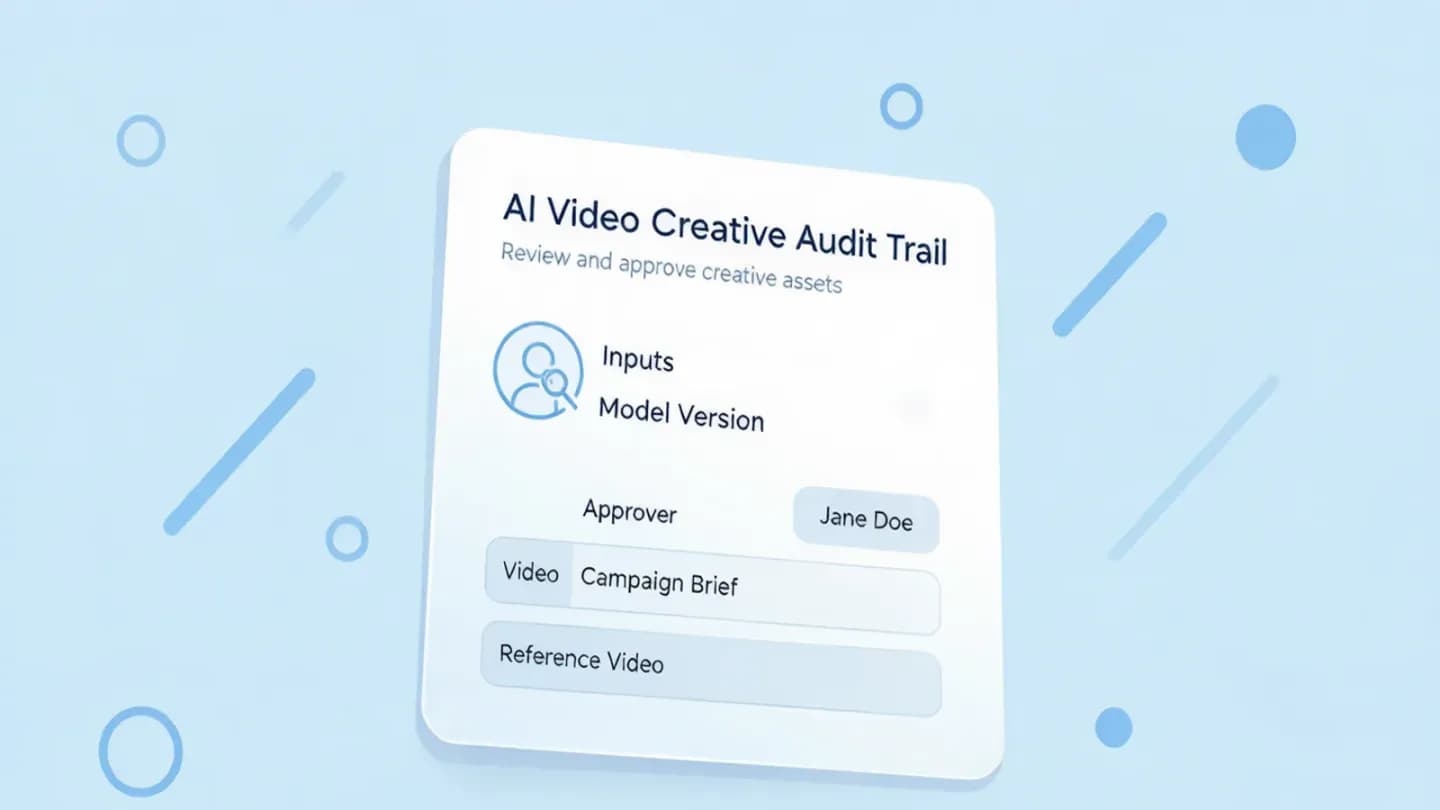
An AI video creative audit trail is a reviewable record of how an asset was produced: which inputs went in, which model or agent generated it, what version, who approved it, and what changed between versions. It answers the question a legal reviewer, a client, or a platform auditor will eventually ask about a specific cut, usually at the worst possible moment. A good trail is boring on purpose: it removes debate by recording the facts instead of relying on memory.
It is not the same thing as the consumer-facing disclosure label. Disclosure tells a viewer that an ad was AI-made. The audit trail tells the people inside the company how the asset came to exist, and lets them defend that process after the fact instead of reconstructing it from memory. The two are easy to confuse, which is exactly why teams should define them as separate artifacts with separate owners.
C2PA, the Coalition for Content Provenance and Authenticity, defines the open technical standard for this kind of record. Its Content Credentials establish the origin and edits of digital content, so anyone can inspect a content's history rather than trust a claim made in a brief that nobody kept. Because the standard is open, a credential issued by one tool can be read by another, which is the property that makes a trail portable.
C2PA and Content Credentials: the Emerging Standard
Content Credentials work like a nutrition label for digital content. They capture the content's history, the model used, the edits applied, and the actor behind each step, and make that history available at any time, attached to the asset itself rather than buried in a separate document. The label travels with the file, so the provenance is present wherever the creative ends up.
For video, that means provenance travels with the file. Every generation, edit, and dubbed version carries a credential that survives delivery, localization, and platform re-encoding, instead of living in a spreadsheet that nobody opens once the campaign is live and the asset has moved on. This matters most in multi-market campaigns, where the same master gets re-versioned a dozen times and the origin story would otherwise be lost.
Teams that adopt the standard early get an interoperable record their partners and platforms can read. A proprietary log that only one tool understands breaks the moment the asset leaves that tool; a C2PA credential keeps working across the supply chain and across the markets where the same creative gets reused. Early adoption also means the team learns the metadata model before a client mandates it.
Humans-in-the-Loop and Guardrails Buyers Now Expect
Agentic AI moves fast, so the controls buyers ask for are about keeping a person accountable. IAB's 2026 analysis shows clear demand for humans-in-the-loop oversight and explicit guardrails on what agents are allowed to do without a review, because speed without accountability is the failure mode everyone has seen. The guardrail is not a brake on creativity; it is the line an agent is not allowed to cross on its own.
In practice, that means a named approver signs off on the asset before it ships, and the audit trail records that sign-off next to the model version and the prompt that produced the cut. The guardrail is the rule; the trail is the proof the rule was followed, and the two together turn an autonomous pipeline into a reviewable one. Without the recorded sign-off, the guardrail is a hope rather than a control.
This is the difference between saying the agent made an ad and being able to show a person reviewed and owned it. The second version is what survives a client review, a platform audit, or a regulator's question about how the creative was built, and it is the version buyers increasingly expect before they will scale spend. It is also the version that lets a team reuse the asset without re-litigating how it was made.

How to Stand Up an Audit Trail This Quarter
You do not need a vendor feature to begin. Most teams can stand up a usable version today with disciplined naming conventions and a shared folder, well before any platform ships provenance natively, and that early version already beats the nothing most teams have now. The point is to start the habit of recording, not to wait for perfect tooling that may never arrive.
Wire the record into your existing {{link}} so the trail becomes the evidence your quality gate consumes before a cut ships. The QC step already decides what is allowed to leave the building; the audit trail is simply the receipt it files, which means you do not have to build a new approval process from scratch. If the trail is missing, the cut fails the gate, which keeps the discipline honest.
Start with four fields on every asset: source inputs, model and version, approver, and a change log. Pin the model version, because a prompt that worked last month can break when an engine updates, and the trail must capture exactly which build produced the asset you shipped so you can reproduce or defend it later. Add a timestamp to each field, because order of operations is half the story.
Wire the record into your existing AI video QC checklist so the trail becomes the evidence your quality gate consumes before a cut ships.
Where the Audit Trail Fits in Your AI Video Stack
The audit trail is not a separate system. It sits underneath governance, disclosure, and asset management, and it is the data those layers read when they do their jobs, which means you can extend it by feeding the systems you already run instead of standing up a new one. Think of it as plumbing, not a feature: invisible until you need it, then essential.
A clear {{link}} decides where AI belongs in commercial work; the audit trail is the evidence that proves you followed it when a claim or a client question lands. Governance sets the boundary, and the trail shows the boundary was respected on this specific asset, which closes the loop between policy and proof.
Separate from that, {{link}} tells a viewer an ad was AI-made, while the audit trail tells the reviewer inside the company how the asset was actually built. Keep the two straight and they reinforce each other, because external labels and internal records describe the same creative from different sides. Confusing them is the most common mistake teams make when they first stand up provenance.
Teams that already practice {{link}} hold most of the metadata the trail needs; they only have to make that metadata reviewable and version-stamped so it survives handoffs and reuse across markets. The payoff is not just compliance but a reusable provenance record that travels with every winning asset you ship, turning a compliance cost into a production advantage.
A clear AI video governance playbook decides where AI belongs in commercial work; the audit trail is the evidence that proves you followed it when a claim or a client question lands.
Separate from that, AI video disclosure compliance tells a viewer an ad was AI-made, while the audit trail tells the reviewer inside the company how the asset was actually built.
Teams that already practice AI video asset management hold most of the metadata the trail needs; they only have to make that metadata reviewable and version-stamped so it survives handoffs and reuse across markets.
Put the framework into production
These related pages connect the article’s planning advice to a specific commercial scope.
References
- C2PA — Coalition for Content Provenance and AuthenticityC2PA
C2PA provides an open technical standard called Content Credentials that establishes the origin and edits of digital content, functioning like a nutrition label that records a content's history for anyone to inspect.
- U.S. Digital Video Ad Spend to Surpass $80B in 2026IAB
Two in three digital video buyers are live, testing, or planning agentic AI for video campaigns in 2026, and U.S. digital video ad spend is projected to surpass 80 billion dollars, growing 11 percent year over year.
- CMO Barometer 2026Serviceplan Group
Based on 805 marketing decision-makers across 15 countries and regions, 68 percent say AI will be the defining topic of 2026, influencing every aspect of their strategy.