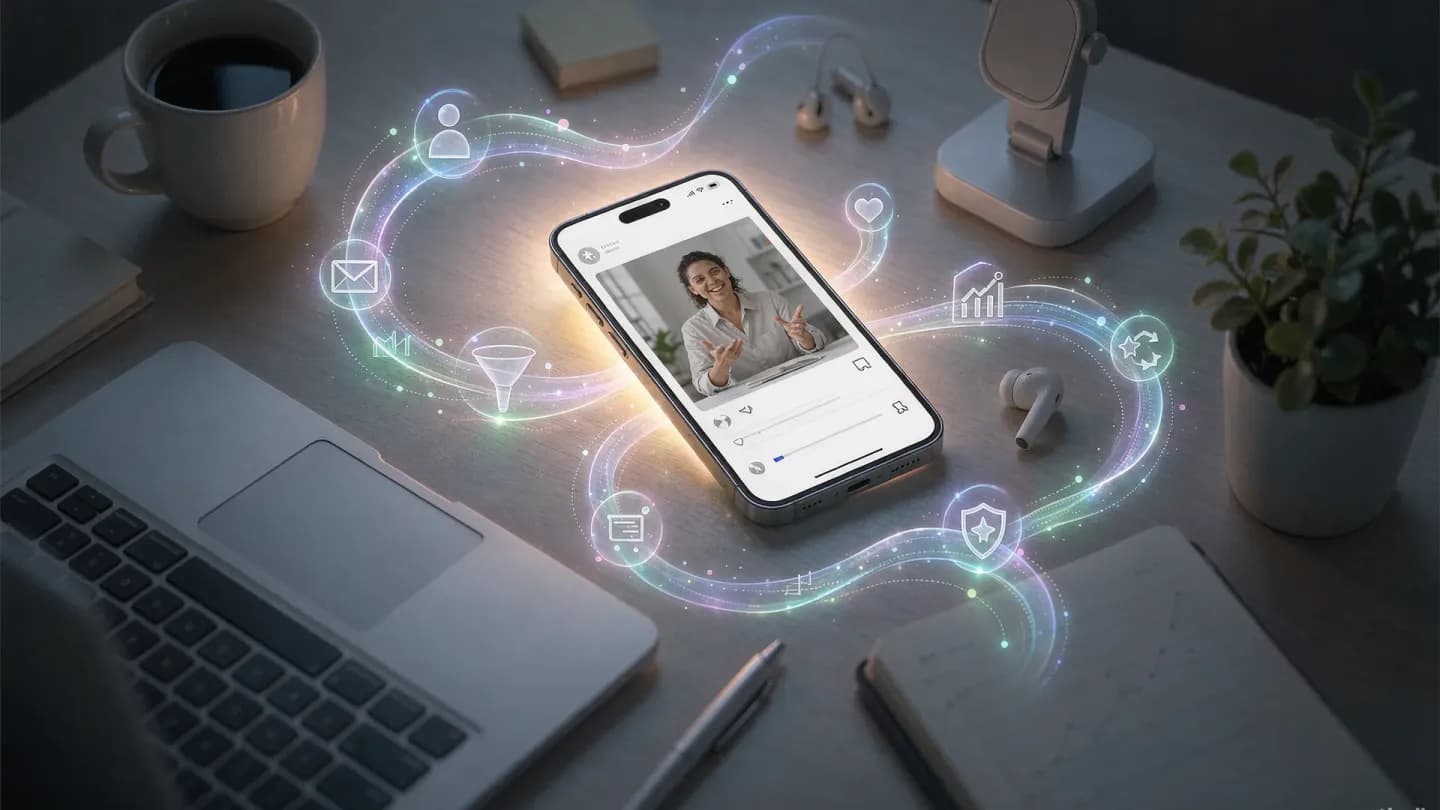
Why AI video email marketing moved into the lifecycle stack
AI video email marketing in 2026 is no longer a novelty open-rate hack. It has become lifecycle infrastructure: a reusable creative layer that fires when a customer event happens, not when a campaign calendar says so.
For three years the pitch was simple and still true enough to work: drop a video thumbnail into a newsletter and watch opens tick up. But that tactic captures only a sliver of the value. The structural shift is that video is leaving the one-to-many ad column and moving into the one-to-one lifecycle stack, where each asset is rendered for a single recipient and triggered by behavior rather than a send schedule.
The ad column was built for reach, while lifecycle is built for the next best action. When the same creative system can serve a prospecting pre-roll and a churn-rescue video from one toolkit, the organization stops arguing about which team owns video and starts arguing about which trigger deserves it first.
The same asset logic already powers {{link}} at catalog scale, where a single master spawns thousands of variants without a reshoot.
The same asset logic already powers product-page video at catalog scale, where a single master spawns thousands of variants without a reshoot.
The trigger-to-render model: events, not campaigns
A lifecycle video program starts with a trigger map. Sign-up, first login, feature activation, billing date, churn-risk score, and renewal window each become a moment that can auto-generate a video tailored to that account's context. The calendar stops being the scheduler; the customer's own behavior is.
The practical trigger map rarely needs more than a dozen events. Most programs ship real value with five: welcome, activation, milestone, risk, and renewal. Each maps to a template, and each template maps to a small set of variables the data layer already knows, so the creative never has to ask the CRM a question it cannot answer.
Even the small stuff, like {{link}}, moves email click rates by double digits when the right frame interrupts the scroll at the right moment.
The render step then pulls a tokenized template, name, plan tier, usage metric, and localized language, and produces a unique cut in seconds. No crew, no reshoot, no waiting on a creative queue. The economics flip from bespoke production to a metered API call, which is the only unit cost that survives at lifecycle volume.
Even the small stuff, like video thumbnail packaging, moves email click rates by double digits when the right frame interrupts the scroll at the right moment.

What the 2026 benchmarks actually say
The performance case is now backed by a full year of benchmark data rather than vendor anecdote. Adoption and engagement numbers have crossed from experimental to default, and the email-specific lifts are large enough that ignoring them is a measurable disadvantage.
Wyzowl's 2026 survey of 266 marketers and consumers found that 63 percent of video marketers now use AI video tools, up from 51 percent a year earlier, while 91 percent of businesses use video at all and 85 percent of consumers say a product video has convinced them to buy.
On the email side specifically, benchmark compilers report that video in email lifts click-through by roughly 65 percent, animated GIF thumbnails earn about 42 percent higher CTR than static images, and 81 percent of B2B marketers now use video thumbnails inside nurture sequences.
Blings' 2026 Smart Video benchmark is the starkest contrast in the data: interactive video in email reached a 46 percent click-through rate against 19 percent for static creative, with named case studies such as Wyndham posting a 75 percent CTR increase. The gap is not marginal, and it is consistent across datasets that normally disagree.
The honest caveat is that benchmarks aggregate wildly different senders, industries, and list quality. The useful move is to benchmark against your own matched cohort and weight the metric that reflects deliberate action, because privacy changes have made open rate a noisy number and click the reliable one.

Building the render pipeline: template once, personalize per recipient
The production discipline that makes this scalable is the opposite of traditional video. You build one approved master and a set of tokenized slots, then let data fill the variables. The brand-controlled still, the hero shot, the spokesperson, and the product in context stay fixed, while the personalization lives in the script and the background rather than in a reshoot.
This is where teams get burned if they skip the approval loop. A template that renders five thousand variants is only as safe as its worst variable. Lock the master, constrain the tokens, and review the output classes instead of every individual frame, because nobody reviews five thousand videos by hand.
Version control matters more than it sounds. When the underlying model updates or the brand still changes, a pinned template and a regression set of sample renders keep the thousands of variants from silently drifting out of brand. Treat the master like code, with a changelog and an owner.
The risk is the trap of {{link}} when a friendly face on screen out-performs the actual offer and the click never becomes a customer.
The risk is the trap of attention without conversion when a friendly face on screen out-performs the actual offer and the click never becomes a customer.

The brand-safety gate you cannot skip
Every benchmark report that breaks out human oversight says the same thing: AI video still requires a person on the publish button. Wyzowl's data shows most teams keep a review step before anything ships, because generative clips that look fine on a quick social cut fall apart on emotional brand storytelling where the details actually matter.
For lifecycle video the gate is stricter, not looser. These assets carry a real person's name, account data, and sometimes a synthetic likeness of a spokesperson. A broken lip-sync, a hallucinated number, or a misplaced disclosure is not a cosmetic miss, it is a trust and compliance event delivered straight to an inbox.
Provenance is part of the gate now, not an afterthought. As disclosure rules spread, the metadata that says a video was AI-generated should travel with the file, so a lifecycle asset sent to a regulated segment does not become a compliance exception the moment it is personalized at scale.
Build the review into the trigger instead of after it. Approve the template, set the disclosure and provenance rules once, and route only the variable layer through a fast check before the API fires the render. The speed that makes lifecycle video valuable is preserved, and the failure modes that make it dangerous are caught.
Measuring lifecycle video with holdouts, not vanity clicks
The temptation is to celebrate the open and click lifts and call it a win. But a 46 percent click-through on a personalized video tells you the pattern interrupt worked, not that revenue moved. Lifecycle video has to be measured against the metric it is meant to shift, activation, renewal, and recovered churn, not against a vanity rate that flatters every sender.
That is exactly the discipline behind {{link}}, where holdout groups separate the causal lift of a video touch from the noise of everything else happening in the journey at the same time.
A simple way to start is a single trigger, a single holdout, and a single metric. Pick the activation email, split the cohort, send video to one side, and measure the delta at day fourteen. If the lift holds, expand the trigger map; if it does not, the test just saved you from scaling a placebo across the whole base.
Run the holdout, watch the 180-day CLV delta, and reinvest the budget you saved on production into the variants that actually converted. In 2026 the teams winning with AI video are not the ones generating the most clips, they are the ones measuring the right one and scaling it on evidence rather than enthusiasm.
That is exactly the discipline behind incrementality testing, where holdout groups separate the causal lift of a video touch from the noise of everything else happening in the journey at the same time.
Put the framework into production
These related pages connect the article’s planning advice to a specific commercial scope.
References
- Video Marketing Statistics 2026Wyzowl
Wyzowl's 2026 survey of 266 respondents found 63% of video marketers now use AI video tools (up from 51% in 2025), 91% of businesses use video as a marketing tool, and 85% of consumers say a product video has convinced them to buy.
- Email engagement benchmarks by industry: 2026 editionBlings
Blings' 2026 Smart Video benchmark shows interactive video in email reaching a 46% click-through rate versus 19% for static creative, with case studies such as Wyndham reporting a 75% CTR increase.
- Video Marketing Statistics 2026: 160+ Essential DataDigital Applied
Digital Applied's 2026 compilation reports that video in email lifts click-through by 65%, animated GIF thumbnails earn 42% higher CTR than static images, 81% of B2B marketers use video thumbnails in nurture sequences, and personalized video emails draw 300% more clicks than generic sends.