What this AI video case study proves about listening first
This AI video case study starts with a 67-million-year-old problem. When Experience Abu Dhabi prepared to open the Natural History Museum Abu Dhabi, its centrepiece was a Tyrannosaurus rex fossil — scientifically priceless, but culturally silent. A museum exhibit does not post, reply, or trend. The brief was never “make a video about a dinosaur”; it was “make a 67-million-year-old asset feel alive to a generation that scrolls.”
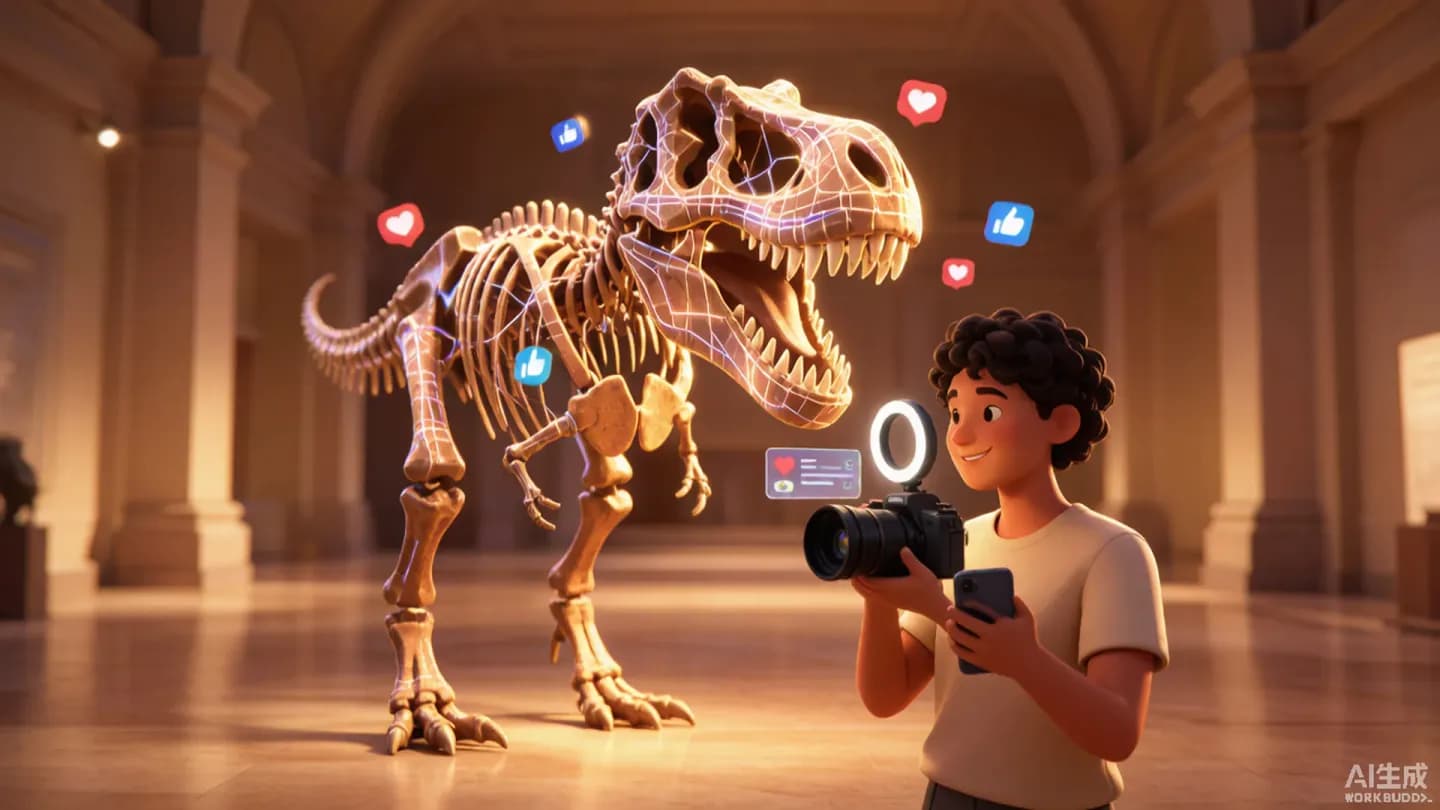
WPP, with Ogilvy Paris’ AI.Lab and Memac Ogilvy, answered by turning the fossil into the first “AI-ncient influencer” — a character built with generative video and given a voice tuned to the platform. The measured result after launch was 50 million video views and 83.8K engagements, with the top posts alone pulling 23.66 million views and 40.7K engagements, and audience sentiment holding at 95.9% positive and neutral. That is not a fluke of a famous fossil. It is a repeatable creative method, and the lessons transfer straight to commercial AI video work. As the Department of Culture and Tourism – Abu Dhabi put it, making science social and accessible is what invites audiences to visit and discover more themselves; the campaign’s job was never just views, it was footfall.
The team did not open a script document. They opened a listening tool. Social listening showed an active, passionate dinosaur fandom online — people already debating paleontology, already blending science with pop culture. The listening work surfaced three things clearly: people already drive dinosaur conversations online, the T. rex already had an active digital footprint, and there was real appetite for content that blends science with pop culture. Those findings, not the brief, set the character’s voice. A proper creative brief for AI video starts with audience truth, not production convenience, and the listening step is exactly where those truths surface. When you generate video before you understand who you are talking to, you ship footage that is technically impressive and emotionally irrelevant.

Give the fossil a voice, not a logo
A fossil cannot speak, so the team gave it a personality: sharp, witty, expressive, built from the memes and formats its audience already loved. The T. rex became a creator with opinions, not a brand with a logo. That personality is what earned attention before any fact landed — the same mechanic a strong high-retention opening hook is built on, because the opening second decides whether the rest of the cut is ever watched.
Generative models are exceptional at rendering a character once you can describe it precisely. The harder, human part is deciding what the character is for. A talking dinosaur is only interesting because someone defined why a 67-million-year-old icon would have a point of view in 2026. The model executed the brief; a person wrote the point of view. WPP’s own framing calls this “transform assets into entertainers” — look past the functional purpose of a brand asset and find the personality inside it. Skip that human step and you get a photorealistic nobody, which performs exactly as well as a nobody should.

Rent the frontier through the right partner
The realism came from Google’s Veo 3.1, which WPP accessed through its partnership with Google ahead of general availability. Ogilvy’s Global AI Creative Lead described the precision as “unprecedented realism and personality” — the model handled detail the team would otherwise have spent days matching in post, from skin and scale texture to the small performance beats that make a character read as alive rather than rendered.
The lesson is not “use the newest model.” It is that emerging capability is only useful when a human art director decides what to do with it. Veo 3.1 supplied the engine; a person supplied the judgement about tone, factual accuracy, and when a shot was good enough to ship. That split is exactly the one a human-core, AI-scaled creative model depends on to stay on brand, because the tool can generate anything and only the human can say which thing is the right thing.
For most teams, the takeaway is partnership, not procurement. You do not need to train your own model to reach frontier quality. You need a relationship, an early-access path, or a vendor who treats the model as a creative instrument instead of a vending machine. The campaign’s realism was a function of access and art direction working together, not access alone.
Speak the platform’s language
The episodes launched as short-form native content across the museum’s social channels, using the formats and tone each platform rewards. The campaign was not one TVC re-cropped into squares; it was born vertical and conversational, written for the scroll rather than the boardroom. That choice is why watch time compounded into the 50-million-view total instead of stalling at a polished-but-ignored hero film.
This is the cheapest lesson to apply and the one most often skipped. Generative video lets a team produce dozens of cuts, but only the cuts that feel native to the feed earn the engagement signals platforms use to distribute content. Match the format to the destination: faster pacing and trending audio for one app, structured substance for another, captions everywhere because most feed video is watched without sound. Track the native signals — watch time, shares, saves — rather than polished-creative vanity metrics, because those are what the algorithm actually rewards.
Label it and attach provenance
A synthetic T. rex is harmless entertainment, but the same pipeline applied to a real person, place, or product is where disclosure becomes a responsibility. YouTube now requires creators to disclose AI-generated or meaningfully altered photorealistic content, and it automatically labels media that carries C2PA provenance metadata. Audiences rewarded this campaign’s honesty, which is why treating disclosure as a trust investment protects the AI video brand trust you are building with generative work instead of quietly eroding it.
Attach Content Credentials at export so the origin travels with the file, and decide the disclosure label before the cut ships rather than after. Provenance is not paperwork; it is the difference between a synthetic character audiences adopt and one they expose. The open C2PA standard records a content “nutrition label” of origin and edit history, and platforms are starting to read that metadata directly — so labeling well is also how your work stays eligible and trusted as rules tighten.
None of this required a 67-million-year-old fossil. It required the same discipline any commercial AI video cut should pass through before it ships: listen first, give the asset a voice, keep a human in the judgement seat, speak the platform’s language, and prove origin by default. The 50 million views are a headline; the method is the asset you can reuse on the next brief.

Five lessons to steal for your next AI video
Pull the method out of the museum and it still holds. Listen before you script, so the character is built from real audience truth instead of a brand deck. Give the asset a voice, not a logo, because personality is what earns the first second of attention. Rent frontier technology through a partner, but keep a human art director in the judgement seat where tone and accuracy are decided. Speak the platform’s language by shipping native-format cuts, not re-cropped hero films. And label and prove origin by default, because trust is the asset that compounds across every campaign.
The campaign’s 50 million views are a number; the repeatable process is the real prize. Treat this AI video case study as a template rather than a trophy, and the next brief that lands on your desk gets faster and sharper because of it. The fossil was a one-off, but the discipline is reusable — and reusable is what turns a single hit into a production system.
Put the framework into production
These related pages connect the article’s planning advice to a specific commercial scope.
References
- How generative AI transformed an ancient icon into a social media starWPP
The “AI-ncient influencer” campaign reached 50 million video views and 83.8K engagements, with top posts at 23.66M views and 40.7K engagements and audience sentiment at 95.9% positive and neutral; it used Google’s Veo 3.1 through WPP’s partnership with Google.
- C2PA — Verifying Media Content SourcesCoalition for Content Provenance and Authenticity
Content Credentials are an open technical standard that records the origin and edit history of digital content, functioning like a “nutrition label” for media so publishers, creators, and consumers can verify provenance.
- Disclosing use of GenAI contentYouTube (Google)
YouTube requires creators to disclose AI-generated or meaningfully AI-altered photorealistic content and automatically applies a label to media that contains C2PA metadata indicating it was made with AI.