
What Google's AI-generated ad labels actually require
Google's 2026 ad policy puts AI-generated ad labels on any creative built with synthetic images, voice, or text. If a model produced the core visual, audio, or copy of your video ad, Google now expects a visible disclosure. This guide breaks down exactly when the label is required and how commercial teams operationalize it without slowing production.
The label is user-facing. On Search, YouTube and Discover, viewers open the three-dot menu or info icon and see a 'How this ad was made' panel that states whether AI created or edited the creative. In some jurisdictions the label also appears directly on the ad itself. Google auto-applies it to ads built with its own generative tools, and gives advertisers a control to self-disclose creatives made elsewhere.
For commercial video teams, the practical question is not whether disclosure exists but when it is triggered. A short social cut generated entirely from a text prompt, a synthetic voiceover, or an AI-extended background all count. The line Google draws is about who created the core asset, not how much of the final frame is synthetic.
The scope is broad on purpose. 'Synthetic' here covers generated stills and video, cloned or synthesized speech, and copy drafted by a model, not just deepfakes. Any of those being the primary creative force pulls the ad into the labeled bucket, which is why the test hinges on origin rather than realism.
The primary-creation test: when disclosure is triggered
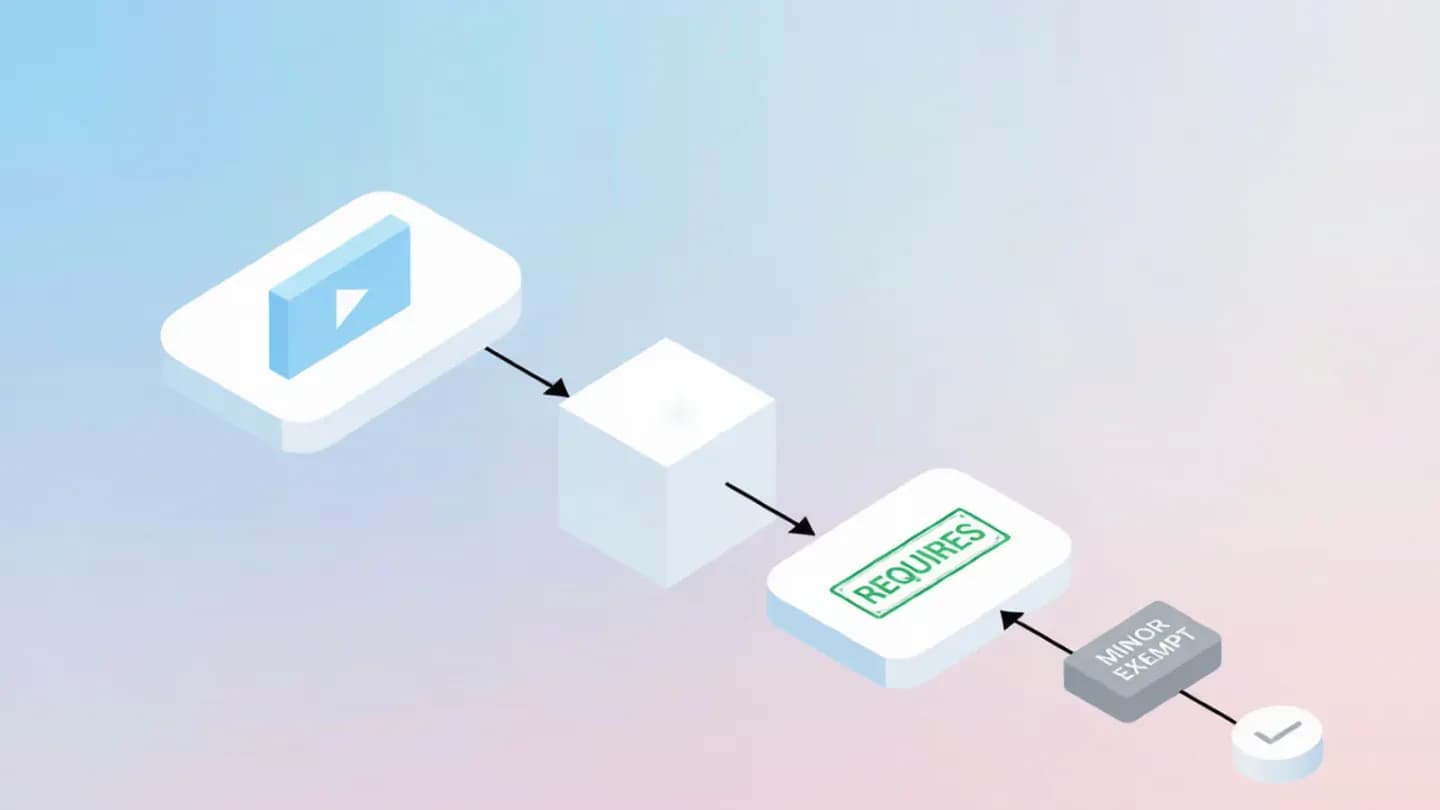
Google applies a 'primary creation' test. If an AI tool produced the core visual, audio, or text of the ad, disclosure is required. If a human was the primary creator and AI only handled minor edits, the ad is exempt. The policy names resizing, color correction, and background changes that do not affect the ad's claims as inconsequential edits.
That distinction matters for video because most production already blends humans and models. A hand-shot interview with AI-denoised audio stays exempt. A fully generated spokesperson, an AI-cloned voice, or a scene where the product is rendered by a model crosses the line. The safest operating rule is to label any asset where the model, not the camera or editor, originated the substantive content.
Document the call. Because the test is judgment-based, keep a one-line provenance note per asset: tool used, what it generated, and who approved it. That note is what lets a reviewer defend an exempt decision or confirm a required one when a platform or client asks.
Consider a product demo where the hero shot is a real photograph but the background is an AI extension that adds a synthetic skyline. Because the extension materially changes what the viewer perceives as the scene, most reviewers would label it; the human-originated photograph alone would not. When the edit shapes the claim, treat it as generative.
Platform rule versus the law
A platform mandate is not the same as a statute, so pair Google's label with the {{link}} your legal team already maintains for EU, US and APAC rules. Google's control helps users; the laws behind it impose fines and, in some markets, auditable records. Treat the label as the visible tip of a broader obligation.
The overlap is the easy part. The hard part is that platform and legal requirements move on different clocks. Google's setting rolled out in July 2026; the EU AI Act's content provisions and several US state rules landed in the same window. A creative approved in one market can fall short in another, so disclosure logic has to be market-aware, not one-size-fits-all.
Political advertising sits one notch stricter. Beyond the standard label, election advertisers must declare AI usage in campaign settings, name the specific tools, and keep auditable records of the original and modified assets. Commercial teams running issue or advocacy spots should assume the stricter path applies.
A platform mandate is not the same as a statute, so pair Google's label with the AI video disclosure compliance checklist your legal team already maintains for EU, US and APAC rules.
Deepfakes of real people are flat-out banned
Beyond labeling, Google prohibits deepfake-style content depicting real, identifiable people. The ban covers AI-generated likenesses, voice clones, and face-swapped video, and it applies whether or not the ad carries a disclosure. Impersonating a real person with synthetic media is a policy violation on its own.
Because synthetic likenesses carry real liability, keep the {{link}} open before any campaign uses a generated face or voice. Consent, clearancing, and a written usage scope are not optional when the subject is a real individual, and a label does not cure an unauthorized depiction. When in doubt, generate from a fully fictional reference instead.
This is where many teams get surprised. They assume a visible 'AI Generated' badge makes any synthetic person acceptable. It does not. The ban is about identity, not transparency, so the compliance gate for real-person likeness is separate from and stricter than the labeling gate.
Voice is the sharpest edge. A cloned spokesperson voice, even with a visible badge, still violates the ban if the person is real and unidentified or unauthorized. The rule protects identity, so the safe pattern is a clearly fictional character with a synthetic voice, disclosed as generated, rather than a likeness of anyone who exists.
Because synthetic likenesses carry real liability, keep the AI video commercial rights guide open before any campaign uses a generated face or voice.

Provenance signals: SynthID, C2PA and the machine-readable trail
Labels are only as trustworthy as the signal behind them. Google embeds imperceptible SynthID watermarks in outputs from its own generative tools, and platforms increasingly read C2PA Content Credentials, the machine-readable provenance standard, to auto-apply disclosures. A file that carries its own history removes the guesswork from the primary-creation test.
The durable fix is to tag the asset itself, which the {{link}} explains as moving disclosure from the campaign form into the file. When provenance travels with the creative through edits, handoffs, and re-cuts, the disclosure question answers itself at every step instead of being re-litigated per platform.
For commercial teams, that means asking vendors and in-house tools for C2PA-tagged exports wherever possible. It is a small intake change that pays back the moment an ad runs across Google, Meta, and TikTok, each of which interprets the same provenance differently but reads the same watermark.
SynthID is the quiet workhorse. It stamps an imperceptible pattern into pixels, audio, and video from Google's own models, so a viewer never sees it but a detector always can. C2PA does the same job in a portable, vendor-neutral way, which is why asking every tool in your stack for C2PA export future-proofs disclosure across platforms.
The durable fix is to tag the asset itself, which the marketplace AI disclosure metadata playbook explains as moving disclosure from the campaign form into the file.

Why platforms are converging on transparency
Google's move is not isolated. Meta applies an 'AI Info' label when its tools are used or C2PA metadata is detected, and TikTok mandates labeling for realistic synthetic content. The platforms are aligning because regulators and advertisers both want a consistent, machine-readable disclosure language.
This convergence is why the buy-side standard matters, and the {{link}} is quickly becoming the disclosure language ad ops teams speak. As more buyers demand provable transparency in insertion orders, the teams that already tag assets will clear brand-safety reviews faster than those still labeling by hand.
The mechanics differ per platform but the signal is shared. Meta reads C2PA or its own tool output to apply 'AI Info'; TikTok requires labels on any realistic synthetic image, audio, or video in ads. Because all three read the same watermark, a single tagged master asset satisfies all of them without per-platform rework.
This convergence is why the buy-side standard matters, and the IAB AI Transparency Framework v2 is quickly becoming the disclosure language ad ops teams speak.
How commercial video teams operationalize the label
Turn the policy into a lightweight workflow rather than a fire drill. Add an AI-usage field to creative intake, require a provenance note per asset, set a named owner for disclosure, and keep an editor-level checklist for sensitive categories such as health, finance, and politics where rules are strictest.
Measure the downside, too. Because a label can shift click-through or perception, run a quiet holdout once per market to see whether disclosure changes performance. Most teams find the effect is small and the trust upside larger, but the data prevents the label from becoming a scapegoat for an unrelated creative miss.
The takeaway is simple. Synthetic creative is now mainstream, and disclosure is the tax for that speed. Teams that build the provenance habit early treat Google's AI-generated ad labels as a routine production step, not a compliance emergency that arrives the week a campaign is due to ship.
Agencies should push the provenance question upstream to clients and vendors, not own it alone. A creative brief that asks for C2PA-tagged deliverables from day one turns compliance into a procurement line item instead of a post-production surprise, and it protects the agency when a platform later questions an asset's origin.
Put the framework into production
These related pages connect the article’s planning advice to a specific commercial scope.
References
- AI label requirements update (July 2026)Google Ads Policy Help
As of July 2026, Google lets advertisers add text or visual AI labels directly inside image and video ad creatives and rolls out an AI-label setting across Google Ads, Display & Video 360, Campaign Manager 360, Merchant Center and Google Ads Editor; where EU, India or New York AI rules apply, ads with AI-generated or modified assets must carry disclosure.
- Regulating artificial intelligence (Article 50)EU AI Act
Article 50 of the EU AI Act requires providers of certain AI systems to ensure machine-readable marking of AI-generated or manipulated content and to put in place a visible or audible disclosure for deepfakes and synthetic content.
- C2PA Content CredentialsC2PA
C2PA Content Credentials embed machine-readable provenance, recording the who, what and when of edits inside a file, the standard platforms such as Google and Meta detect to auto-apply AI-disclosure labels.