
What the 2026 agentic AI marketing data actually shows
Agentic AI marketing is splitting the industry into two tiers. In 2026, only about 8% of brands run autonomous, multi-agent campaigns, yet that small group reports roughly 3x marketing ROI and 10x faster cycles than peers still using AI as an assistant. The divide—not tool choice—defines who wins the next cycle.
Several 2026 surveys point the same direction. BCG's global CMO survey of 300 marketing leaders finds 96% believe AI is transforming marketing, but just 8% have deployed campaigns where multiple agents operate autonomously. The capability is no longer theoretical; it is already in production at a meaningful minority of brands.
Serviceplan Group's CMO Barometer 2026, based on 805 leaders across 15 countries, reports 68% now treat AI as the defining topic of the year—yet only 12% expect their agencies to lead on AI-specific skills. Brands increasingly see autonomous capability as something they must own, not outsource.
Autonomous does not mean unsupervised. In practice the 8% let agents own the repetitive decision layer—briefing, first-pass creative, bid pacing, audience expansion—while humans sit at defined approval gates. The shift is from 'AI helps me write' to 'AI runs the loop and I govern the gates,' which is a different operating model entirely.
For commercial and video teams the implication is direct. Autonomous campaign systems do not just write faster—they hold brand consistency, localize at scale, and optimize spend continuously across every market, the exact jobs that used to require a standing agency retainer. The divide reaches the production floor first.
The three maturity tiers BCG found
BCG segments respondents into three tiers based on how they actually deploy AI, not on stated ambition. The Leaders (32%) deploy agents across strategy, insights, briefing, creation, activation, and optimization, pairing them with human oversight. The Followers (26%) have scaled beyond pilots in one or two domains. The At-Risk (42%) still use GenAI only to assist humans with discrete tasks.
Within the Leaders, roughly 8% run campaigns where multiple agents operate autonomously end to end. Those organizations report 20–30% cost-efficiency gains, about 3x marketing ROI, and roughly 10x faster campaign cycles than the at-risk majority. The returns are real; the adoption is not.
The pattern repeats across regions. Coverage of the same survey notes that the defining characteristic separating leaders is no longer access to AI tools but the ability to build the infrastructure that lets multiple agents, workflows, and data systems operate together.
The pressure is competitive, not just internal. A beauty-company CMO quoted in BCG's report describes racing to avoid 'a future where we lose ground to agent-native startups that use these new tools to take share.' When incumbents see venture-backed competitors built around autonomous systems, the maturity gap becomes an existential one.
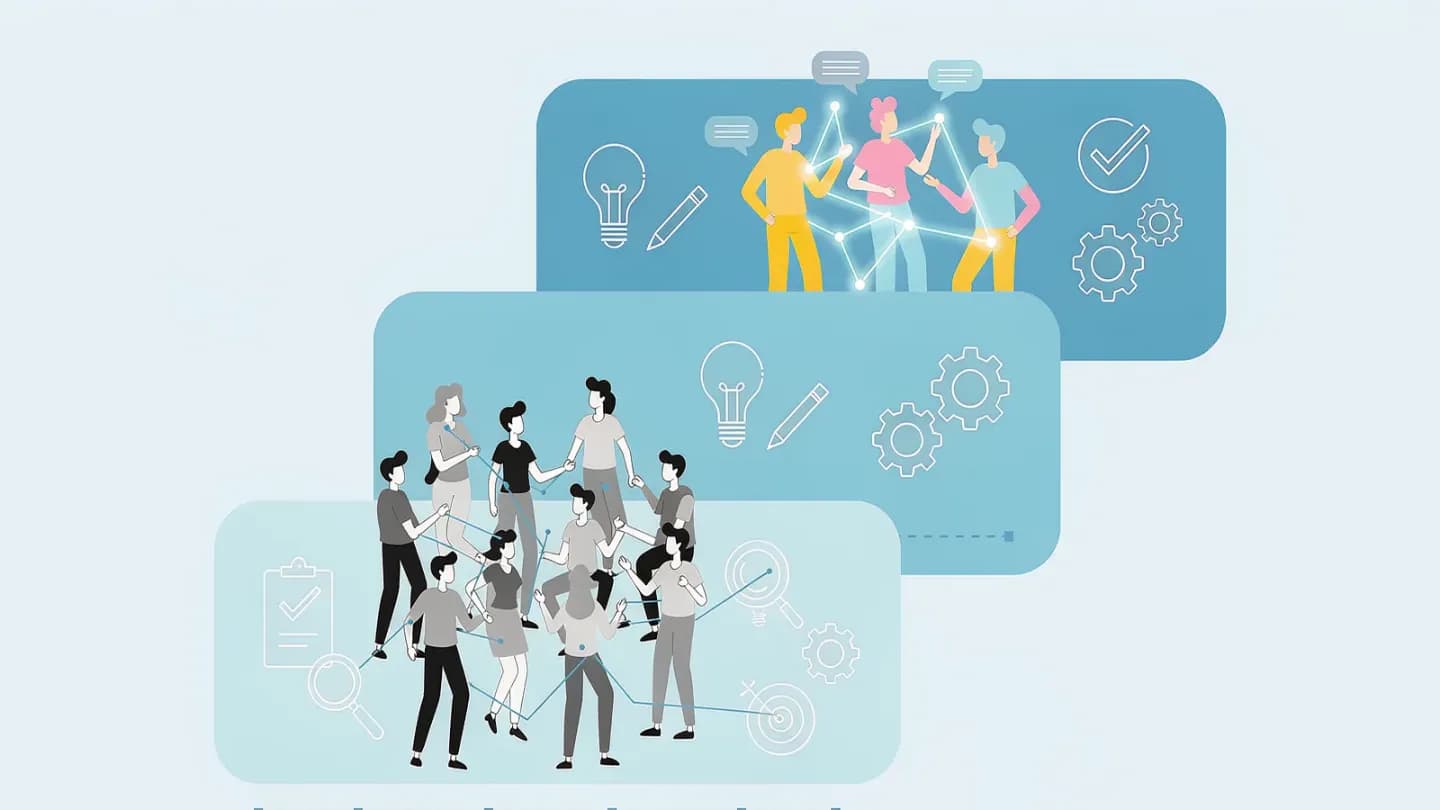
Why deployment architecture beats tool choice
The real story of 2026 is not whether a brand uses AI, but the depth of its operating model, which is the {{link}} that separates aspiration from measurable return. Two brands can license the same models and still land in different tiers based solely on how they wire those models into workflows.
BCG's analysis names four structural gaps that explain why 92% stay stuck: governance deficiency, talent misalignment, measurement-infrastructure lag, and organizational inertia. Each is an architecture problem, not a licensing problem. The brands pulling ahead invested in data foundations, brand-intelligence layers, and multi-agent orchestration before chasing point-tool productivity.
This reframes the 2026 buying conversation. The question is no longer 'which AI tool should we buy' but 'what operating system connects our data, agents, and human reviewers into one accountable loop.' Tool selection is now a downstream consequence of that decision, not the starting point.
The measurement-infrastructure lag is the gap that kills pipeline. Agentic systems make allocation decisions dozens of times a week, but most enterprise stacks still report on a monthly dashboard. When decision velocity outruns the measurement system, teams cannot tell which agentic choices drove revenue—so they default to caution and stall.
The real story of 2026 is not whether a brand uses AI, but the depth of its operating model, which is the AI marketing maturity gap that separates aspiration from measurable return.
Agentic ad buying is already mainstream
Two-thirds of advertisers now prioritize {{link}} for campaign execution, according to the IAB 2026 Outlook Study. Autonomous systems that plan, activate, and optimize media in real time have moved from emerging experiments to core industry infrastructure in under a year.
The same IAB study, based on more than 200 brands and agency buyers, forecasts 9.5% growth in U.S. ad spend for 2026, with digital social (+14.6%), connected TV (+13.8%), and commerce media (+12.1%) leading. Cross-platform measurement rose to 72% priority, up from 64%, reflecting the need to connect AI-orchestrated buying with outcomes.
One signal worth watching: 73% of marketers now prioritize content structured for AI-generated answers. As assistants and recommendation engines mediate more discovery, the agentic shift is rewriting not just how campaigns run but how creative and metadata must be built to be cited.
The same study shows the strategic center of gravity moving from acquisition to retention. Customer acquisition remains the top objective for 54% of buyers, but that is down 10 points year over year, while driving repeat purchases has nearly doubled since 2024 to 25%. Agentic systems are uniquely suited to that retention motion, optimizing known-customer journeys at scale.
Two-thirds of advertisers now prioritize agentic AI video buying for campaign execution, according to the IAB 2026 Outlook Study.

The governance gap that still blocks autonomy
Autonomous systems still need a verifiable {{link}} so every generated asset can be traced back to its source. Without it, legal and compliance teams block deployment, because no one can review, reverse, or audit an agent's decision after the fact.
C2PA, the open standard for content provenance, lets any asset carry a tamper-evident record of its origin, edits, and generators. For brands running multi-agent creative pipelines, that record is the audit trail BCG says is missing across most organizations—the difference between an autonomous system a regulator will accept and one that gets shut down.
The governance deficiency is the first of BCG's four gaps and the one most likely to freeze deployment. Brands that encode brand voice and provenance as structured data—readable by every agent before it generates—turn a compliance liability into a scaling advantage.
The practical fix is to treat governance as a data layer, not a style guide. Salesforce's Summer '26 release ships Brand Center as a headline feature, encoding brand voice and positioning as structured data every agent reads before generating. The lesson generalizes: autonomous systems scale safely only when the rules they must obey are machine-readable.
Autonomous systems still need a verifiable AI video creative audit trail so every generated asset can be traced back to its source.

What the 8% do that the 92% don't
Closing the {{link}} means building the talent and data foundations that autonomous systems depend on. About 80% of CMOs report heavy investment in AI upskilling, yet the brands in the top tier treat capability as something they must build internally, not hire from the market.
Concretely, the 8% restructure around outcomes instead of channels, stand up real-time control towers that monitor trends across functions, and measure decision velocity rather than monthly dashboards alone. They treat autonomy as an operating model, not a feature toggle.
For video and commercial teams, the takeaway is practical: start with one campaign type, give agents a governed data layer and a provenance standard, and expand only once the loop is auditable. The divide is not about being first to a tool—it is about being last to rely on assistants alone.
A realistic starting point for a video or commercial team is narrow by design. Pick one recurring campaign type—say, performance creative for a single product line—define its governed data layer and provenance standard, set one human review gate, then let agents handle variation and optimization. Expansion follows proof, not ambition.
Closing the CMO AI adoption gap means building the talent and data foundations that autonomous systems depend on.
Put the framework into production
These related pages connect the article’s planning advice to a specific commercial scope.
References
- IAB 2026 Outlook StudyIAB
Two-thirds of advertisers prioritize agentic AI for ad buying and campaign execution, and 73% now prioritize content optimized for AI-generated answers.
- CMO Barometer 2026Serviceplan Group
Based on 805 marketing leaders across 15 countries, 68% view AI as the defining topic of 2026 and only 12% expect agencies to lead on AI-specific skills.
- C2PA — Coalition for Content Provenance and AuthenticityC2PA
C2PA defines the open standard for content provenance (Content Credentials) that lets any digital asset carry a tamper-evident record of its origin and edits.