What the 2026 CMO surveys measured about the capability gap
Two reports published in the back half of 2025 and early 2026 give brand-video leaders a rare, quantified view of the AI video capability gap and how the market now judges AI creative capability. These surveys land on top of a wider AI marketing maturity gap: most teams use AI but few can prove its return. Adobe's 2026 AI and Digital Trends study, run with Oxford Economics across 3,000 executives and 4,000 customers, found that 78% of CMOs name data integration and quality as the single largest barrier to adopting agentic AI. Campaign's Global CMO Survey 2026, built from 72 senior marketers worldwide, asked respondents to rate their agencies on AI and new technology directly. The results are not flattering to creative shops, and they hand brand teams a new job: deciding who is actually competent at AI video before the brief goes out.
The throughline of both studies is that adoption has outrun judgment. Organizations are being pushed into AI by leadership and by competitors, but they lack the internal scorecard to tell a capable partner from a confident one. For video specifically, that gap is dangerous because the difference between vendors shows up in the frame, not the proposal. A team that cannot grade AI video capability is effectively trusting the vendor's showreel to self-report.
Reading the surveys together lets a brand-video lead skip the hype cycle and go straight to the operational question: which partners can actually deliver generative video that ships, and how do I prove it to my CFO? The rest of this article turns those findings into a repeatable evaluation step you can run before any AI video contract.
The split verdict: media agencies pass, creative agencies don't
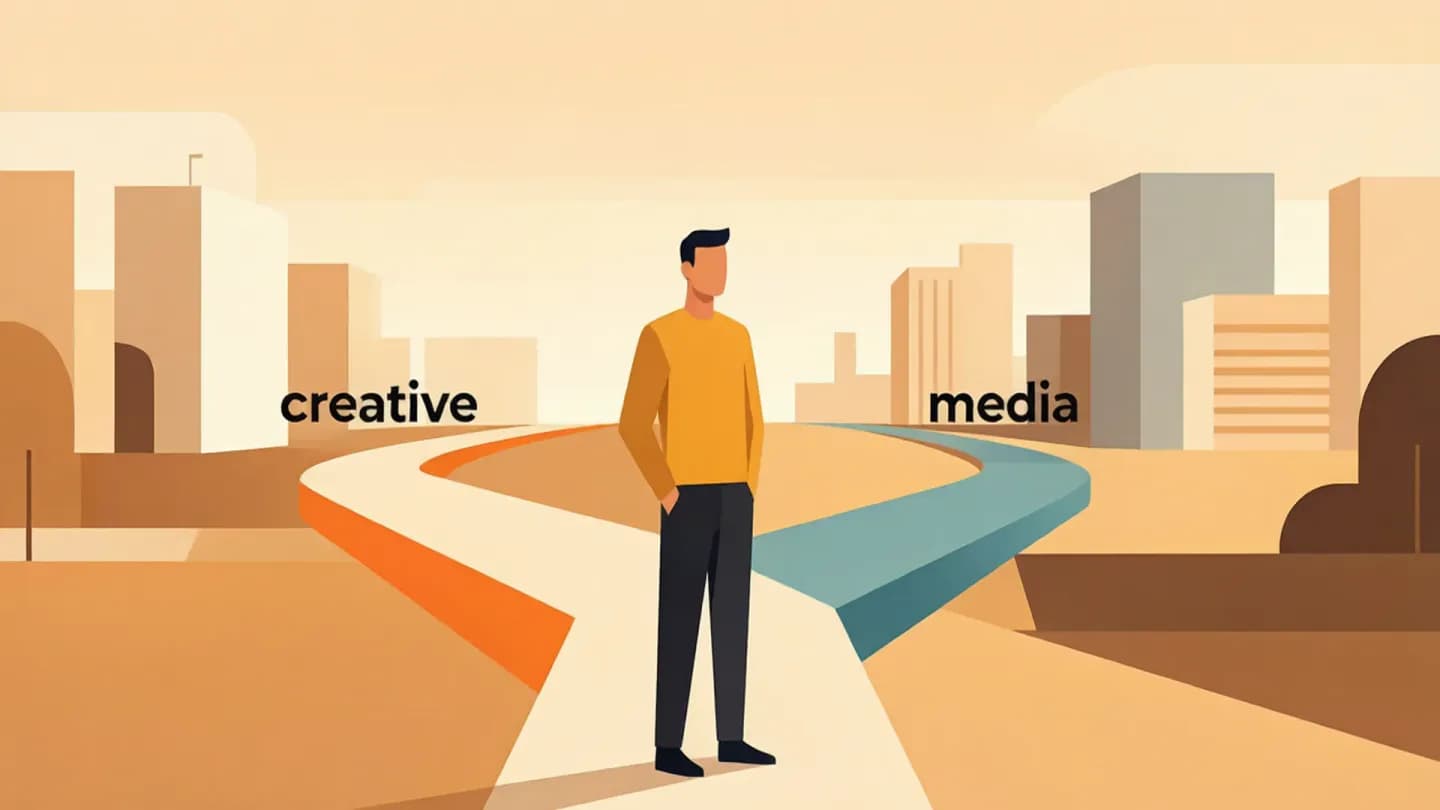
When marketers graded their agencies, the gap between media and creative was stark. In the Campaign survey, 32% of respondents rated creative agencies 'poor' at AI and new technology (25% 'somewhat poor' and 7% 'very poor'), while only 36% called them 'good.' Media agencies scored the opposite way: 36% rated them 'good' (32% 'somewhat' and 4% 'very'), and just 21% called them 'poor.' That is a 15-point swing on the 'good' rating and an 11-point swing on the 'poor' rating between the two disciplines.
The same survey shows the pressure is coming from the top. More than half of marketers (55.6%) say a CEO or CFO has asked them to implement AI to drive efficiencies and cut spend, and half have explicitly asked their agencies to find those efficiencies with AI. When the mandate is handed down and the creative partner is the one rated weakest on the exact technology in question, the brand team stops being a passive client and becomes the evaluator. The scorecard that used to live inside the agency now sits on the brand side of the table.
It is worth noting what the survey did not say. Marketers did not report that creative agencies are useless at AI; they reported inconsistency and weak fundamentals. That distinction matters, because it means the fix is evaluation and direction, not replacement. A brand-video team that can spot the gap can still get good work from a creative shop that is merely uneven.

Why brand-video teams now own vendor evaluation
For most of the last decade, the brand-video lead received whatever the agency shipped. Generative video breaks that model because the capability difference between vendors is now visible in the output itself: consistency, lip-sync, physical plausibility, and editability all vary wildly by engine and by how the shop wires its pipeline. A producer-led workflow keeps generative output inside brand and budget guardrails instead of letting the model decide. That means the producer, not the account lead, is the person who has to tell whether a vendor's reel is masking weak fundamentals with prompt tricks.
Evaluation also has to happen before the contract, not after the first cut. The IAB's 2026 Digital Video Ad Spend and Strategy Report projects U.S. digital video ad spending will reach $81.9 billion in 2026, up 11% year over year, and finds that two-thirds of video buyers are already live, testing, or planning agentic AI for digital video campaigns this year. Money is moving fast enough that a weak vendor choice is a budget-line error, not a footnote. The team that evaluates early protects the spend; the team that evaluates late explains the write-off.
Owning evaluation also changes the brief. Instead of describing a deliverable and hoping the vendor has the chops, the brand team specifies the capability it expects and asks for evidence. That single shift turns a vague 'make us something with AI' into a measurable procurement conversation, which is exactly what the C-suite mandate demands.
A five-point scorecard for AI video vendors
Treat vendor selection as the front door to your AI-native pipeline, not a separate purchase. A usable scorecard grades five things. First, reference discipline: can the vendor hold a character, product, or location across shots without manual repair? Second, editability: when a client note arrives, can the shot be changed without a full re-roll? Third, pipeline transparency: do you see where each frame came from, or is it a black box?
Fourth, rights and disclosure: does the vendor document training-data licenses, support in-frame AI labeling such as YouTube's synthetic-content disclosure, and attach C2PA provenance so a buyer can verify the clip's origin? Fifth, cost clarity: before signing, map how each vendor is putting AI video on the rate card so the cost shows up as a line item, not a black box.
Score each vendor on a one-to-five scale per dimension and weight by your actual risk. A pharmaceutical brand cares more about disclosure and rights than a social-first fashion label cares about editability. The point is not to produce a perfect matrix; it is to make the capability gap explicit so a 'poor' creative partner cannot hide behind a confident deck. A vendor that scores threes across the board is easier to manage than one that scores fives on the demo and ones on the deliverable.
Run the scorecard on a real brief, not a vendor-supplied sample. Give two finalists the same script, the same reference, and the same note, then grade the returned cuts against the five points. The gap between what the deck promised and what the cut delivered is the single most useful number you will produce all quarter, and it is far more honest than any case study a sales team can show you.

Where AI video still needs a human in the loop
The surveys also explain why the human side still matters. Adobe's 2026 study found that 69% of customers say a promotion has at most five seconds to capture their attention, which raises the stakes on the first frame rather than lowering them. The human-core, AI-scaled model argues that hybrid production beats fully automated output for brand safety, because a human catches the off-brand detail a model treats as plausible. That is exactly the judgment a 'poor' AI creative shop is most likely to miss, and it is the difference between a cut that ships and a cut that gets pulled.
Human oversight is also where trust is won. Adobe's data shows customers rank the ability to switch to a human at any time as the single biggest factor in feeling comfortable with a brand's AI agent. For video, the equivalent is a named producer who owns the cut. Vendors that cannot name a responsible human are signaling they have not closed the capability gap themselves, and you should score them down on pipeline transparency accordingly.
None of this argues against generative video. It argues for keeping a human accountable for the output, which is precisely the capability the surveys say is uneven. The teams that win in 2026 are not the ones with the most AI; they are the ones with the clearest human owner of the AI's work.

Turning the AI video capability gap into a buying advantage
The 2026 CMO surveys are not a referendum on AI video; they are a map of who can actually deliver it. Brand-video teams that build a short, repeatable evaluation step turn a market weakness into a sourcing edge: they brief fewer, better vendors, ask sharper questions, and stop paying for demos that hide weak fundamentals. The capability gap is real, but it is also measurable, and a team that measures it spends less cleaning up after vendors that merely looked competent.
Start with one pilot and one scorecard. Run two vendors on the same brief, grade them on the five points above, and keep the results in your vendor file. Within a quarter you will have a defensible read on the market that no survey can give you, because it is built from your own briefs and your own standards. The AI video capability gap will not close on its own, but it stops being a liability the moment you can name it, grade it, and choose against it.
Put the framework into production
These related pages connect the article’s planning advice to a specific commercial scope.
References
- Disclosing use of altered or synthetic contentYouTube Help (Google)
YouTube requires creators to disclose AI-generated or meaningfully AI-altered realistic content and automatically applies labels to clips that carry C2PA metadata, making provenance a checkable, platform-level signal for buyers.
- C2PA: The Coalition for Content Provenance and AuthenticityC2PA
The C2PA open standard lets creators attach tamper-evident provenance metadata to images, video, and audio, giving buyers a way to verify whether an AI-generated clip came from a disclosed, licensed pipeline.