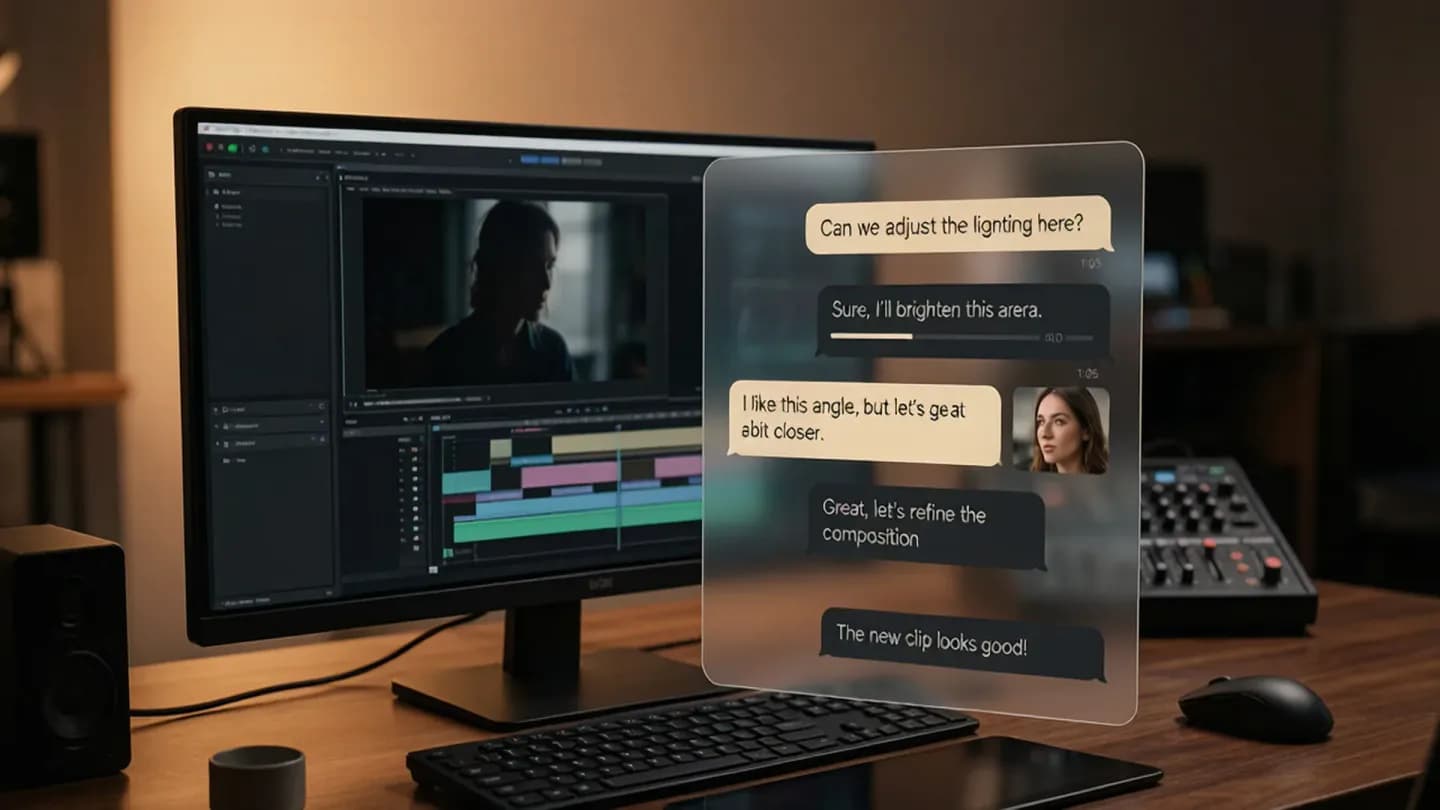
Why the revision loop was the real bottleneck
Conversational AI video editing is the quiet upgrade commercial teams have been waiting for, because it fixes the part of production that was never about the first render. Generation is cheap now. A single text or image prompt can return a usable clip within seconds, and the cost per generated second keeps falling.
{{link}} used to mean rebuilding continuity by hand after every change.
Every regeneration reset the camera angle, the product identity, and often the performance. A note as small as make the background warmer could quietly undo an hour of careful direction. Teams learned to over specify the first prompt because they could not afford to iterate, which pushed the real creative risk into a single high stakes generation instead of a series of cheap corrections.
Editing AI-generated video used to mean rebuilding continuity by hand after every change.
What conversational AI video editing actually does
Stateful, conversational editing changes that loop. After the model produces an initial clip, you issue natural language instructions that are interpreted against everything generated so far. The model keeps a session history, so each instruction builds on the previous state rather than starting from a blank prompt.
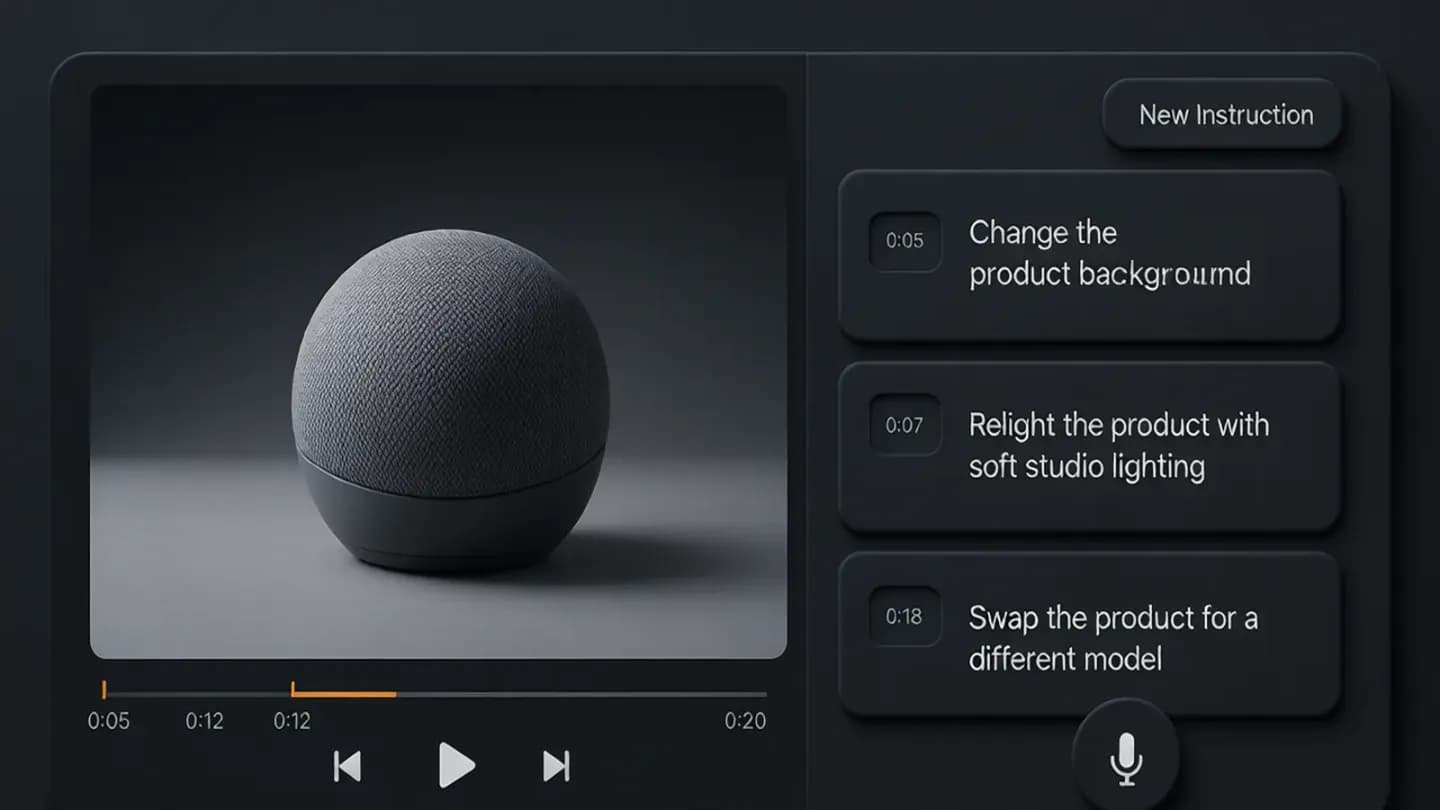
The operations are the ones commercial work actually needs. Change the background to a Scandinavian kitchen. Swap the product for the new SKU. Relight the scene for golden hour. Nudge the camera angle. Each instruction preserves the camera, the product identity, the character, and the audio that were already approved, and only repaints the region you named.
This is different from image to video or first pass generation. Those decide what the clip is. Conversational editing decides what the clip becomes after you have seen it, which is the moment most feedback actually arrives. The capability shipped in mid 2026 as a new generation of unified multimodal models brought video output with an editing memory, and it is quickly becoming the default iteration mode for teams whose brief is still moving.
A concrete example makes the leverage obvious. The first pass shows a product on a white background. The reviewer wants a Scandinavian kitchen, then golden hour light, then a glass of water beside the product. Under the old loop that is three regenerations, each one re deciding the product and risking a new camera move. Under conversational editing it is three instructions on the same clip, each one preserving what already works and changing only what was named. The product stays identical, the camera stays put, and the total compute is a fraction of a full re roll.
Where conversational editing fits in the pipeline
{{link}} is about choosing an edit path before you generate; conversational editing is what happens after.
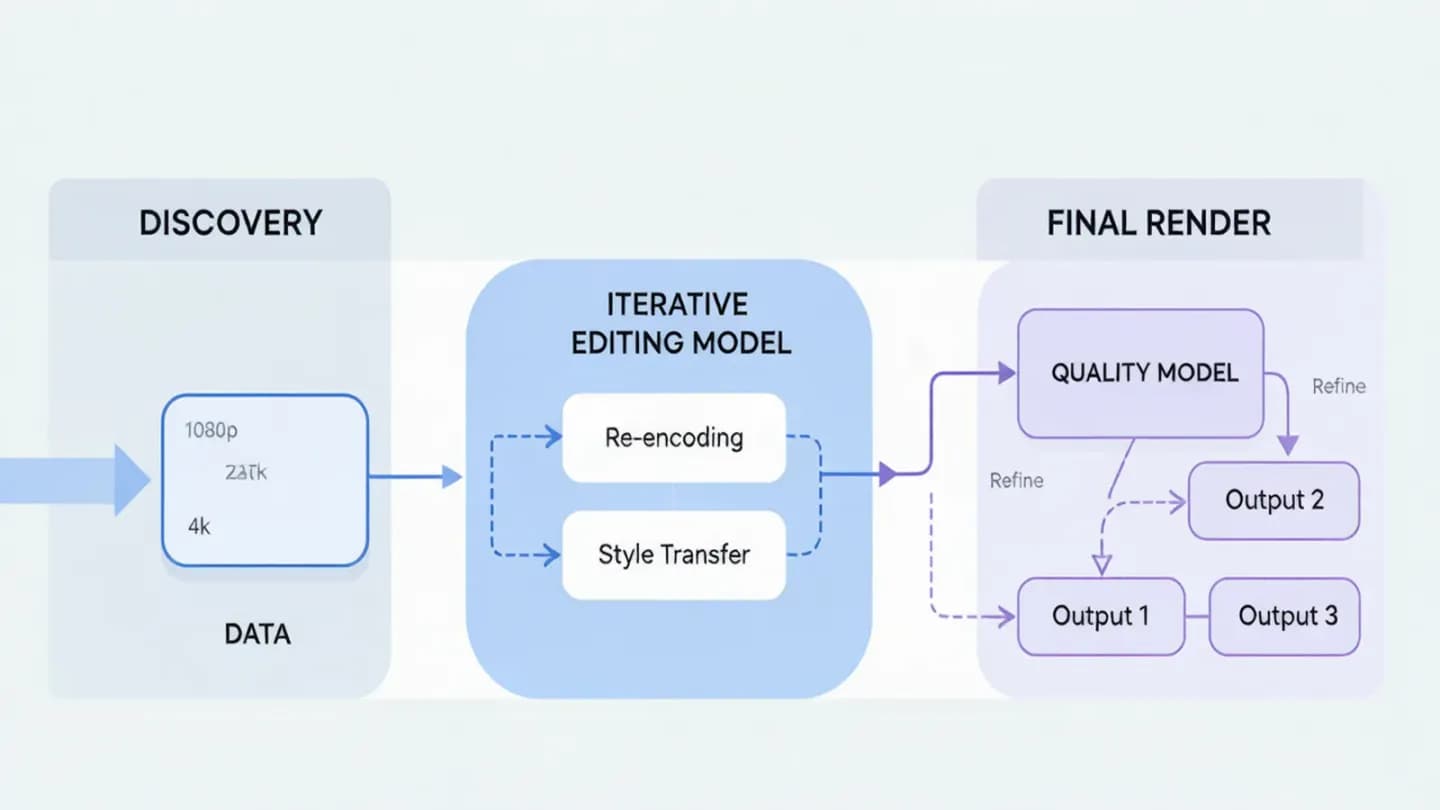
Think of it as the discovery phase of production. When the creative direction is still evolving, conversational editing turns each round of stakeholder feedback into a targeted revision instead of a full regeneration. You iterate toward an approved direction at a fraction of the compute and none of the continuity loss.
Once the direction is locked, the job changes. You stop iterating and start rendering. For many teams that means taking the prompt you refined through conversational edits and running it through a model optimized for single pass quality. The edit session discovers the look; a high fidelity model delivers it. Keeping those two stages separate is what makes the workflow fast without sacrificing the final frame.
AI video revisions without regenerating is about choosing an edit path before you generate; conversational editing is what happens after.
Route the model to the job
{{link}} still decides which engine iterates and which one renders the final cut.
Not every model carries an editing memory, and the ones that do are not always the ones that produce the cleanest hero shot. A pragmatic setup routes the iterative, conversational work to a model built for stateful refinement, then routes the confirmed direction to a model known for the best first pass quality on product and environment work.
The decision rule is simple. If the brief is still shifting and you expect several rounds of change, pick the editing capable model. If the direction is confirmed and you need the highest possible fidelity, pick the quality model. Matching the model to the stage is cheaper than forcing one model to be good at both, and it keeps the regeneration count low.
The cost math is the part that surprises teams. A targeted instruction on an existing clip costs a small fraction of a full regeneration, and because the approved elements are preserved, you rarely pay twice for the same camera move or product render. Over a campaign with dozens of revision rounds, that difference is the gap between an iteration budget you can afford and one that forces you to stop polishing early. Route by stage, and the expensive high fidelity model only runs once, on the cut you have already approved.
AI video model selection still decides which engine iterates and which one renders the final cut.
Pin the version you iterate on
{{link}} matters because an edit session assumes the underlying model stays put between instructions.
A conversational edit is a sequence: generate, then instruct, then instruct again, each step leaning on the state the previous step left behind. If the model version changes mid session, the editing memory can break, the character can drift, or a later instruction can reinterpret an earlier one in a way you did not intend.
Treat the model version like a dependency. Pin it for the duration of a campaign, record which version produced each approved cut, and gate any upgrade behind a regression check on a few saved clips before you let it touch live work. The same discipline that protects a tuned prompt library protects an edit session.
AI video model drift matters because an edit session assumes the underlying model stays put between instructions.
Disclosure and provenance still apply
Editing does not remove the obligations that come with AI generated video. If the clip is altered or synthesized, the platform still expects a disclosure, and the rules around language versions are stricter than they look. YouTube, for example, lets you upload your own dubbed audio tracks for multiple languages, but it does not automatically generate them; you must record the dubbed audio before uploading, which means the localized version is a deliberate production step, not a free translation.
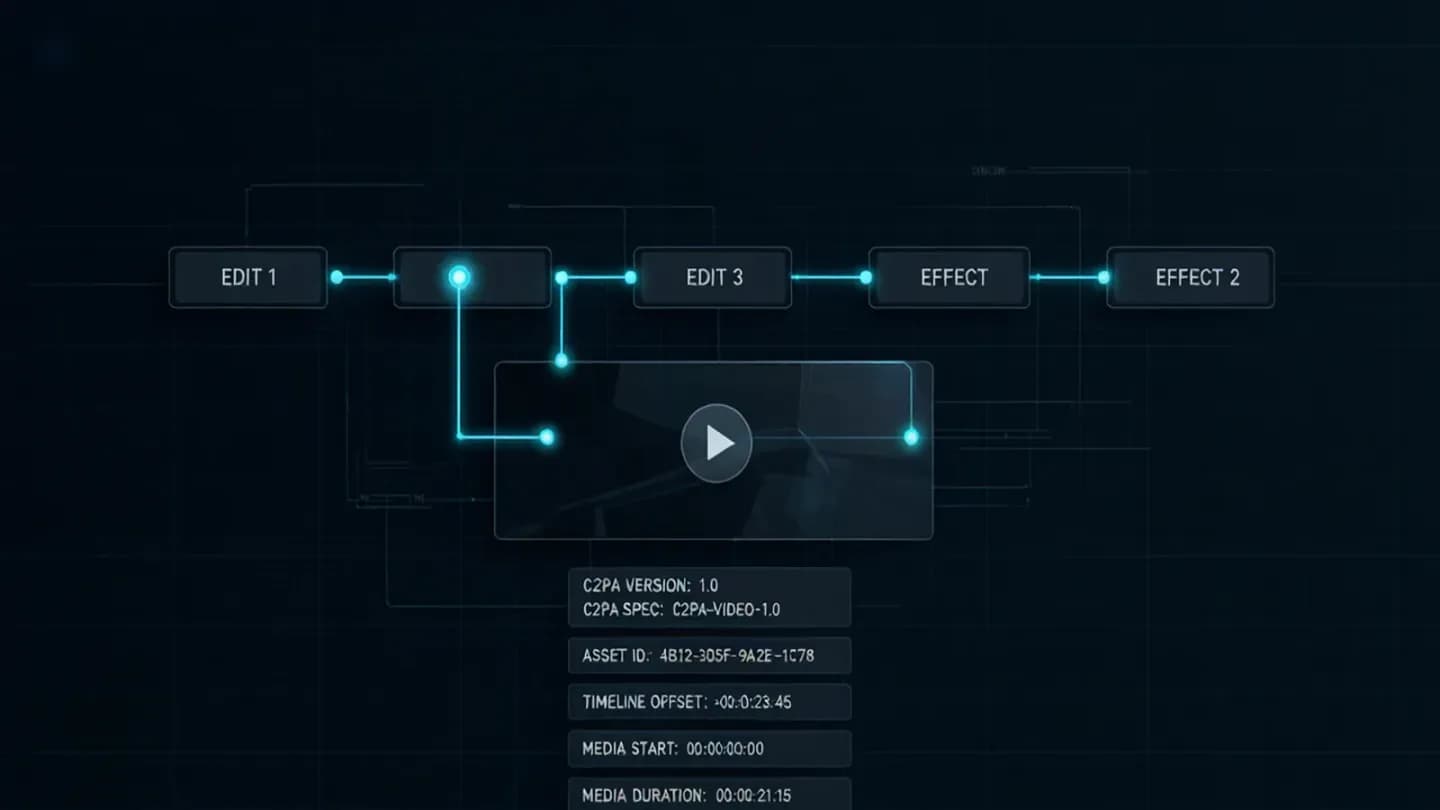
Provenance is the other half. A conversational edit produces a derived asset: a new file created by modifying an existing one, not merely a re encode. C2PA Content Credentials are built for exactly this. Each time an asset is changed, the existing provenance is preserved and the new change is appended to the manifest, so a buyer or auditor can see not just that the video is AI assisted, but which edits were applied and in what order.
For commercial teams this is becoming a requirement, not a nicety. Brands increasingly ask for a reviewable record of how an asset was produced, which model generated it, and who approved it. An edit session that keeps its own instruction history is half the audit trail already built; attaching a provenance manifest closes it.
When not to use conversational editing
Conversational editing is not a replacement for generation, and it is not always the right tool. When the direction is already confirmed and you need the best possible single clip, a high fidelity first pass beats a sequence of edits every time. Iterate only when there is actually something to discover.
It also has limits on consistency. Editing excels at localized changes, a background, a product, a light. It is weaker when the change is structural, a different edit rhythm, a new scene, a performance that needs to read as human. For those, regenerate or shoot. And whenever the asset needs a real person on camera to land, the traditional shoot is still the right line; generated faces only earn trust when they are disclosed and used knowingly.
Used where it fits, stateful editing turns the revision loop from a regeneration tax into a conversation. That is the shift worth adopting in 2026: not more generation, but cheaper, continuity safe iteration.
Put the framework into production
These related pages connect the article’s planning advice to a specific commercial scope.
References
- U.S. Digital Video Ad Spend to Surpass $80B in 2026IAB
Two in three digital video buyers are already live, testing, or planning to use agentic AI for campaigns in 2026, signaling iterative AI tooling is now operational rather than experimental.
- Add Multi-language features to your videosYouTube Help (Google)
Multi-language audio lets you upload your own dubbed tracks but does not automatically generate them; you must record dubbed audio before uploading.
- C2PA Technical Specification 2.1C2PA
A derived asset is created by modifying an existing asset's digital content, and C2PA preserves provenance by appending each change to the asset's manifest.