
A $7 micro-drama that moved 70% more braised duck
AI video case studies from 2026 show what generative production actually costs when it ships. A four-person braised-duck brand spent $7 and five hours on a micro-drama that drove a 70% sales lift, while Google's Sundance short used a 45-person crew. Here is what each build got right.
In late February 2026, a four-person team at a Guizhou braised-duck brand published an AI-generated wuxia micro-drama on Douyin. The hook was a snowy-mountain fox fable flipped into a vengeful-duck reversal. Within 24 hours the first episode drew 12 million views, and the brand became a case study in how cheap AI video can reach tens of millions.
The production numbers are the part worth stealing. The team spent about $7, roughly 40 yuan, on generation trials and took five hours from idea to published first episode. In the month after release, braised-duck sales rose 70% month over month, units climbed from 38,000 to 64,500, revenue grew 77%, and new-customer acquisition rose 45%. Average order value ticked up 12%.
What shipped was not a finished film but a reusable format. The interchangeable plot let the team spin sequels and let viewers remix characters across Douyin, TikTok, and YouTube. For a niche food brand, AI video collapsed the cost of cinematic storytelling from agency-scale budgets to a single afternoon.
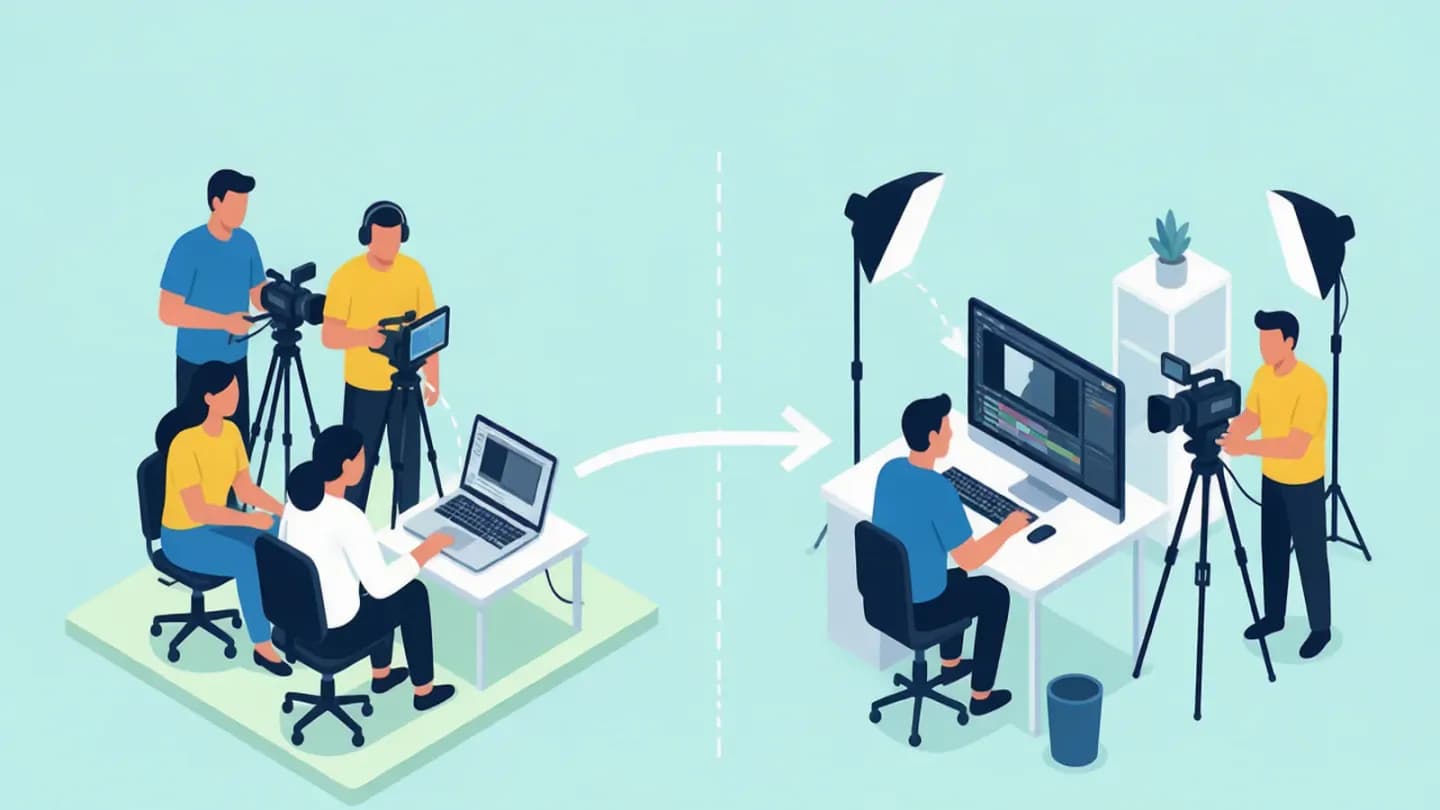
The workflow was deliberately legible. The team wrote a story outline, let AI cut it into roughly 15-second scripts, then generated and edited the clips, with one person on AI production, one on campaign planning, and one on distribution. That division of labor is the part other small brands can copy without touching a model.
The reason it resonated is not the tool but the hook. A familiar 'fox repays a debt' trope, reversed into a duck's revenge, gave viewers a line to repeat and a reason to remix. Generative video only amplifies a story that already has a spine; it does not invent one.

Google's 45-person Sundance short: AI as a stylization layer
At Sundance 2026, Google DeepMind premiered Dear Upstairs Neighbors, a six-minute animated short directed by former Pixar story artist Connie He. The film renders a sleep-deprived woman's hallucinations in shifting painterly styles using fine-tuned versions of Veo and Imagen. The headline number is the crew: 45 people built new AI capabilities for one short.
Holding the painterly look across every shot is the {{link}} solved here by fine-tuning. Artists taught custom Veo and Imagen models new visual concepts from a few example images, then animated rough performances in Maya and TVPaint that AI stylized frame by frame.
The 45-person crew is the practical proof of the {{link}} operating model. Motion and timing stayed in human hands; AI handled stylization and localized refinement, and final shots were upscaled to 4K without regenerating from scratch.
The video-to-video step is the detail worth copying. Because text prompts alone could not control the rhythm of a typing hand or the timing of a facial beat, animators acted out the performance first, then let fine-tuned models transform it. Google also funded a $2 million AI Literacy Initiative to train more than 100,000 artists through Sundance Collab, treating the tools as something to teach rather than hide.
Holding the painterly look across every shot is the AI video brand consistency challenge solved here by fine-tuning.
The 45-person crew is the practical proof of the human-core, AI-scaled creative model operating model.

The production economics that actually changed
Put the two builds side by side and a pattern appears. One cost $7 and five hours; the other cost a 45-person research crew and a festival cycle. Both treated AI as a layer, not a replacement, and both shipped because a human owned the story and the motion.
The gap between a seven-dollar micro-drama and a studio build is the same cost curve we mapped in {{link}}. The braised-duck case compressed a TV spot into an afternoon; the Sundance case compressed a stylization pipeline into custom tooling. Different budgets, same lesson: the expensive part was never the pixels.
Not every generated cut ships, which is why the {{link}} matters more than raw output. The duck team tested multiple concepts in a day and doubled down on the winner; Google reviewed every shot in dailies and refined regions rather than regenerating. Volume without a selection gate is just noise.
The selection gate is the unglamorous differentiator. The duck team shipped the winner of a same-day concept test; Google kept a dailies loop where every shot was critiqued before refinement. Neither build treated generation as the finish line. The economics changed because review moved earlier, not because production got cheaper end to end.
The gap between a seven-dollar micro-drama and a studio build is the same cost curve we mapped in AI video production cost benchmarks.
Not every generated cut ships, which is why the AI video creative yield gap matters more than raw output.
Why adoption is up but governance is the new bottleneck
These builds are no longer unusual. Jasper's State of AI in Marketing 2026, based on 1,400 marketers, finds 91% of teams now use AI, up from 63% a year earlier, and 95% plan to increase AI investment. The experimental phase is over; the operational phase has begun.
The constraint has moved. Governance is now the top blocker to scaling, with legal, compliance, and brand-review friction up 3.4 times year over year as volume grows. Only 41% of marketers say they can confidently prove AI ROI, down from 49%. Adoption is universal; accountable production is not.
The human gap is widening too. Jasper's data shows 61% of CMOs are confident in AI ROI versus just 12% of individual contributors, and 85% of CMOs say AI raised job satisfaction against 56% of ICs. The teams that scale are the ones that close that gap with clear ownership, enablement, and realistic expectations for how AI fits daily work.
Disclosure is now part of the shot list
Every AI video that ships to an audience now carries a disclosure obligation. C2PA's Content Credentials attach provenance metadata so a viewer or platform can see that a clip was generated or edited by AI, and YouTube requires synthetic-content labeling on AI-altered material.
Treat disclosure as a pre-production decision, not a publish-time checkbox. Bake the label and the provenance stamp into the export, and the shot list stays clean across markets. Brands that skip this step inherit the trust penalty after the fact.
The rules are not uniform across markets. The EU AI Act and the UK's ASA media-neutral guidance both push transparency for AI-generated advertising, so a clip cleared for one region still needs a disclosure pass for another. Bake the label into the master export and the localization step stays simple instead of becoming a compliance scramble.
What three AI video case studies teach you about reusable builds
Start with the story, not the tool. The duck team led with a cultural hook; Google led with a director's vision. In both, AI executed a brief it did not write.
Keep motion human and stylization machine-assisted. Rough animation or a clear shot plan beats text-only prompting for control. Iterate in dailies, refine regions, and upscale last.
Feeding paid social the volume these builds unlock is the {{link}} playbook. Measure across sales, sentiment, and new-customer acquisition, not just views, and disclose generation up front. That is the repeatable system, not the one-off viral clip.
Measure the system, not the spot. The duck brand tracked units, revenue, order value, and new customers; Google tracked stylistic consistency across hundreds of shots. Pick the metric that maps to the business outcome you sold internally, report it per build, and let the next brief start from that evidence rather than from a blank page.
Feeding paid social the volume these builds unlock is the AI UGC creative volume playbook playbook.
Put the framework into production
These related pages connect the article’s planning advice to a specific commercial scope.
References
- China's Braised Duck Brand Spends $7 to Create Viral AI Microdrama in 5 HoursiMillerPR / DigiCult
A four-person team spent about $7 (roughly 40 yuan) and five hours to produce an AI micro-drama that drove a 70% month-over-month sales increase (38,000 to 64,500 units) and 77% revenue growth.
- Google premieres AI-animated short at Sundance, demonstrates new workflow for creative controlVP Land
Dear Upstairs Neighbors, a six-minute short directed by ex-Pixar Connie He, used a 45-person crew and fine-tuned Veo and Imagen with video-to-video workflows; no final shot was a one-click generation.
- New Research: The State of AI in Marketing 2026Jasper
91% of marketing teams use AI (up from 63%); governance is the top scaling blocker (legal, compliance, brand-review friction up 3.4x year over year); 41% can prove AI ROI; 95% will increase AI investment.
- Content CredentialsC2PA
Content Credentials attach provenance metadata marking content as AI-generated or AI-edited, supporting platform disclosure requirements for synthetic media.