Why Creative Became Programmatic Inventory
In 2026, programmatic AI video turns creative from a finished asset into live inventory. Generative tools now output versioned, tagged variants that flow straight into CTV, DOOH, and real-time bidding, so the creative team and the media plan are no longer separate steps.
For years the workflow looked like a relay: a studio delivered a master, an ops team trafficked it into a DSP, and a planner bought impressions against it. Generative production collapses that relay. The same brief can now spawn dozens of cuts, each rendered, captioned, and tagged for a specific audience or placement, then pushed into the buy without a handoff.
That change moves creative from the top of a linear pipeline to the center of a real-time one. When an asset is just one of many machine-readable variants, the interesting question is no longer how it was made but how it performs once it is in market, and whether the systems that buy media can actually consume it at scale. A master film was measured in reach; a variant library is measured in match rate, the share of impressions served by a cut the model expected to win.
The implication for 2026 is that creative strategy and media strategy can no longer be planned in separate quarters. The brief that defines a variant library is also the brief that defines the buy, and the team that owns one should own both.
The 2026 Numbers Behind Programmatic AI Video
The {{link}} make the shift concrete: AI adoption in commercial video is now near-universal, and programmatic buying is where that volume lands.
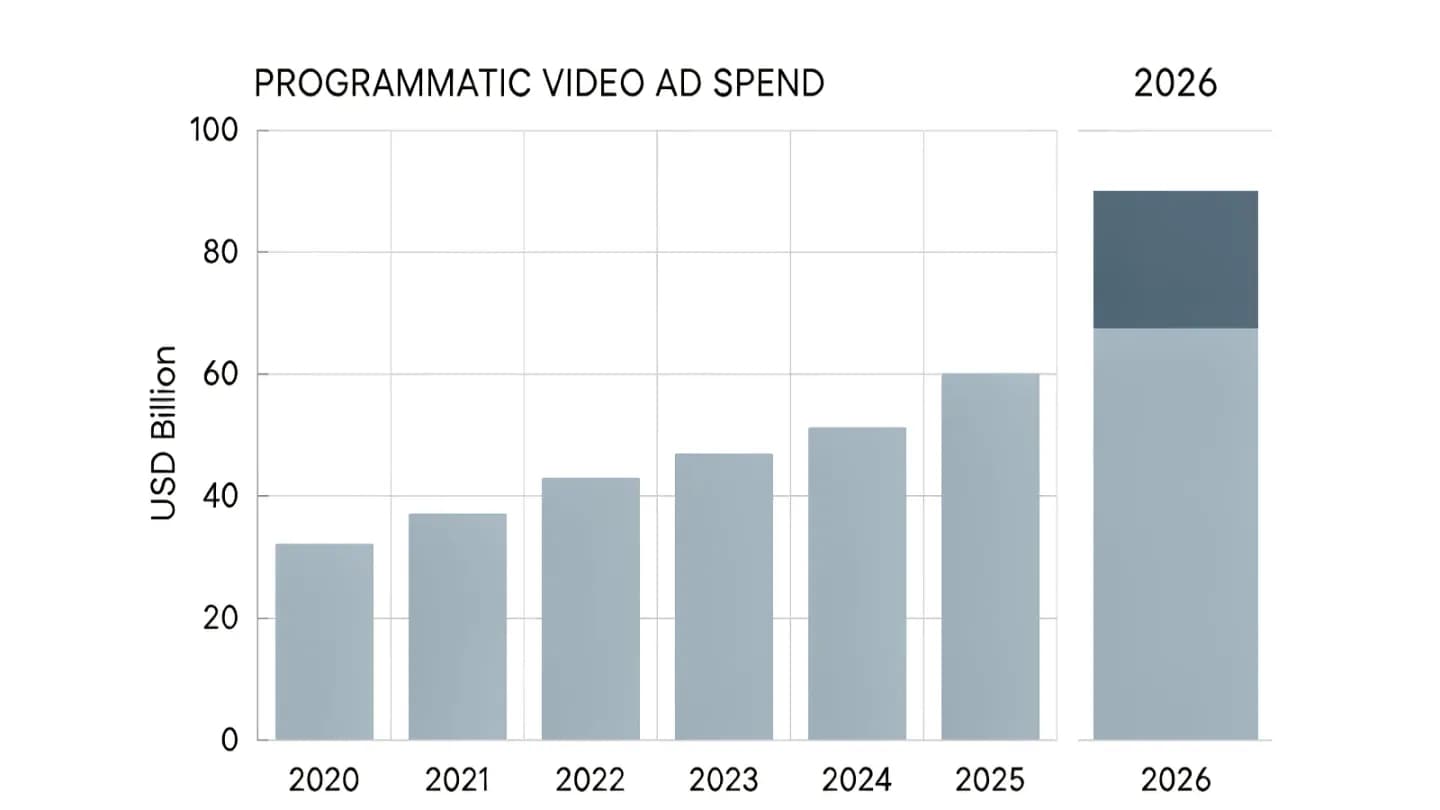
The IAB 2026 Digital Video Ad Spend and Strategy Report puts US digital video ad spend above 80 billion dollars this year, with targeting and audience reach now ranking alongside business outcomes as top decision criteria. The same report notes that generative AI adoption for video creative keeps accelerating, while nearly all buyers see a role for agentic AI in how video is planned and bought. That inversion matters because programmatic systems optimize for the next impression, not for a campaign narrative, so creative that cannot be sliced into addressable units simply never enters the auction.
Trade forecasts sharpen the picture: by the end of 2026 at least a quarter of DOOH and video campaigns globally are expected to be AI-planned, with humans setting the vision and AI doing the heavy lifting. A StackAdapt survey of 484 senior marketers finds that 66 percent blame siloed execution for wasting 10 to 30 percent of their programmatic budget, proof that creative, data, and media are still too often managed apart.
The 2026 video marketing statistics make the shift concrete: AI adoption in commercial video is now near-universal, and programmatic buying is where that volume lands.
CTV and DOOH: Where Generative Creative Meets Real-Time Buying
Connected TV is the clearest proving ground. Streaming inventory is already bought programmatically, and new ad formats such as pause ads and native placements on OEM platforms scale only when creative innovation is paired with programmatic efficiency. AI-generated variants let a brand test a dozen intros against the same CTV slot instead of shipping one master and hoping it lands. The auction rewards the cut tuned to the moment, not the cut that tested best in a focus group weeks earlier.
AI-generated variants reach audiences through the same {{link}} that already serve CTV and DOOH, so creative and media stop being separate workflows.
Digital out-of-home extends the model into the physical world. Programmatic DOOH spend crosses past one billion dollars in 2026, and the same screens that once needed a booked campaign can now swap creative by weather, time of day, or local event. Generative video makes those swaps cheap enough to run continuously, turning a billboard into a live, context-aware surface that updates as often as the feed.
AI-generated variants reach audiences through the same AI video delivery platforms that already serve CTV and DOOH, so creative and media stop being separate workflows.

Siloed Stacks Waste Programmatic Budget
The 66 percent stat is a warning. When creative lives in one tool, audience data in a CDP, and media in a DSP, the variant that would have won never gets built, or gets built too late to enter the auction. StackAdapt's top performers are four times more likely to modernize half their stack by 2027, and 53 percent say consolidated tools drive ROI versus 31 percent of laggards.
Closing that gap means treating the creative engine as a first-class input to the buying system, not a downstream vendor. The report frames AI as the intelligence layer that connects creative, data, and optimization, exactly the connection programmatic AI video needs if versioned assets are to reach the right impression at the right price.
For commercial teams this is an org question as much as a tech one. The teams pulling ahead are not those with the cheapest generation; they are the ones who wired their generation, tagging, and trafficking into a single loop so a new cut can move from prompt to placement in minutes, not weeks. The cost of generation is no longer the bottleneck; the cost of coordination is.
Versioning Is the New Creative Department
Once creative is inventory, volume is the default. A single brief can yield hero cuts, vertical adaptations, language variants, and platform-specific edits, each a separate SKU in the programmatic catalog. The job of the creative team shifts from making the one perfect film to maintaining a library that stays on-brand and ready to ship. The skill is curating that library, retiring weak variants before they drain budget and promoting the ones the buy keeps selecting.
The economics of programmatic supply reward a small set of winning cuts, which is why the {{link}} now decides which variants get funded.
That reframes quality control. With many variants in market, the constraint is not production capacity but governance: which faces, claims, and disclosures are approved, and how fast a bad cut can be pulled. Generative speed only helps if the review gate moves at the same pace as the generator, or the catalog fills with variants nobody vetted. Versioning without governance is just more unvetted output, and the programmatic buy will happily spend against it.
The economics of programmatic supply reward a small set of winning cuts, which is why the AI video creative winner rate now decides which variants get funded.
Provenance and Measurement Close the Loop
Inventory that is generated at scale needs provenance attached at the asset level, not added later as a campaign form. Buyers increasingly treat inventory quality and trust as decision criteria, and a variant with no traceable origin is harder to place safely. Tagging creative with model, prompt, and rights metadata turns governance into something the buy can read. This is where many generative programs stumble: they ship volume but cannot prove which cut earned the impression.
Treating creative as inventory also forces a harder {{link}}: every variant must show incremental return, not just low production cost.
Measurement closes the loop. Because each variant is a distinct, addressable unit, teams can finally attribute performance to the specific cut, not the campaign average. That is the payoff of programmatic AI video: creative stops being a cost center measured by output and becomes a measurable input to revenue, optimized like any other line in the plan. Teams that treat variants as measurable inventory stop arguing about creative volume and start managing it as a portfolio with a real return.
Treating creative as inventory also forces a harder AI video budget proof: every variant must show incremental return, not just low production cost.
What Commercial Teams Should Do Next
The practical move is to stop treating generative video as a production tactic and start treating it as a supply chain. Define a small set of modular assets, faces, products, voices, and styles, that every variant draws from, so the catalog stays coherent as it grows.
Then wire those assets into the buying stack. Push tagged variants to the DSP and DOOH platforms through one pipeline, instrument each cut for attribution, and review performance on the same cadence the auction runs. The teams that win in 2026 are the ones where a new creative idea can be generated, approved, and live before the campaign's next optimization window closes. Start with one channel, prove the loop, then extend; the mistake is to replatform everything at once.
Put the framework into production
These related pages connect the article’s planning advice to a specific commercial scope.
References
- 2026 IAB Digital Video Ad Spend & Strategy ReportIAB
US digital video ad spend will surpass 80 billion dollars in 2026; generative AI adoption for video creative keeps accelerating and nearly all buyers see a role for agentic AI in planning and buying.
- Ad Tech and CTV Experts Forecast 2026's Biggest TrendsTV Tech
By the end of 2026 at least a quarter of DOOH and video campaigns globally will be AI-planned, and new CTV formats scale through programmatic efficiency.
- The State of Programmatic Advertising 2026StackAdapt
66 percent of marketers say siloed or fragmented channel execution wastes 10 to 30 percent of their programmatic budget; top performers treat AI as the intelligence layer connecting creative, data, and optimization.