
The 2026 AI video ROI mismatch: bought for speed, audited for revenue
AI video ROI fails in budget reviews for one structural reason: teams buy generative video to move faster and are then asked to prove it moved revenue. Epsilon's 2026 benchmark found 71% of marketers use AI mainly for productivity and efficiency while only 9% use it for revenue generation, yet 46% measure AI performance by revenue gains. Closing that gap starts with the asset record, not the dashboard.
Epsilon surveyed more than 250 marketing decision-makers across retail, consumer packaged goods, financial services, travel and restaurants for its 2026 benchmark study, published in August. Every respondent reported using AI, and 91% called it extremely or very valuable to the organisation. Confidence has risen fast: half now describe their organisation as extremely mature with AI, up from 35% a year earlier. The same respondents name data quality, meaning incomplete, inconsistent or unreliable inputs, as their single biggest technical challenge at 45%. Speed is being delivered reliably; the evidence layer underneath it is not.
The split is sharper by seniority. Sixty-seven percent of C-level marketers call their organisation extremely mature on AI, against 33% of senior managers, and 73% of leadership rate their AI tools as extremely valuable versus 25% of senior managers. The people signing the budget and the people operating the pipeline are describing two different systems. That gap is why {{link}} has become a budget-line item rather than a marketing debate.
That gap is why the proof burden on generated video has become a budget-line item rather than a marketing debate.
Why video is the hardest medium to prove
Money is not the constraint. IAB's 2026 Digital Video Ad Spend and Strategy Report puts US digital video ad spend above 80 billion dollars in 2026, continuing to outpace the broader ad market, with targeting and audience reach now ranking alongside business outcomes as top decision criteria. The same report notes that GenAI adoption for video creative keeps accelerating while many advertisers want more proof of performance, and that confidence in inventory quality remains a challenge across every buying method. Demand is at a record high; proof is the scarce input.
Video is structurally harder to prove than text or static creative. A single brief becomes dozens of shipped variants, each cut to different aspect ratios, durations and caption treatments for different placements, and each of those becomes a separate file with a separate URL. Platform reporting aggregates at the ad or campaign level, so the object that produced the outcome, meaning one specific generated variant, is rarely the object the invoice or the dashboard describes. Without an asset-level key, every efficiency claim you make is an average over a set you cannot reconstruct later.
That is the mechanical reason {{link}} has become its own discipline: when delivery data cannot be tied back to a specific file, teams fall back on platform-reported counts and estimated time savings, which are the two numbers least likely to survive a finance review.
That is the mechanical reason AI video measurement verification has become its own discipline: when delivery data cannot be tied back to a specific file, teams fall back on platform-reported counts and estimated time savings, which are the two numbers least likely to survive a finance review.
Start with a variant registry, not a dashboard
The fix is unglamorous: one row per shipped variant, written before the variant ships, in a table you own. Minimum fields are a stable variant ID, the parent brief or concept ID, the model and version that generated it, the reference or prompt lineage, the disclosure state, the placement and market, the all-in cost in credits and hours, and the launch date. If a field is not in the registry at launch, assume it is unrecoverable later, because no production team will reconstruct a prompt chain from memory three months into a flight.
Model and version sound like metadata trivia until a pricing or capability change moves your cost per usable clip. Logging the version lets you separate a creative problem from a model problem when performance shifts: if variant performance moves in the same week the model version changes, you have a regression to investigate rather than a creative hypothesis to re-test. The same logic applies to disclosure state, which increasingly determines where a variant is allowed to run at all, and to market, which determines which regulatory label travels with the file.
Registries fail in one predictable way, which is that teams key them to the concept rather than the shipped file. A concept is a creative idea; a variant is a deliverable that can be measured. Key to the deliverable and the join to spend, delivery and outcome stays intact. Key to the concept and you are back to averages.

Make the asset machine-readable: VideoObject, clips and timestamps
Once the registry exists, publish the same record in a form machines can read. Google's video structured data documentation sets the minimum: VideoObject requires name, thumbnailUrl and uploadDate, and recommends description, contentUrl, duration and hasPart. Dates and durations use ISO 8601, region restrictions use ISO 3166-1 codes, and every video should carry a unique name. Emitting this from the registry means one source of truth feeds search, internal analytics and the client report instead of three hand-maintained versions that drift apart by the second week of a campaign.
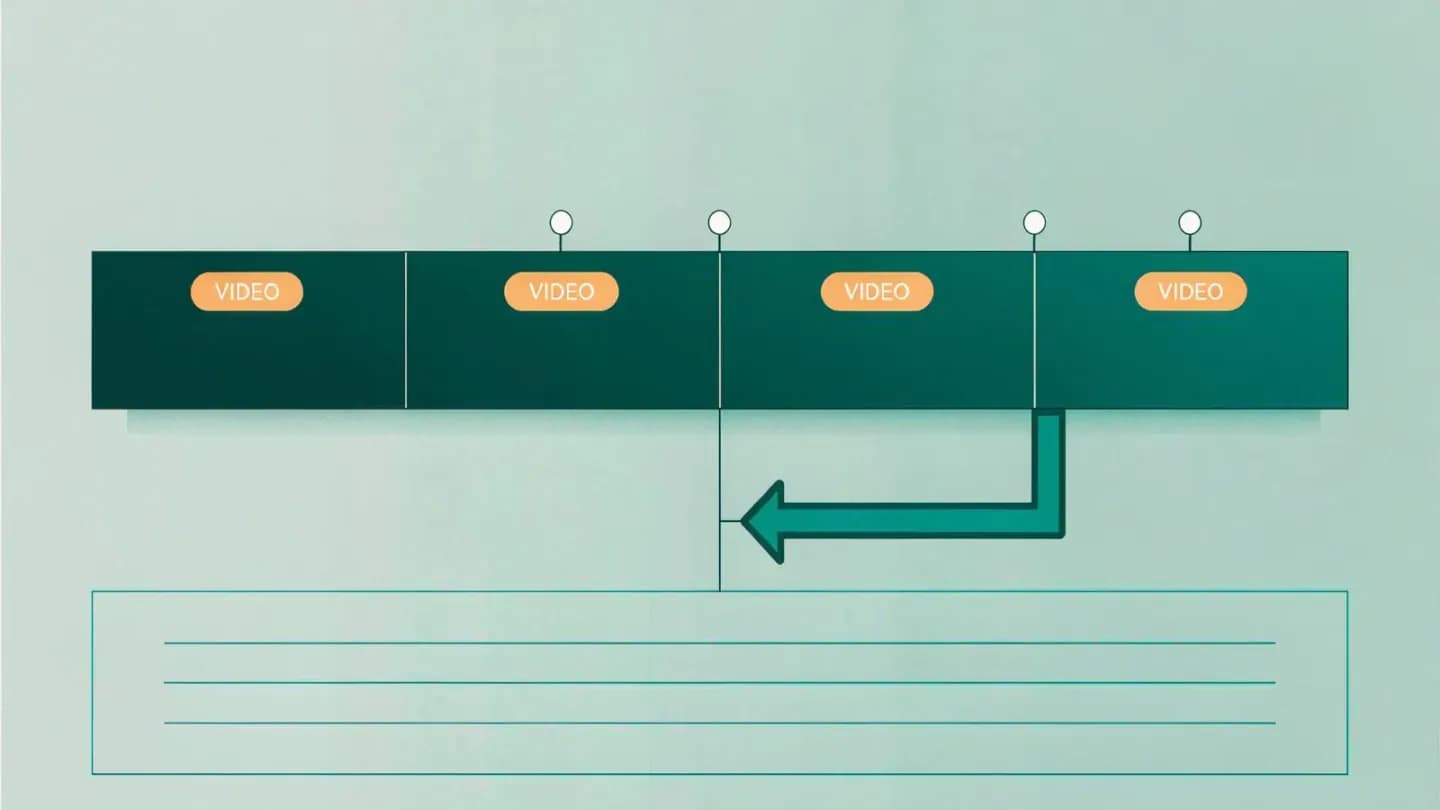
The underused part is hasPart. Nesting Clip objects lets you declare key moments with name, startOffset and url, and Google states it will prioritise moments declared through structured data over its own automatic detection. In production terms, that means you control the chaptering that both discovery surfaces and your own retention analysis read, so the beat-level structure you designed is the structure that gets measured rather than a machine guess. A variant that is declared is a variant that can be analysed at beat level.
This is the same discipline as {{link}}, applied one layer earlier in the chain: if a machine cannot parse what the asset is and when it shipped, it cannot be retrieved, quoted, credited, or attributed.
This is the same discipline as generative engine optimization for video, applied one layer earlier in the chain: if a machine cannot parse what the asset is and when it shipped, it cannot be retrieved, quoted, credited, or attributed.
Keep the provenance record alive through transcoding
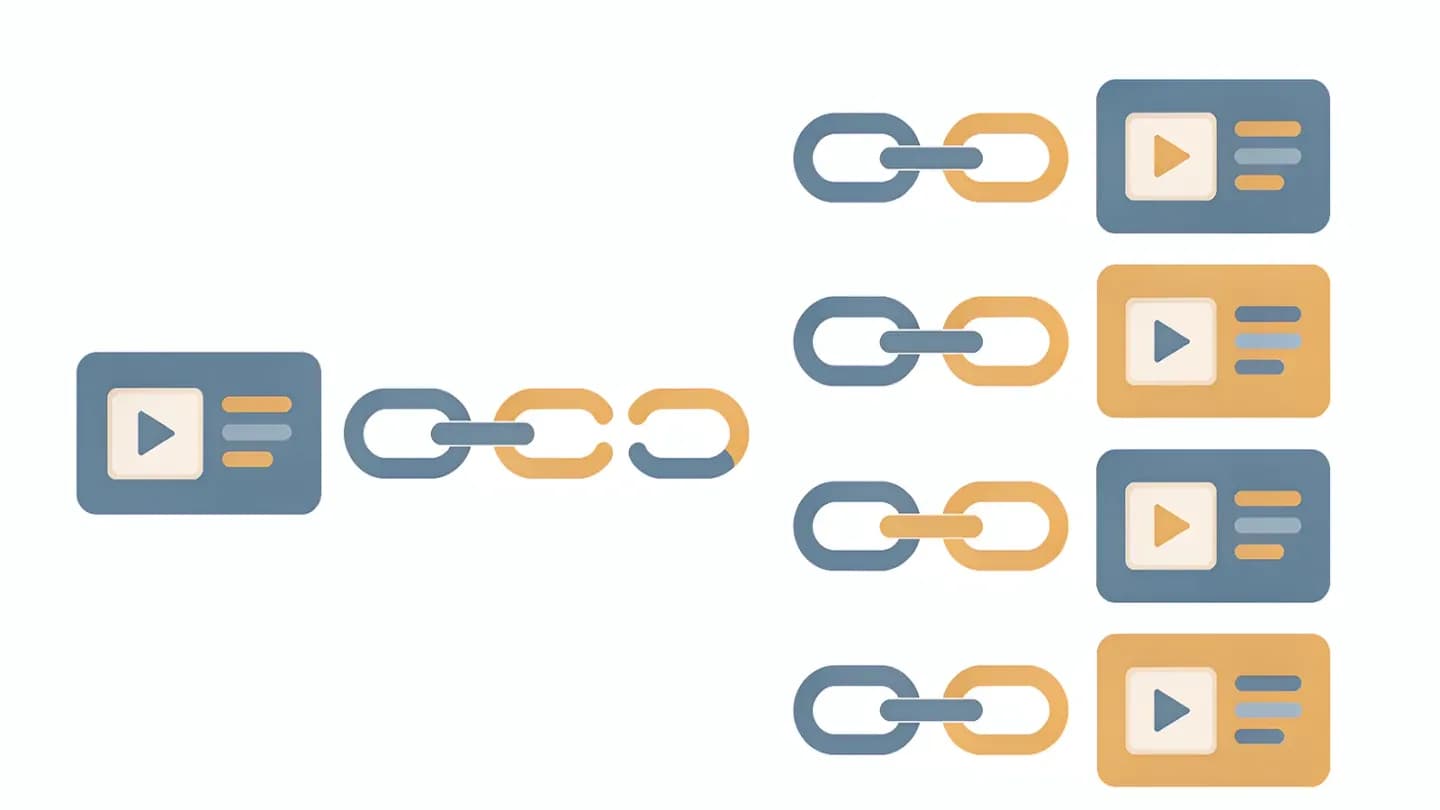
Provenance is where most asset records quietly die. The C2PA 2.1 specification distinguishes a derived asset, which involves an editorial modification, from an asset rendition, which is a non-editorial transformation such as a re-encode or a resize. Hard binding is a byte-level hash: it is exact, and it breaks the moment the file is transcoded. Soft binding, meaning fingerprints and invisible watermarks, is what still recognises a derived asset or a rendition after the bytes have changed.
Every platform delivery is a re-encode, so a hard-bound manifest written at generation time will not match the file that actually ran. Re-bind provenance at each rendition step and store both the manifest reference and the soft-binding fingerprint in the registry. Skipping this step is how teams end up with a provenance record that is verifiable for the master file and silent for the ninety files that actually reached audiences.
Practically, {{link}} is the artefact buyers and legal teams now ask for, and it is only as good as the binding that survives delivery. A record that cannot follow the asset through the transcoding step is a record that will not be there when someone asks which file produced the result.
Practically, an AI video creative audit trail is the artefact buyers and legal teams now ask for, and it is only as good as the binding that survives delivery.
What to bring to the next budget review
A budget conversation about generated video should answer four questions in order: what shipped, what it cost all-in, what changed in a causal read, and what you would cut. Efficiency answers the second question and is usually the only one prepared. Epsilon's numbers explain why that fails: buyers are measuring a productivity tool against a revenue yardstick, and 46% of them are doing it explicitly, while only 9% ever aimed the tool at revenue in the first place.
Pair every efficiency claim with at least one causal read before asking for more money, whether that is a geo holdout, a sequential market test, or a media-mix model that carries generated variants as their own line. Map the result to commercial outcomes finance already tracks rather than to video metrics it does not, and {{link}} show how several commerce teams have done exactly that.
The teams that win the 2027 budget will not be the ones that generated the most variants. They will be the ones that can point to a specific shipped file, its provenance, its declared structure and its measured effect, and then say what they would do again. That is a data problem, and it is solvable this quarter.
Map the result to commercial outcomes finance already tracks rather than to video metrics it does not, and commerce video KPI case studies show how several commerce teams have done exactly that.
Put the framework into production
These related pages connect the article’s planning advice to a specific commercial scope.
References
- 2026 benchmark study: Marketing's AI inflection pointEpsilon
Across 250+ marketing decision-makers, 100% use AI, 71% use it primarily for productivity and efficiency while only 9% use it for revenue generation, 46% measure AI performance by revenue gains, and 45% cite data quality as the top technical challenge.
- 2026 IAB Digital Video Ad Spend & Strategy ReportIAB
US digital video ad spend will surpass $80 billion in 2026 and continue to outpace the broader ad market, while GenAI adoption for video creative accelerates and many advertisers want more proof of performance.
- Video structured data (VideoObject, Clip, BroadcastEvent)Google Search Central
VideoObject requires name, thumbnailUrl and uploadDate; key moments declared through hasPart Clip are prioritised over automatic detection; durations use ISO 8601 and regions use ISO 3166-1.
- C2PA Specification 2.1C2PA
A derived asset involves an editorial modification while an asset rendition is a non-editorial transformation such as re-encoding; hard binding is a byte-level hash that breaks under transcoding, whereas soft binding still recognises derived assets and renditions.