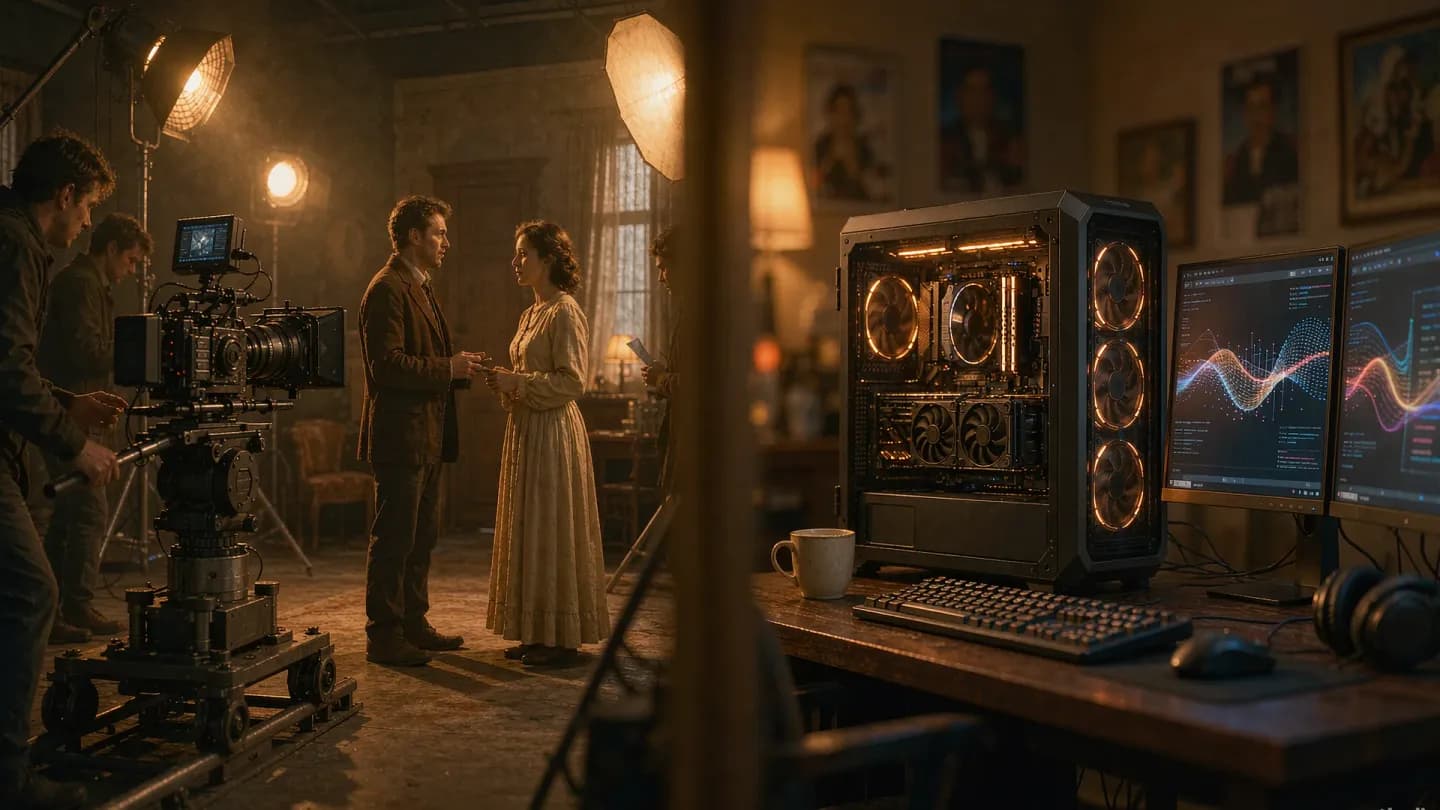
What changes in AI vs traditional video production
AI vs traditional video production is no longer a question of which looks better—it is a question of which production model fits the brief. In 2026 the gap that matters is structural: cost, timeline, versioning, and ownership each shift in different ways, and the teams that win are the ones that map each asset to the right model instead of picking a side.
Most comparisons stop at price, which is the least useful axis. AI generation is dramatically cheaper to run, but the saving rarely shows up as a smaller total budget—it shows up as more assets. To decide correctly you have to look at all four axes at once, because the one that bites you is usually not the one you expected. Teams that default to a single model for every brief, AI for everything or a camera for everything, systematically overpay on one axis and underdeliver on another.
The framework below treats the two as a spectrum, not a switch. For each asset you weigh cost, timeline, versioning, and ownership, then assign the part of the work to the model that wins on the axes that matter for that specific brief. A campaign is rarely all-one or all-the-other; it is a portfolio of assets, each with its own best method.
Cost: the money moves, it doesn't disappear
A professionally produced 30-second commercial sits between $10,000 and $50,000 in 2026, simple local spots run $1,500 to $10,000, and national broadcast easily clears $250,000. AI generation, by contrast, costs cents to a few dollars per clip depending on model, resolution, and length. On the per-asset number AI wins by an order of magnitude.
But the honest read is that AI does not make video cheaper by a fixed percentage—it moves where the money goes. Generation stops being the expensive part, and the budget shifts into creative direction, brand quality control, rights clearance, and versioning. The catch is that cheaper generation has not lifted returns; {{link}}, which means the budget conversation has moved from cost-per-asset to proof-of-performance.
The '70–90% cheaper' headline you see from platforms is directionally true and commercially motivated—it measures generation cost, not project cost. Budget the direction, QC, and clearance work explicitly and the real number is far easier to defend internally than a vendor's percentage. For a high-volume, multi-market campaign the saving is large; for a single hero film it is much smaller, because the human direction and clearance work barely shrink.
The catch is that cheaper generation has not lifted returns; AI video ROI is falling even as adoption climbs, which means the budget conversation has moved from cost-per-asset to proof-of-performance.

Timeline and versions: from shoot weeks to iterate in hours
A traditional brand video runs 6 to 12 weeks from brief to delivery, most of it scheduling rather than shooting—crew availability, location permits, talent bookings, and a post cycle that cannot start until the shoot wraps. AI production compresses that to days, and revision cycles to hours, because those dependencies disappear.
Versioning is where the economic model flips. Traditionally every ratio, language, and market was an incremental production cost; now a master asset fans out into cutdowns, localization, and social spins at near-zero marginal cost. That is the same dynamic behind {{link}}, where volume—not craft—decides which ads win, and near-zero cost finally makes out-testing the field affordable.
The new bottleneck is approval, not production. When generation is no longer the constraint, a slow review cadence quietly rebuilds the traditional timeline you thought you escaped. Teams that compress their sign-off process capture the speed; teams that don't get AI pace on paper and traditional pace in practice. Build the review loop for hours, not weeks, or the advantage evaporates.
That is the same dynamic behind AI video testing economics, where volume—not craft—decides which ads win, and near-zero cost finally makes out-testing the field affordable.

Ownership, likeness, and disclosure: where AI still loses
This is the axis most cost comparisons skip, and it is the one with the most legal exposure. In the US, purely AI-generated elements are not registrable for copyright—the Copyright Office requires human authorship, a position the Supreme Court left standing in March 2026. Human-authored elements, including the edit and the creative arrangement, stay protectable, but the generated frames do not.
Likeness is now a consent workstream. Digital replicas of a performer's voice or image require specific written consent; California's Labor Code 927 voids contract clauses that permit replica use without it, and the NO FAKES Act advanced out of the Senate Judiciary Committee in June 2026 to create a federal replica right. Using a real face is a legal step, not a production shortcut.
Disclosure is also now mandatory in places that matter. New York's synthetic-performer law took effect 9 June 2026 and requires conspicuous disclosure for ads featuring an AI-generated performer, reaching any ad that targets New York consumers wherever the advertiser sits. The EU AI Act's transparency obligations for AI-generated content apply in full from 2 August 2026. C2PA's Content Credentials provide the technical backbone here, acting as a nutrition label that records a piece of media's origin and edit history so generated and altered assets stay traceable.
None of these are reasons to avoid AI—they are reasons to plan the rights and labels at the brief stage. A generated asset with a clear provenance record and a disclosure plan is far easier to ship than one discovered to need both after the cut is locked. Treat provenance as a production input, not a compliance afterthought.

The hybrid split: which parts are hero, which are volume
The useful framing is not AI or traditional—it is which parts of the campaign are hero and which are volume. Traditional production earns its keep on the hero asset: the film that carries the campaign idea and needs performance, ownership, and craft. AI earns its keep on everything downstream of that hero—the cutdowns, the market variants, the ratio changes, the language versions, the always-on social layer that would never justify a second shoot day.
The practical rule is to reserve traditional production for the hero asset and run everything downstream through AI, but only after {{link}} clears the cut for trust and disclosure. Answered well, the production model chooses itself, and the argument about tools disappears. In practice this looks like one traditional hero film per quarter feeding ten or fifty AI-generated cutdowns beneath it. The hero carries the idea and the legal ownership; the variants carry the reach and the test results. The split is predictable per brand once you have run it once.
The practical rule is to reserve traditional production for the hero asset and run everything downstream through AI, but only after a four-check trust-QC gate clears the cut for trust and disclosure.
When to still shoot it: four briefs for traditional
Four situations still call for a camera. First, when the output must be a defensible owned property—generation alone will not give you registrable rights, so a controlled shoot protects the asset. Second, when real people are in it, because replica consent is now a legal requirement, not a courtesy.
Third, when disclosure would undercut the idea—if a label revealing the synthetic performer breaks the creative, the brief belongs on a set. Fourth, when the piece is a hero film, complex narrative, or live event where the value is a performance and a moment, exactly the things generation is worst at guaranteeing. For briefs where the asset must be a defensible owned property, the safer route is a controlled shoot, especially since {{link}} and buyers now rank measurement over creative.
The point is not nostalgia for the shoot—it is matching risk to method. When the asset is a one-off hero, a regulated claim, or a performance you cannot fake, the camera is the lower-risk choice even at higher cost. When it is volume, AI is. Plot each asset on the four axes, decide hero versus volume, and the right model is usually obvious—and so is the one brief where you still book the crew.
For briefs where the asset must be a defensible owned property, the safer route is a controlled shoot, especially since AI video budgets are tightening and buyers now rank measurement over creative.
Put the framework into production
These related pages connect the article’s planning advice to a specific commercial scope.
References
- AI vs Traditional Video Production: Full Comparison (PUNX)PUNX
A 30-second traditional commercial costs $10,000–$50,000 in 2026 and national broadcast clears $250,000, while AI generation runs cents to a few dollars per clip; the US Copyright Office holds purely AI-generated elements are not registrable (Supreme Court left this standing 2 Mar 2026); New York's synthetic-performer disclosure law took effect 9 Jun 2026.
- Video Marketing Statistics 2026 (Wyzowl)Wyzowl
63% of video marketers used AI video tools in 2026 (up from 51% in 2025), 82% report a good ROI (down from 93%), and 92% plan to spend the same or more on video in 2026.
- C2PA — Verifying Media Content SourcesC2PA
C2PA's Content Credentials function like a nutrition label for digital content, recording a piece of media's origin and edit history so generated and altered assets can be traced and verified.
- Regulation (EU) 2024/1689 — Article 50 (EU AI Act)EU AI Act
Article 50 requires providers of general-purpose AI models to ensure AI-generated content is marked in a machine-readable format and disclosed as artificially generated.