
App preview videos are the only creative with an expiry date
App preview videos now expire. Google Play requires games-tab videos to have been uploaded within the last 21 days, and the iOS 26 Liquid Glass redesign has made every storefront video shot against last year's system chrome look stale. The deliverable most teams still produce once per launch has quietly become a recurring production obligation with deadlines, and pipelines built for a one-time upload are not built for that.
Every other asset in the commercial video stack has a campaign window: it flights, it ends, it is replaced on purpose. App preview videos were supposed to be the opposite, the evergreen asset at the top of the store listing that autoplays muted above the screenshots and then lives forever. 2026 broke that arrangement from both sides at once. Google tied video eligibility to upload recency, and Apple's most sweeping interface redesign in a decade dated creative captured against the old system chrome.
The result is a deliverable with a maintenance schedule. A storefront video that is technically live can silently lose its placement on a discovery surface because it was uploaded 22 days ago, not because anyone rejected it. Nothing errors out. The video simply stops being eligible, and the listing quietly degrades while the team assumes the job was finished at launch.
The maintenance framing also reorders priorities inside the pipeline. A commercial team that plans creative around campaign flights already knows how to schedule replacement; the storefront team often does not, because the listing was treated as infrastructure rather than inventory. Merging the two calendars is the organizational shift underneath the technical one, and it lands on whoever owns the app's growth dashboard.
Apple fixed the format; the storefront moved under it
Apple's own specification is a model of stability: app previews run 15 to 30 seconds, cap at 500MB, ship as H.264 or ProRes 422 HQ, max out at 30 frames per second at a 10 to 12 Mbps target bit rate, and each locale accepts up to three previews. The poster frame defaults to five seconds after upload. None of those numbers has moved in years, and none of them is the problem.
The problem is everything around the numbers. App previews are captured against system chrome, and iOS 26's Liquid Glass redesign re-rendered every navigation bar, tab bar and sheet as layered, translucent glass. A preview recorded against iOS 25 chrome now mismatches what buyers actually see on device, which makes the capture look wrong even though it complies with every technical requirement. The poster frame belongs to the same hand-finished layer as {{link}}, picked after upload and judged on the first frame a shopper sees.
Device classes compound the versioning load. Apple accepts exports across the 6.9-inch, 6.5-inch and 6.3-inch iPhone display classes in portrait or landscape, and a listing that still carries last year's device frames reads as dated to exactly the buyers most likely to upgrade this quarter.
The poster frame belongs to the same hand-finished layer as thumbnail packaging, picked after upload and judged on the first frame a shopper sees.
Google Play turned freshness into a hard requirement
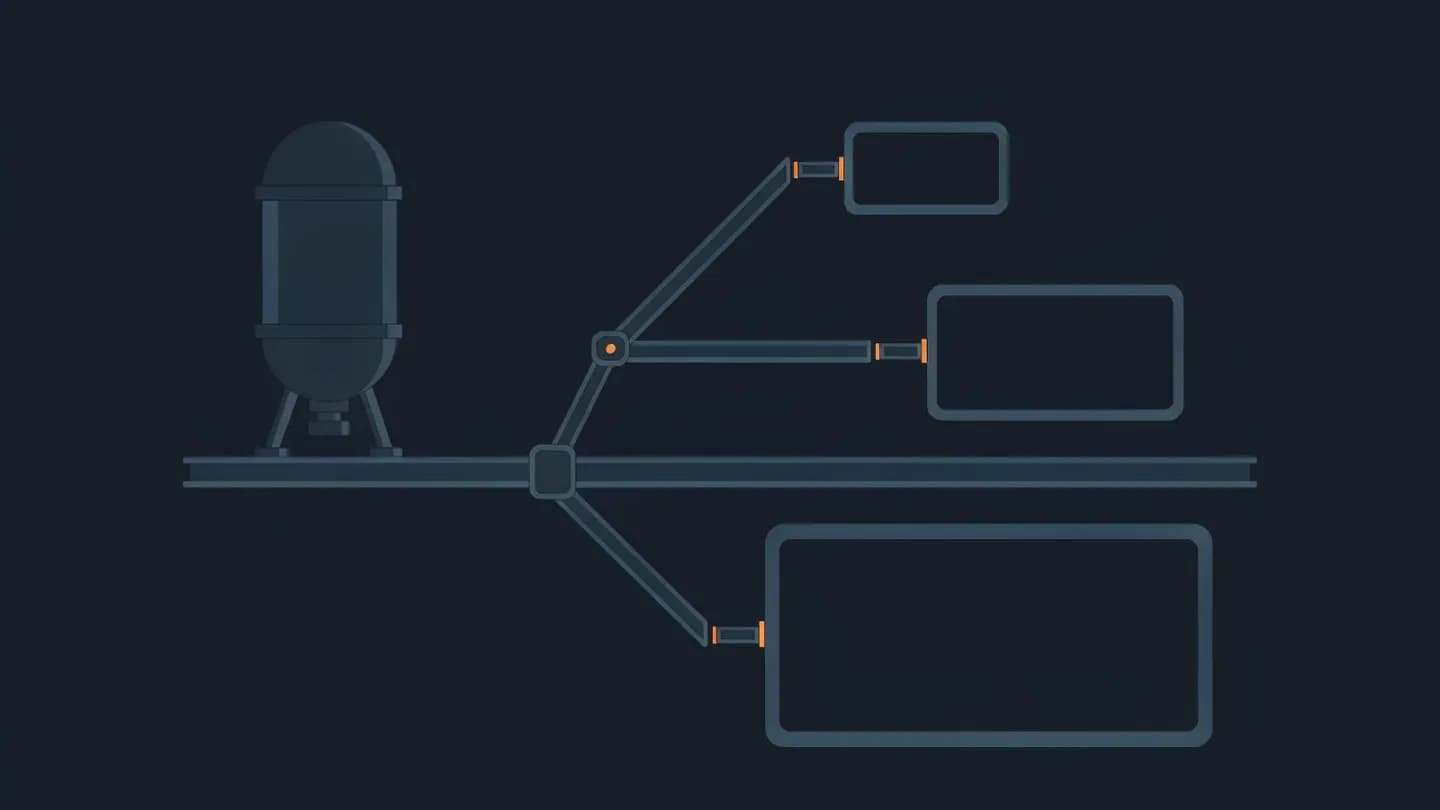
Google Play's rules are stricter because its listing videos are YouTube-hosted. The baseline requirements are mechanical: the video must be public, monetization disabled, embeddable, not a live stream, owned by the developer and free of unlicensed copyrighted material. Most teams can clear that checklist once and forget it.
The recency windows are the part that changes the production model. For games, a video must have been uploaded within the last 90 days to appear on the store listing, and within the last 21 days to be eligible for the Games tab. Videos uploaded within the last 180 days qualify for the Apps tab. Those are expiry dates attached to a deliverable most studios still treat as finished output, and Google's video performance dashboard, rolling out to app developers in Play Console, now measures whether the repeat effort pays for itself.
There is a second, quieter requirement buried in the same documentation: the feature graphic that hosts the play button is the video's cover frame, and it has to work as a still at small sizes. That couples two assets most teams produce independently, the cut and its packaging, into one review decision, and it makes the storefront video one of the few deliverables where the first frame, the autoplay behavior and the cover are judged as a single unit.

Liquid Glass reset the visual baseline in September
iOS 26 shipped to the public in September 2026 with iPhone 17 hardware days behind it, and the Liquid Glass design language is the most significant visual overhaul since iOS 7. System chrome now renders as layered, translucent glass, which changes the ambient backdrop behind every piece of captured UI.
The adoption curve compresses the damage window. In hardware-launch years, iOS adoption among active users has historically reached more than 50 percent within 60 to 90 days, driven by new device activations. That means the majority of a listing's audience sees the new visual baseline within a quarter. Storefront creative re-shot on the old chrome is not gradually aging; it is already wrong for half the people who open the listing.
Google's storefront applies its own version of the same pressure: portrait video composed for phone-first listings, captions designed to be read muted, and custom store listings that expect localized cuts. Neither platform penalizes stale creative with a takedown; both simply hand the placement to the competitor whose assets match the device in the shopper's hand.
The refresh pipeline is capture once, version everywhere
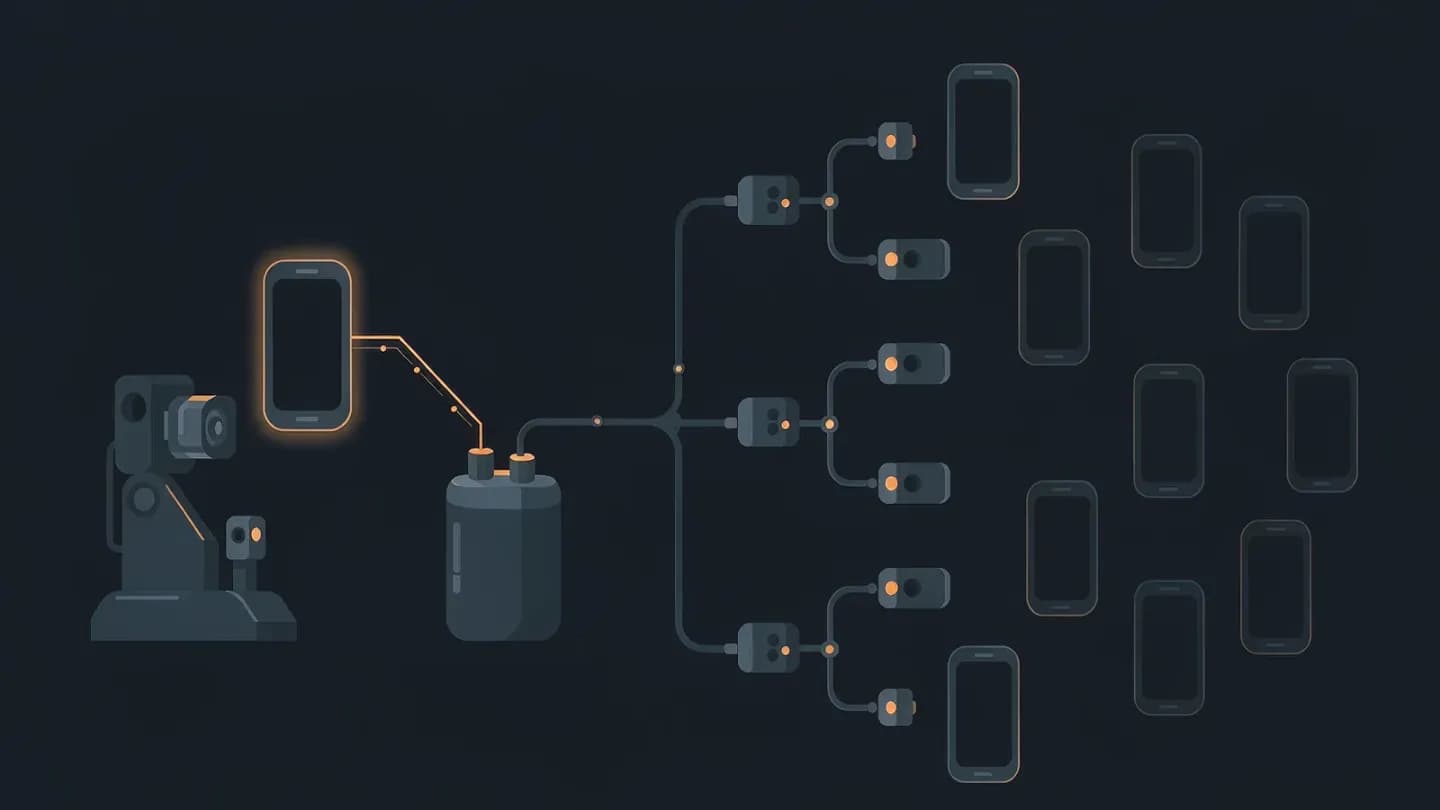
The unit of production changes from a video to a manifest. One real UI screen-capture session becomes the master asset; everything downstream is derivation: per-device-class exports, localized captions and taglines, the muted-autoplay caption layer Google explicitly recommends, and a poster frame chosen per locale. Localizing every preview for the top five markets is the multi-market {{link}} problem, applied to a deliverable with a deadline.
AI's role in that pipeline is bounded by the storefronts' own honesty rules: the video has to show the real app experience, so generated UI is off the table. What generative tooling does own is everything around the capture, from re-timing cuts to the 30-second cap to deriving aspect ratios and resolutions, drafting localized caption overlays, running QC against the current spec sheet and scheduling the next re-shoot before the recency window closes. Exporting one master capture down to every device class is the same branching logic a {{link}} applies to delivery specs.
Localizing every preview for the top five markets is the multi-market localization deliverable problem, applied to a deliverable with a deadline.
Exporting one master capture down to every device class is the same branching logic a resolution pipeline applies to delivery specs.
What breaks when a storefront video ages out
The failure mode is silent. A game's listing video uploaded 91 days ago does not display an error; it simply drops out of the eligibility pool, and the Games tab placement, the highest-intent discovery surface in mobile, goes to competitors who re-shot in time. With video performance data now visible in Play Console, the cost of a lapsed video stops being theoretical.
Teams that treat the storefront video as a calendar item survive this. The operating checklist is short: a locale manifest with upload dates and review dates, an owner accountable for the 21, 90 and 180-day windows, a re-capture trigger tied to OS releases, and QC that reads the current spec sheet rather than last year's. The distinction {{link}} draws for web commerce applies here as well: a listing video and a campaign cut are different deliverables with different jobs, and only one of them expires on a timer.
None of this makes app preview videos harder than ads. It makes them accountable in a way ads never were: the deadline is public, the measurement exists, and the failure is a visible absence rather than a soft metric. The teams that industrialized generation for feeds already have every tool this needs, from capture discipline to versioning to QC gates and a shared calendar. The work is pointing that machinery at a deliverable that used to ship once and quietly rot.
The distinction product page video draws for web commerce applies here as well: a listing video and a campaign cut are different deliverables with different jobs, and only one of them expires on a timer.
Put the framework into production
These related pages connect the article’s planning advice to a specific commercial scope.
References
- App preview specifications - App Store Connect HelpApple Developer
Apple's App Store Connect specification defines app previews as 15 to 30 seconds with a 500MB maximum file size, delivered as H.264 or ProRes 422 HQ at a maximum of 30 frames per second (10-12 Mbps target bit rate for H.264), in portrait or landscape per device class, with a default poster frame set at five seconds, and up to three app previews accepted per locale across the iPhone 6.9-inch, 6.5-inch and 6.3-inch display classes, which accept 886x1920 portrait or 1920x886 landscape resolutions.
- Use YouTube videos to showcase your app on Google PlayGoogle Play Console Help
Google Play requires store-listing YouTube videos to be public, embeddable, monetization-disabled, not live streams, owned by the developer and free of unlicensed copyrighted material. Recency rules: for games, a video must have been uploaded within the last 90 days to show on the store listing and within the last 21 days to be eligible for the Games tab, while videos uploaded within the last 180 days are eligible for the Apps tab. Play Console video performance data for app developers was expected by the end of Q1 2026.
- iOS 26 Is Live: What App Developers Need This WeekAppsOps
iOS 26 shipped to the public in September 2026 with iPhone 17 hardware reaching consumers days later. Liquid Glass is described as the most significant visual overhaul since iOS 7: system-level UI now renders with a layered translucent glass effect that changes the ambient backdrop behind app UI, so screenshots and creative captured against iOS 25 system chrome look visually mismatched on new devices, and device mockup frames need updating. In hardware-launch years iOS adoption among active users has historically reached 50% or more within 60 to 90 days.