Smart TV home screen ads are now a buying channel, not a placement
Smart TV home screen ads stopped being a placement and became a buying channel in 2026. iSpot's annual survey found ad buying through smart TV OEMs jumped from 25% of marketers in 2025 to 55% in 2026, while social platforms reached parity with traditional TV as a buying method. The consequence for commercial video teams is specific: the first frame now has to win before the content starts.
That is a claim about transactions, not budgets. The dollar side of the same shift gets its own treatment in {{link}}, and it points the same direction: half of the marketers iSpot surveyed expect to increase spending on social video and streaming or national CTV this year, and 73% expect total budgets to hold or grow. What changed is not how much video gets bought. It is where the buy happens, and increasingly that is the screen the viewer touches before choosing anything to watch. Upfront buying still accounts for more than 37% of the TV budget on average, which means guaranteed inventory is now negotiated alongside surfaces that were not ad products three years ago. A channel that more than doubles its share of buyers in a single year is no longer an experiment; it is a line item with a creative brief attached.
The dollar side of the same shift gets its own treatment in where the 2026 ad budget flows, and it points the same direction: half of the marketers iSpot surveyed expect to increase spending on social video and streaming or national CTV this year, and 73% expect total budgets to hold or grow.

The home screen is a creative surface with its own physics
Treat the home screen as inventory and you will under-brief it. LG Ad Solutions' report on the surface calls the Smart TV home screen the front page of the living room, and its numbers describe a different attention contract from pre-roll: home screen ads deliver seven seconds of attentive viewing time and 16% higher attention retention than skippable pre-roll. Experian's 3D home screen takeover produced 13 times higher recall in LG's case data, and the report points at interactive 3D units and geo-targeted storytelling as the formats earning that premium. None of that survives a bad handoff, which is why {{link}} is now a home screen question too: the grade, the supers and the encode all have to hold at living-room scale before a single frame plays.
The physics are worth stating plainly. A pre-roll interrupts content the viewer already chose. The home screen ad is the front page of the session itself, seen before app selection, on the largest screen in the house, usually with the remote still in hand. Roku's advertising page puts its US base at more than 125 million daily active users, and its stack now runs from self-serve Ads Manager through programmatic pipes into commerce and measurement partnerships. The OEM is not reselling somebody else's inventory at this point; it is the publisher, the ad server and the data provider in one device. That vertical stack is why the buying numbers moved so fast, and it is also why the creative rules are increasingly set by the hardware rather than by the media plan.
None of that survives a bad handoff, which is why AI video HDR delivery is now a home screen question too: the grade, the supers and the encode all have to hold at living-room scale before a single frame plays.
One master, two very different rooms
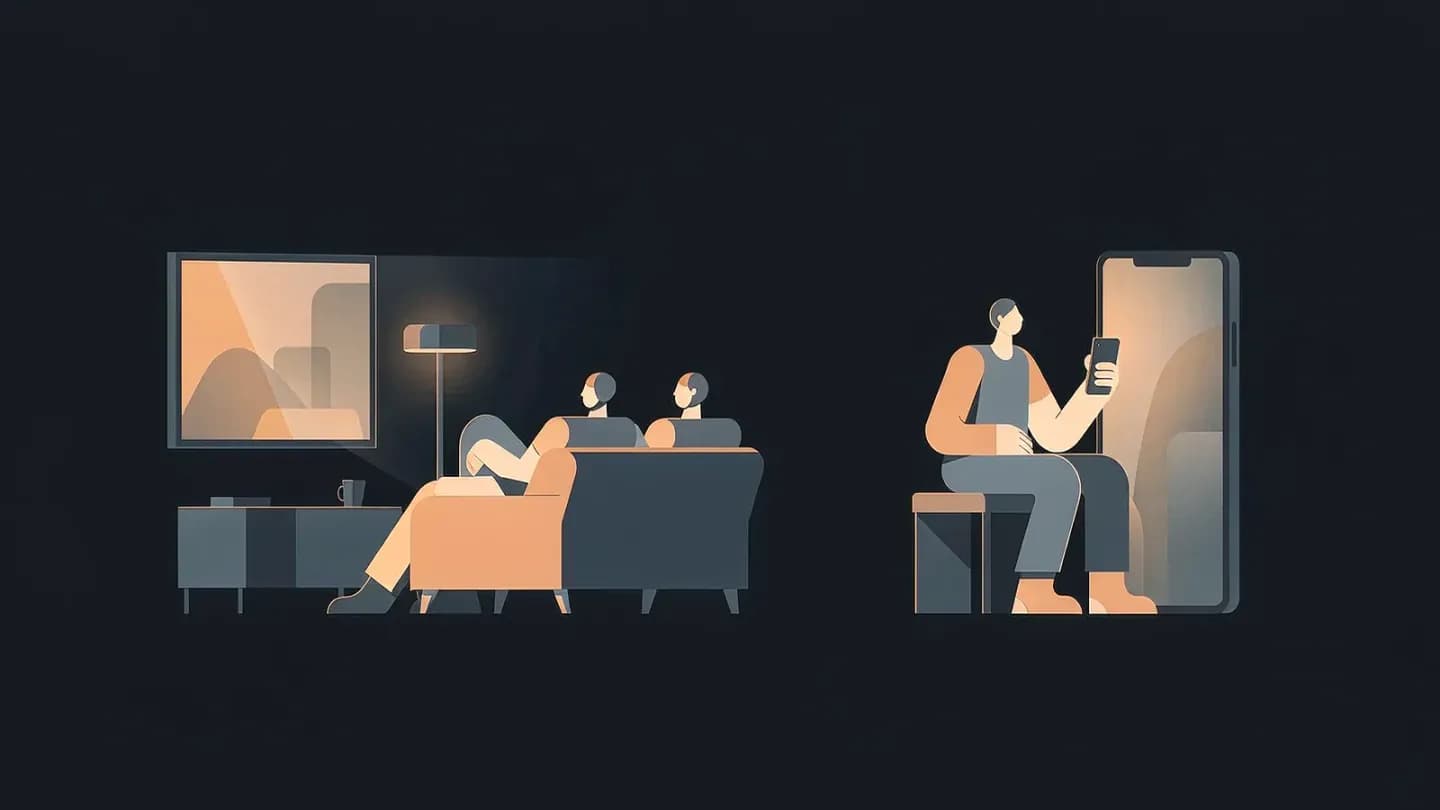
Here is the production consequence that rarely makes the brief. iSpot found that 39% of marketers now place more than half of their TV and streaming creative on social media as well, so the same hero film has to hold a living-room screen at three metres and a phone feed at thirty centimetres. That is not a resize job. Supers that read at TV distance turn into posters at feed distance. The hook that works with sound in the living room fails silently on a muted phone. And the geometry gets worse before it gets better, because each OEM surface carries its own safe area for the tile, the sidebar unit and the persistent end frame.
The practical answer is to spec cross-placement at the master stage rather than the delivery stage. Build the 16:9 hero with a first frame that works sound-off, keep the product legible at both scales, and treat the vertical cut as a re-frame with its own supers instead of a crop. Volume still decides the auction that follows, as {{link}} showed, and volume only pays when every surface receives a version that was designed for it. Fifty near-identical resizes are fifty chances to look wrong, not fifty chances to win.
Volume still decides the auction that follows, as creative auction weight showed, and volume only pays when every surface receives a version that was designed for it.
Spec the first-on-screen unit like its own deliverable
The craft shift is smaller than it sounds and easier to get wrong. A home screen unit is not a pre-roll with a different media plan. It plays before the viewer has committed to anything, which means the brand has to be identifiable in the first second without leaning on audio, and the product has to survive being seen at a glance from across the room. LG's case data points at interactive 3D units and geo-targeted storytelling as the formats earning the attention premium, which makes the takeover the premium tier rather than the default buy. The standard unit still has to work, though, and it works on recognition rather than on narrative.
That changes the brief in three places. The open has to carry the brand, because there is no preceding content to borrow context from. The close has to be a single idea, since the viewer is one click away from leaving. And the unit needs a designed still frame, because on several OEM surfaces the ad persists as a tile after the motion ends. Teams that treat the tile as an afterimage rather than a deliverable are leaving the most-viewed frame of the campaign to chance. The same discipline applies to geo-targeted variants: the local reference has to be built into the shoot or the generation, not pasted on in post.
Measurement is now part of what you ship
The buying shift and the proof demand arrived together. In iSpot's survey, over 45% of marketers called business outcomes the most critical factor in buying and negotiating media, 47% described measuring those outcomes as a significant challenge, and more than 68% said independent third-party measurement is essential to optimize media buying. The rulebook behind that demand already exists, and we broke it down in {{link}}. What the framework does not do is make the asset measurement-ready; that part is still a production decision.
There is an AI trust gap sitting underneath all of it. 80% of marketers told iSpot they already use AI somewhere in their video strategy, but 45% worry about the reliability of the outputs, and the same survey frames outcomes as the reference point even for television. For a production team that is not an abstraction. The asset you deliver increasingly carries the measurement burden: clean duration and encoding metadata, deduplicated reporting across the TV screen and the phone, and attention evidence a buyer can take into an upfront negotiation. A film that cannot be measured consistently across both rooms is a discount asset in 2026, however good it looks on the grade.
The rulebook behind that demand already exists, and we broke it down in CTV measurement gets a rulebook.
The 2026 home screen checklist
Five decisions decide whether a campaign is ready for the surface where the buy now happens. Spec the first-on-screen unit as its own deliverable, with its own duration, supers and end frame, instead of inheriting the pre-roll spec. Build the master for cross-placement from the start, so the 39% statistic is a workflow rather than a rescue. Design the open for sound-off and the product for living-room distance. Price the interactive and 3D tier separately, because takeover economics are not pre-roll economics. And ship with the metadata and attention evidence the measurement conversation will demand.
None of this replaces the work that already performs elsewhere. The home screen is simply the next chapter of {{link}}: finished commercial work, delivered to spec, at the point where the session begins. The teams that win it will be the ones that briefed the first frame like a headline instead of like a placement, and that treated the tile as the campaign's most-seen asset rather than its leftover.
The home screen is simply the next chapter of the AI video delivery era: finished commercial work, delivered to spec, at the point where the session begins.
Put the framework into production
These related pages connect the article’s planning advice to a specific commercial scope.
References
- Nearly Half of Marketers Focus on Media ROI: iSpot's 2026 Video Ad Spend and Strategy SurveyMarTech Cube
iSpot's 2026 Video Ad Spend and Strategy Report (released May 11, 2026, as carried by MarTech Cube) found that ad buying through smart TV OEMs jumped from 25% of marketers in 2025 to 55% in 2026, that social platforms such as YouTube reached parity with traditional TV as the most popular ad-buying method, that 50% of marketers expect to increase spending on social video and streaming/national CTV, that 39% now place more than half of their TV/streaming creative on social media, that over 45% call business outcomes the most critical factor in buying and negotiating media while 47% call measuring outcomes a significant challenge, that over 68% say independent third-party measurement is essential, that 80% use AI in their video strategy while 45% worry about output reliability, and that Upfront buying still accounts for over 37% of the TV budget on average.
- The Home Screen: For First ImpressionsLG Ad Solutions
LG Ad Solutions' report 'The Home Screen: For First Impressions' (dated November 18, 2025) argues the Smart TV home screen has become 'the front page of the living room' and the most valuable real estate in Connected TV, reporting that home screen ads deliver 7 seconds of attentive viewing time and 16% higher attention retention than skippable pre-roll, that Experian achieved 13x higher recall with a 3D home screen takeover, and pointing to interactive 3D units and geo-targeted storytelling as the formats earning the attention premium.
- Roku AdvertisingRoku
Roku's advertising platform page states that its data is powered by 125M+ daily active users in the US, and documents an ad stack that spans streaming ads, the self-serve Ads Manager, programmatic solutions, commerce integrations and measurement partners, positioning the TV operating system as publisher, ad server and data provider in one device.