
The 2026 numbers behind the video gap
The AI video adoption gap is the distance between intent and output: 74% of marketers want to make AI video, but only 37% actually do. The blocker isn't the tools — it's the lack of a production system. This guide shows the three stalls that keep teams stuck and the operating model that closes the gap.
Social Media Examiner's 2026 AI Marketing Industry Report, drawn from 681 marketers, found the split hiding in plain sight. Ninety-five percent now use AI for written content, yet only 37% use it for video — even though video is the one format 74% most want to learn to create. That 37-point gap between demand and adoption is the widest of any content type the study measured, and it has barely moved since 2024.
The tooling debate is already settled on the other side of the workflow. IAB's 2026 Digital Video Ad Spend & Strategy Report shows two-thirds of digital video buyers are live, testing, or planning agentic AI for their campaigns. Brands trust machines to place and optimise video spend, but hesitate to let them make the video. The stall is in production, not in strategy.
The same report shows the platform race shifting underneath the content gap. Claude tripled its marketer user base and overtook ChatGPT as the most important AI platform in 2026, while daily AI use nearly doubled in two years to 73%. The teams adopting fastest treat AI as shared infrastructure, not a personal shortcut — the exact posture that closes the video gap.
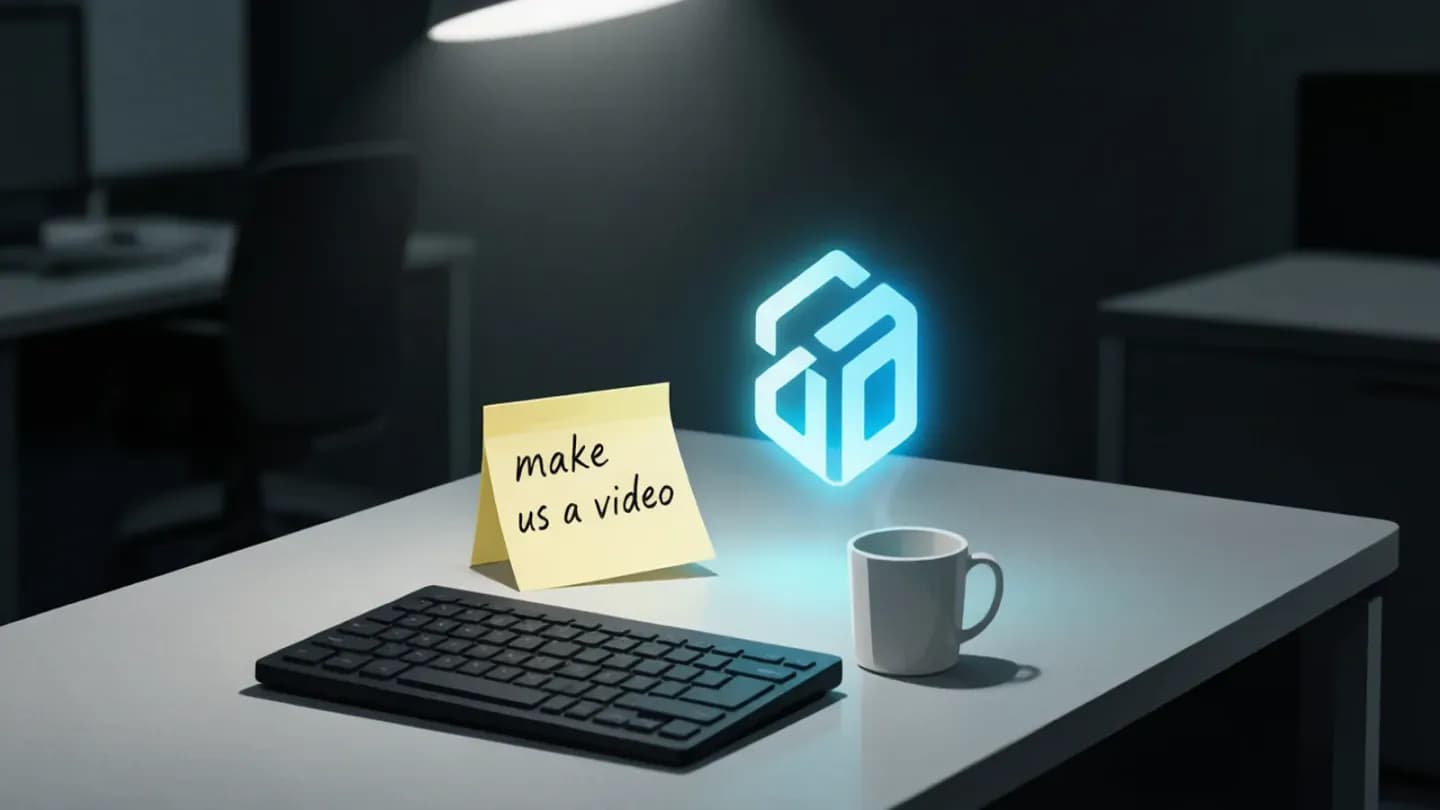
Why AI video adoption stalls between wanting and shipping
Three stalls explain almost every stalled AI video program, and none of them is about model quality. The first is a skills and ownership gap: no one on the team is explicitly responsible for turning AI into shippable video. The second is production capacity — the intent to publish outruns the ability to brief, generate, and finish clips. The third is review: brand and legal sign-off built for monthly shoots breaks down at AI volume.
A tight {{link}} is what turns a vague 'make us a video' request into shippable cuts. Most stalled programs never write one, so every request restarts from zero and the gap between wanting and shipping stays open.
Notice the pattern: each stall is organisational, not technical. The models are good enough today to ship real work. What is missing is the system that lets a normal team use them every week without heroics.
The fastest way to see the gap is to watch where work actually happens. Written content shipped because it slid into existing workflows — email, docs, CMS. Video did not, because it needed a pipeline that never existed. AI did not remove that requirement; it only made building it worth the cost.
A tight creative brief for AI video is what turns a vague 'make us a video' request into shippable cuts.
Stall one: nobody owns the AI video skills
Serviceplan's CMO Barometer 2026, based on 805 leaders across 15 markets, shows why the skills gap persists. Sixty-eight percent of CMOs call AI the defining topic of the year, yet only 12% expect their agencies to lead on AI-specific skills. Brands have decided AI is a capability they must own in-house — but few have hired or trained for it.
That decision leaves a vacuum. The people who understand the brand are not trained on the tools, and the people who know the tools do not own the brand. Until a named owner sits between the two, AI video stays on the 'someday' list while written content and image generation pull further ahead.
The practical fix is unglamorous: give one person the title and the time. A producer who owns the AI video pipeline, reports on output, and builds the brief library will close more of the gap in a quarter than a year of vendor demos.
Ownership also changes how the team learns. When one producer is accountable for output, every clip becomes a small experiment with a recorded result and the brief library compounds. Without ownership, each person learns in private and the organisation re-learns the same lesson every quarter.
Stall two: production capacity lags intent
Even teams that hire the owner hit a throughput wall. A single brief can spawn dozens of candidate clips, and each one needs a hook, a cut, a caption, and a brand check before it touches a channel. The {{link}} still decides whether a generated clip earns its first three seconds, so volume without craft just produces more forgettable footage.
The remedy is not more tools — it is a production system. Teams that ship AI video consistently treat generation as a batched process with gates, not as a string of heroic one-off efforts. They lock formats up front, generate variants in parallel, and let a small review queue — not a committee — decide what goes live.
Throughput also comes from repetition. The teams that close the gap run a standing weekly batch: one brief, ten variants, three winners, one published cut. The cadence matters more than the headcount.
Capacity is also a briefing problem. Vague briefs produce unusable clips; specific briefs produce winners. The teams that scale write the brief once, reuse it across variants, and let the model do the repetition, so human effort goes into the brief instead of rescuing each render.
The high-retention opening hook still decides whether a generated clip earns its first three seconds, so volume without craft just produces more forgettable footage.

Stall three: review and brand-safety bottlenecks
The third stall is the one teams underestimate most. Approval workflows designed for a monthly brand film assume a handful of cuts; they collapse when a team produces fifty a week. Disclosure rules, likeness rights, and on-screen text all need a check, and every manual check adds latency that eats the speed advantage AI was meant to deliver.
Closing this stall means moving the safety check into the pipeline. Provenance tagging, a pre-flight disclosure checklist, and a named approver with a clear mandate turn review from a bottleneck into a gate the system passes through automatically. The teams that win here review outcomes, not every frame.
This is also where governance and speed stop fighting. When disclosure and rights checks are baked into the template, a new clip inherits compliance instead of negotiating for it — and the gap between a finished render and a live post shrinks from days to minutes.
A practical starting point is a one-page pre-flight checklist: a disclosure label, a likeness-rights check, an on-screen text pass, and a single named approver. Most teams already know the rules; they fail because the rules live in someone's head. Writing them down turns review from a person into a process.
How AI video tooling closes the execution gap
The throughline is simple: delegate the repeatable 80% to the machine and keep the human on the 20% that decides whether the work is any good. Generation, variation, captioning, and localisation are mechanical and scale; concept, brand judgment, and the final yes are where people earn their keep.
An {{link}} lets a two-person team feed the paid-social auction without a creator roster.
A variant library that runs on a {{link}} keeps a small team's AI video from decaying in the feed.
Tooling only closes the gap when it is pointed at a system. A model in a tab helps one person; a pipeline with owners, briefs, and gates helps the whole team ship every week. Buy the second, not the first.
The convergence of make-side and buy-side is the real story of 2026. On media, agentic AI already plans and buys; on creative, the same logic — batch, gate, measure — lets a small team match a large one. The gap closes when creative stops being craft-by-heroics and becomes operations.
An AI UGC testing system lets a two-person team feed the paid-social auction without a creator roster.
A variant library that runs on a creative refresh cadence keeps a small team's AI video from decaying in the feed.

The cost of leaving the gap open
The gap is not free. Every quarter a team sits on the sidelines, competitors who ship AI video accumulate the variant libraries, the audience data, and the creative instinct that only repetition builds. Brands on the sidelines are already paying for it as the {{link}} cuts into watch time while cheaper AI-native rivals take the feed.
Closing the AI video adoption gap does not require a bigger team or a new agency. It requires naming an owner, writing one brief, and treating production as a system instead of a wish. The 37% who ship today have a head start — but the window to join them is still open.
Start this week with one format and one brief. The distance between wanting AI video and shipping it is shorter than the data suggests; it is a system away.
The 37% who ship today are not more talented — they are more organised. They treated AI video as a system early, and that system is now compounding. The 63% who do not ship are not behind on skill; they are behind on structure, and structure is the cheaper thing to fix.
Brands on the sidelines are already paying for it as the video engagement decline cuts into watch time while cheaper AI-native rivals take the feed.
Put the framework into production
These related pages connect the article’s planning advice to a specific commercial scope.
References
- 2026 AI Marketing Industry ReportSocial Media Examiner
Survey of 681 marketers: 95% use AI for written content but only 37% use AI for video, while 74% most want to learn video creation — the largest intent-to-adoption gap of any content type measured.
- 2026 IAB Digital Video Ad Spend & Strategy Report: Part OneIAB
U.S. digital video ad spend to surpass $80B in 2026 (+11% YoY); two-thirds of digital video buyers are already live, testing, or planning agentic AI for video campaigns.
- CMO Barometer 2026Serviceplan Group
Survey of 805 marketing leaders across 15 markets: 68% say AI is the defining topic of 2026, but only 12% expect agencies to lead on AI-specific skills — brands see AI as a capability to own in-house.