What Agentic AI Video Media Buying Looks Like Today
Agentic AI video media buying is the use of autonomous agents that plan, launch, and optimize digital-video campaigns across planning, buying, and inventory discovery, not just generate the creative. Where generative AI produces one asset when prompted, an agentic system closes the loop: it reads performance signals, decides the next action, and executes without a human steering every step. A buying agent might pause an underperforming placement, shift budget to a winning audience, or generate a fresh variation for a fatigued creative set, all inside the live campaign rather than in a separate planning meeting. In 2026 this stopped being a lab project and became a mainstream buy-side capability that sits inside the budget decision rather than the production line.
The 2026 IAB Digital Video Ad Spend & Strategy Report finds that two-thirds of digital-video buyers are already live, testing, or planning agentic AI for video campaigns, with another 28 percent actively investigating, meaning nearly all buyers are in-market or on a near-term activation path. The capability moved from experimental to operational in a single budget cycle, and teams treating it as a one-off pilot are now the exception rather than the rule.
The pattern mirrors an earlier split on the creative side, where a full {{link}} shows CMOs use AI daily but only a third have handed creative work to agents, the buying desk is now closing the same gap in the opposite direction.
The pattern mirrors an earlier split on the creative side, where a full agentic AI marketing divide shows CMOs use AI daily but only a third have handed creative work to agents, the buying desk is now closing the same gap in the opposite direction.
Small Spenders and Enterprises Use It for Opposite Jobs
The IAB survey splits buyers by size, and the divergence is the most useful part of the data. Smaller and mid-size spenders lean into agentic AI for creative testing, pre-planning, and performance analysis, because their pain is producing and proving enough variant creative to feed the platforms without a large in-house team. For them the agent is a force multiplier on a small creative bench. Their agent drafts variant storyboards, scores them against past performance, and queues the strongest for a human to approve, compressing a week of creative ops into an afternoon.
Larger spenders running many deal types and partners point agentic AI at inventory discovery and evaluation, where the volume of supply and the number of overlapping workflows make human-only triage slow. Their agent sifts thousands of placements and deal permutations so buyers can spend their judgment on the few decisions that actually move cost and reach. At enterprise scale the same engine instead ranks deals by predicted completion and flags the supply that will not clear brand or fraud rules before a buyer ever sees it.
That split matters for vendors and for internal teams, because the agent you build for a mid-market brand looks nothing like the one you build for a holding-company trade desk. Treating agentic buying as one product hides the fact that the two buyer groups are automating opposite ends of the workflow, and a tool tuned for one will frustrate the other.
Why Targeting Now Outranks Creative in the Buy Box
The buy-side reordering is the context agentic buying walks into. IAB reports targeting overtook content quality as the top criterion for TV and video investments, rising about ten points year over year, while content quality slipped a notch. Buyers are weighting audience and signal above the spot itself, which changes what an agent should be optimizing for.
The reordering is concrete: a full {{link}} shows targeting jumped past content quality as the top criterion for TV and video buys, up roughly ten points year over year as signal loss pushed buyers toward audiences they can actually trust.
The driver is erosion, not taste. IAB points to overall signal loss and the rapid rise of non-human traffic as the reasons buyers now prize addressable, verifiable audiences. When you cannot trust the impression, you pay for the audience instead, and agentic tools are being pointed at exactly that targeting-and-measurement layer where the fraud and waste actually show up. Non-human traffic alone can inflate reach by double digits on open exchanges, so an agent that can read verified audience signals protects budget better than one tuned purely for cheap impressions.
The reordering is concrete: a full video ad buyer targeting shift shows targeting jumped past content quality as the top criterion for TV and video buys, up roughly ten points year over year as signal loss pushed buyers toward audiences they can actually trust.
The $80B Market Behind the Shift
The dollars make the automation inevitable. IAB projects US digital video ad spend above 80 billion dollars in 2026, growing about 11 percent year over year and roughly 20 percent faster than the total ad market, with digital video taking more than 60 percent of total TV and video ad spend for the first time. The channel is now the default, not the experiment.
Social video now outpaces connected TV for the first time, powered by AI personalization and the creator economy, while consumer packaged goods lead at about 16.9 billion dollars and retail follows at 9.4 billion. The category mix is exactly where agentic buying is being pointed, because that is where the volume and the fragmentation are highest and where manual buying breaks down first. CPG and retail lead because their purchase cycles are short and their creative churn is high, exactly the conditions where agentic testing pays back fastest.
The efficiency case is already on the board: AI-driven video delivery shows an 82 percent ROI lift over traditional workflows and 96 percent of marketers report positive ROI from AI-powered video, so the question for buying teams is no longer whether AI helps but whether the agent is aimed at the right lever and measured against the right outcome.
The Value Gap: Adoption Is Universal, Proof Is Not
Epsilon's 2026 benchmark study of 250-plus marketing decision-makers finds 100 percent of surveyed marketers now use AI, but only 71 percent point it at productivity and efficiency while just 9 percent aim it at revenue generation, and 46 percent still measure AI performance by revenue gains. Adoption is universal; proof is not. Epsilon also finds 45 percent cite data quality as their top technical challenge, which is the exact foundation an agentic buyer depends on. The gap is not a talent problem, it is a measurement problem: teams celebrate adoption while the dashboards still report activity, not incremental revenue.
Reaching that bar starts with disciplined {{link}}, because every automated buy still has to clear a cost-and-performance threshold before it scales, and agentic tooling only helps if it ships fewer, better-measured campaigns.
The proof question is the same one every AI video effort hits: a clear {{link}} shows teams now win by proving revenue, not by counting impressions, and agentic buying lives or dies on the same measurement spine.
Reaching that bar starts with disciplined AI video budget proof, because every automated buy still has to clear a cost-and-performance threshold before it scales, and agentic tooling only helps if it ships fewer, better-measured campaigns.
The proof question is the same one every AI video effort hits: a clear AI video ROI reversal shows teams now win by proving revenue, not by counting impressions, and agentic buying lives or dies on the same measurement spine.
A Playbook for Buying Teams Adopting Agentic AI
Start with governance, not automation. Define which decisions an agent may make unaided, which require a human checkpoint, and which stay manual, then write that boundary into the workflow before the first campaign runs. The buyers who struggle are the ones who bolt an agent onto a process that was never documented, so the first deliverable is a written decision map, not a dashboard.
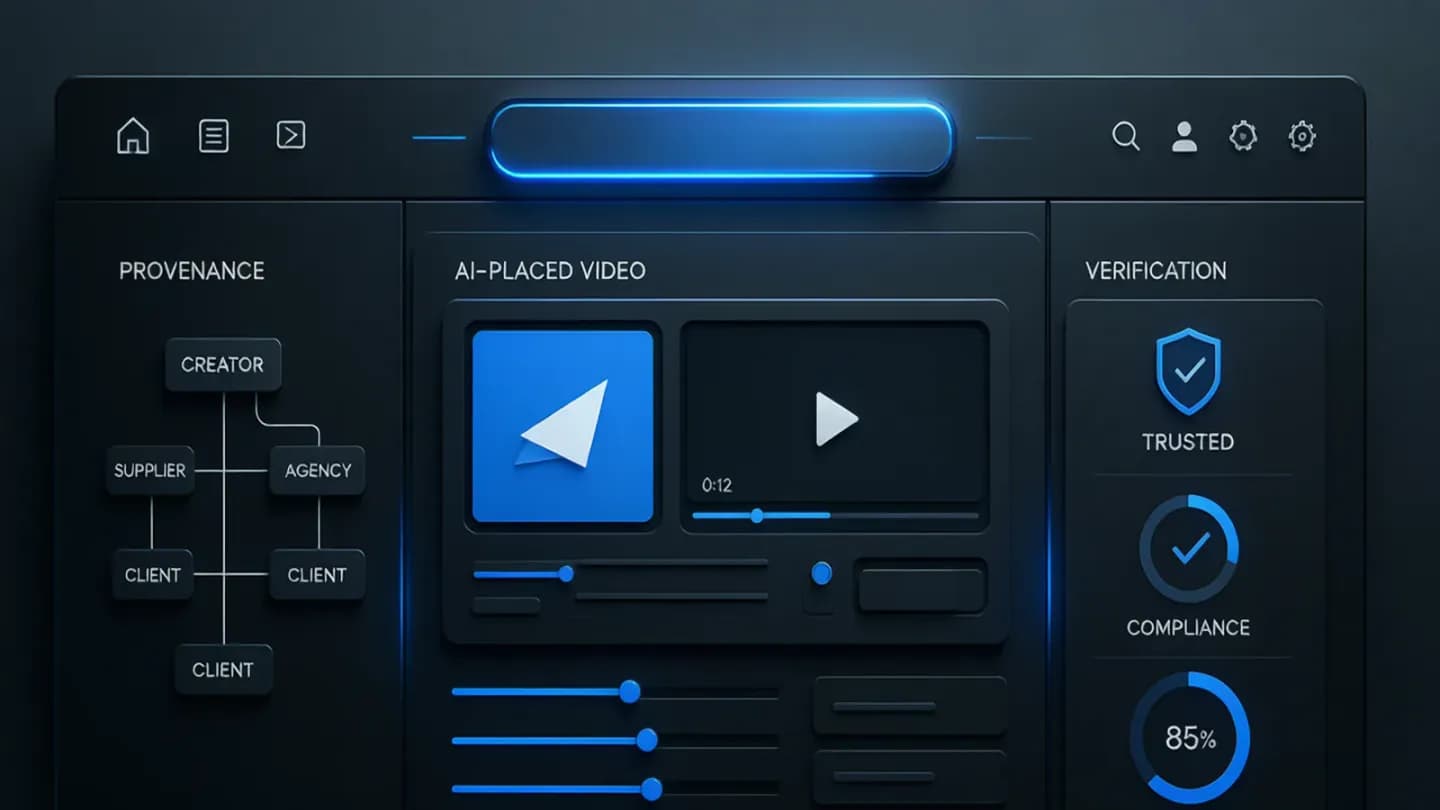
Before any agent touches live budget, stand up a {{link}} that checks provenance, platform disclosure, and aesthetic trust on the creative the agent selects and places, since the bot inherits every compliance obligation a human buyer would carry.
Close the loop with measurement and a named owner. Route agent-placed spend into the same incrementality and creative-fatigue review you already run on human buys, cap iteration so cost stays visible, and keep a person accountable for the result. A practical first step is a 90-day scoped pilot on one channel where the agent may only propose, never execute, until its recommendations beat the human baseline often enough to earn autonomy. If the pilot shows the agent consistently wastes spend or skips a disclosure, tighten the guardrails before expanding, because autonomy without proof is just faster waste.
Before any agent touches live budget, stand up a AI video trust QC gate that checks provenance, platform disclosure, and aesthetic trust on the creative the agent selects and places, since the bot inherits every compliance obligation a human buyer would carry.
Put the framework into production
These related pages connect the article’s planning advice to a specific commercial scope.
References
- 2026 IAB Digital Video Ad Spend & Strategy Report: Part OneIAB
US digital video ad spend will surpass $80B in 2026, growing ~11% YoY and ~20% faster than total ad market; two-thirds of digital-video buyers are live (21%), testing (20%), or planning (25%) agentic AI for video, with another 28% investigating; targeting overtook content quality as the top TV/video buy criterion (+~10pts YoY); small spenders use agentic AI for creative testing/pre-planning/performance analysis while large spenders use it for inventory discovery/evaluation.
- 2026 benchmark study: Marketing's AI inflection pointEpsilon
100% of surveyed marketers use AI; 71% primarily for productivity and efficiency while only 9% use it for revenue generation; 46% measure AI performance by revenue gains; 45% cite data quality as their top technical challenge.
- Video Marketing Statistics 2026: ROI, Short-Form, AI & Conversion DataLoopex Digital
AI-driven video marketing shows an 82% ROI increase versus traditional workflows and 96% of marketers report positive ROI from AI-powered video, supporting the case that AI helps video performance when aimed at the right lever.