AI animation in 2026 split along two seams, not one
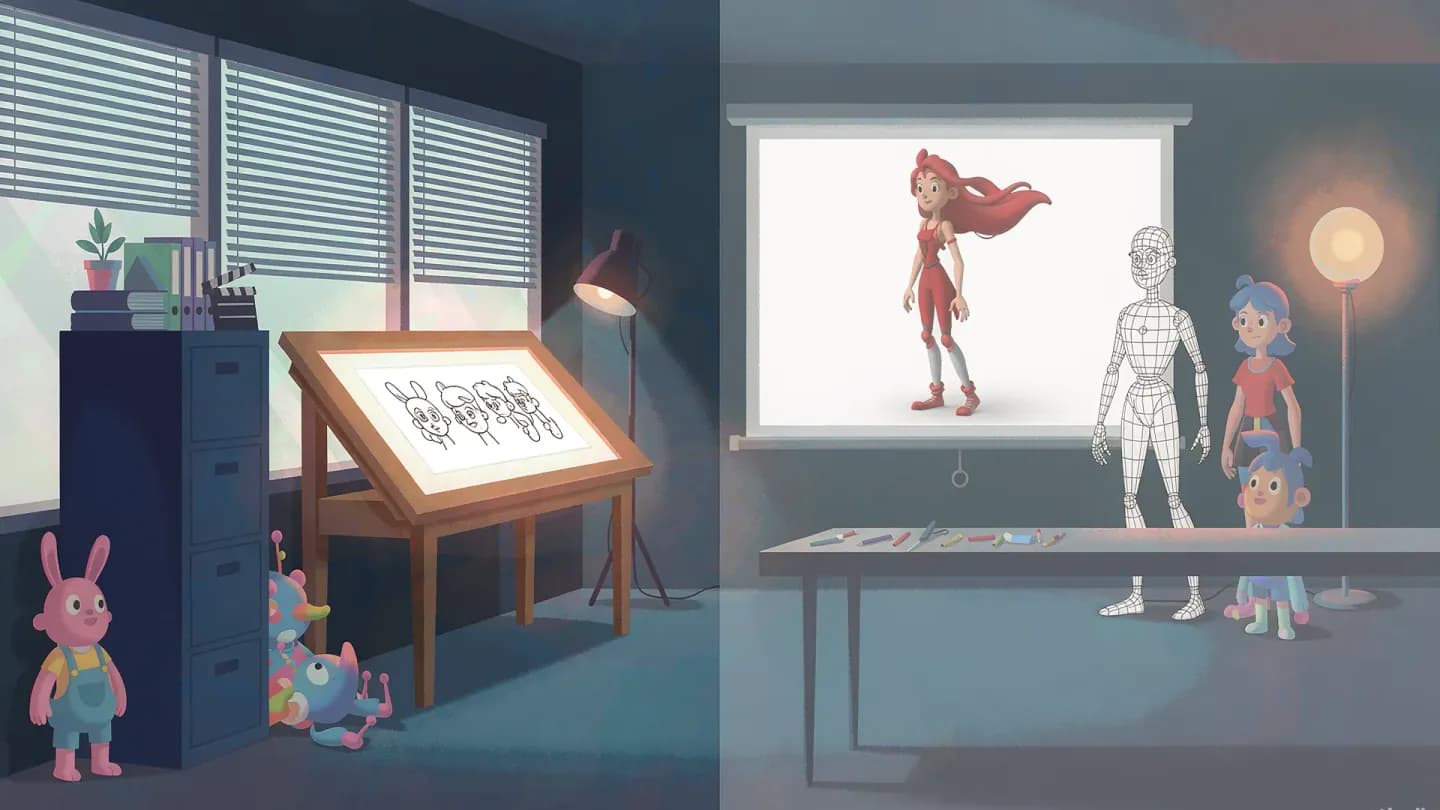
AI animation did not arrive as one technology in 2026. It arrived twice, at opposite ends of the pipeline. In 2D, generative models absorbed the process around the drawing, the in-betweens, the cleanup, the flat colour, while the drawing itself stayed human. In 3D, the models absorbed the asset itself: the mesh, the texture, the rig. That split decides which teams feel the change first, and what a brand should actually buy.
The numbers behind the split are not new, but 2026 is the year they land. The Animation Guild entry for the Future Unscripted study, commissioned from CVL Economics after surveying 300 entertainment executives, put the projection at about 21.4% of film, television and animation jobs in the United States, roughly 118,500 roles, having enough tasks consolidated, replaced or eliminated by generative AI to count as disrupted by 2026. Three-quarters of the executives surveyed said the technology had already supported the elimination, reduction or consolidation of jobs inside their own division.
What matters for commercial work is where that disruption sits. It is not spread evenly, and it is not the same job in 2D as in 3D. Reading the two seams together is the only way to price an animated deliverable honestly in 2026.
In 2D, AI absorbed the process, not the drawing
The clearest evidence comes from a six-person studio in Nagoya. K&K Design placed two drawings into the model, one at the start of a movement and one at the end, and let generative AI build the poses in between. The studio's design director described work that would otherwise take an animator a week to ten days being finished in about four or five hours, with animators then fixing the rough parts and smoothing the movement by hand.
That is the 2D shape of the change. Key poses, timing, acting and the final look stay with the animator. What gets absorbed is the volume labour that used to fill the space between those decisions: in-between frames, line cleanup, flat colour. It is the entry tier of the craft, the layer where juniors historically learned to draw on model, and it is the layer a generation tool replaces most cleanly.
For a brand this reads as a cheaper and faster path to animated output, which is mostly true. It also reads as a thinner apprenticeship pipeline, which is a problem the buyer inherits later, when nobody left on the team can hold a character on model by eye without a reference set in front of them.
The part that does not move is judgement. A model will fill a gap between two drawings; it will not decide that the gap should be there at all, or that the hold is one frame too long for the beat. Losing that layer is cheap this quarter and expensive in three years.
In 3D, AI absorbed the product, a blunter problem
3D behaves differently, because the deliverable and the tool overlap. A 2D animator's output is a performance. A 3D modeller's output is an object, and an object is exactly what a generator can now produce directly. When the thing you sell is the asset, generation does not speed up your job. It competes with it.
The tooling map in 2026 shows where the investment went. Vendors spent the year wiring generative steps into the existing 3D pipeline rather than replacing it. Motion generation and character or object creation were productised into mainstream animation software updates, and one 3D software maker framed its whole 2026 direction around a hybrid approach that plugs generative workflows into traditional production, including image-to-3D and hardware-accelerated rendering, explicitly to cut friction between an idea and a usable asset. Studios that could not build that depth bought it instead: an established 3D house expanded production capacity through a partnership rather than through headcount.
The task-level data points the same way. Among the executives who expected generative AI to be effective inside their pipeline, the single most commonly named capability was generating 3D assets, cited by just under half of respondents, ahead of sound design, dubbing and music masters.
The asymmetry is the practical point. AI compresses 2D by removing the steps between human decisions. It compresses 3D by removing the object decisions a human used to make.
The production answer: 3D previz as the control layer
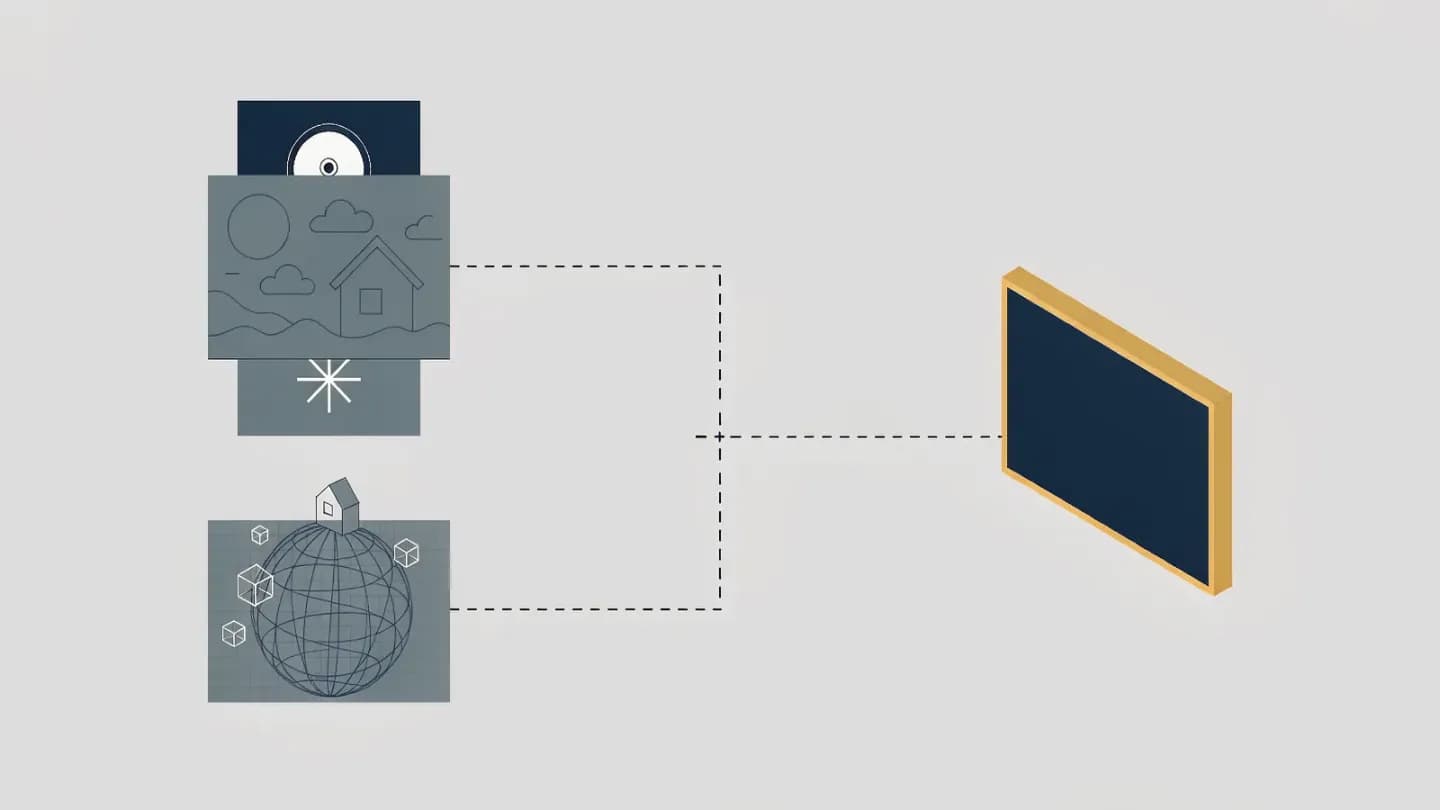
Prompt-only generation keeps failing on the things animation cares about: consistent geometry, repeatable camera movement, exact placement of a product or a prop across shots. Teams shipping animation at any volume have stopped treating the prompt as the control surface. They block the scene in 3D first, fixing the camera path, the staging, the timing and the position of the object, then hand the model a structure to render instead of a paragraph to interpret.
This is the same instinct that made pre-production the fastest-moving part of the 2026 AI video workflow. The {{link}} argument applies directly here: moving work earlier is what makes the expensive decisions reversible.
Once the scene is blocked, {{link}} carries the rest of the weight, because the shot list rather than the adjectives is what the model has to obey.
That is why the control layer, not the engine, is the differentiator in 2026. Two teams can license the same model and get very different output, because one arrives with a locked 3D scene and the other arrives with a description of one.
It also changes what a studio is buying. A 3D block-out library and an identity lock are reusable assets. A model subscription is not, which is why the teams with the deepest pipelines are the least worried about which engine wins the next release cycle.
The AI video pre-production argument applies directly here: moving work earlier is what makes the expensive decisions reversible.
Once the scene is blocked, camera control in AI video carries the rest of the weight, because the shot list rather than the adjectives is what the model has to obey.

The commercial blocker is rights, not render quality
Render quality stopped being the objection some time ago. Rights are the live problem. Studios cannot put generated frames into a commercial pipeline when the model cannot account for what it was trained on, because the exposure lands on the finished work, including whether it can be distributed at all.
That is not hypothetical. The U.S. Copyright Office has published its report on copyright and artificial intelligence in parts: Part 2, released in January 2025, addresses the copyrightability of outputs created using generative AI, and Part 3, released in pre-publication form in May 2025, addresses how training data is handled. Both questions sit directly under an animated deliverable. If an asset's provenance is unclear, the brand carries the risk, not the vendor.
The practical consequence for a buyer is a shorter list of acceptable inputs. Studios working from their own cleared reference material can move quickly. Teams pulling from general-purpose models inherit a question their legal review cannot close in a campaign timeline, and the answer is often to rebuild the shot rather than argue about it.
This is also why the animation side of the market is moving slower than the tooling suggests. The tools exist. The paperwork does not.

What brand teams should change about animated video in 2026
Animated video is now the cheapest format to test and one of the harder ones to keep on model, and that combination should change how the format is scoped, not just how much of it gets made.
The {{link}} question is worth answering before an animation budget is approved, because some jobs are won by animation and others are only made cheaper by it.
Cost comparisons also need an honest finish line, since the {{link}} arithmetic only holds when the human pass is priced in.
Three checks matter before an animated deliverable ships. First, is identity held by the pipeline rather than the prompt, through a reference set, a 3D block-out or an approved character sheet that survives a model switch? Second, can the team state what the model was trained on, or is the honest answer that nobody knows? Third, is a human continuity pass budgeted, because generated motion is where the errors survive the render and reach the audience intact.
None of this argues against animation. It argues for buying the pipeline and the rights record rather than renting a model and hoping the frame holds.
The AI video content-type fit question is worth answering before an animation budget is approved, because some jobs are won by animation and others are only made cheaper by it.
Cost comparisons also need an honest finish line, since the AI versus traditional video production arithmetic only holds when the human pass is priced in.
Put the framework into production
These related pages connect the article’s planning advice to a specific commercial scope.
References
- The Animation Guild on generative AI and entertainment industry jobsThe Animation Guild, IATSE Local 839
The Future Unscripted study, commissioned from CVL Economics and based on a survey of 300 entertainment executives, projected that about 21.4% of film, television and animation jobs in the U.S., roughly 118,500 roles, would have enough tasks consolidated, replaced or eliminated by generative AI to count as disrupted by 2026, and 75% of respondents said GenAI had already supported job elimination, reduction or consolidation in their division.
- How A Japanese Studio Is Embracing AI In Its Anime Production PipelineCartoon Brew
K&K Design in Nagoya needs only two drawings per shot, one at the start and one at the end of a movement, and its generative AI fills the poses between them; work the studio said would take an animator a week to ten days is completed in about four or five hours, after which animators fix the rough parts by hand.
- 3D Animation Services MarketPW Consulting
In April 2026 Autodesk released AI features pairing motion generation with 3D character and object creation across its core animation software, Reallusion framed its 2026 direction around a hybrid AI approach that plugs generative workflows into traditional 3D production including image-to-3D and hardware-accelerated rendering, and in February 2026 Mainframe Studios partnered with Cookbook Media to expand 3D animation production capacity.
- Copyright and Artificial IntelligenceU.S. Copyright Office
The Office is publishing its copyright and artificial intelligence report in parts, with Part 2 covering the copyrightability of outputs created using generative AI and Part 3 covering generative AI training, both of which bear directly on whether a generated asset can be protected and used commercially.