
The AI Campaign Optimization Gap: 70% Want It, 17% Use It
AI campaign optimization is the one AI use case almost every marketing leader says they need, yet almost no team has operationalized. A 2026 survey of more than 400 marketers found that 70% named optimizing marketing spend a top short-term priority, but only 17% actually use AI to analyze and fine-tune live campaigns. The ambition is universal; the activation is rare.
That 17% figure is the lowest adoption rate across every AI marketing use case the study measured. Content generation led at 38% and workflow automation at 27%, but the discipline that most directly protects budget — using AI to surface winning campaigns and retire losing ones — trails far behind. For video and ad production teams shipping more creative than ever, the disconnect is expensive: every extra asset still gets optimized by hand, even after the team has paid for an AI stack. The result is a strange inversion — teams own the most powerful optimization tooling in marketing history and still apply it to the least leveraged part of the workflow. When creative volume is rising and each asset compounds the optimization burden, that manual step does not shrink — it grows in proportion to output.

Why the Gap Isn't a Model Problem
The bottleneck is not that the models are weak. It is that the supporting data and operating layer are missing. The same study points to three barriers: 38% of marketers cite a talent shortage, 30% say their technical stack cannot support AI workloads, and 27% are unclear about the ROI AI can deliver in their context. Each is an activation problem, not an algorithm problem — the model is ready long before the organization is. Worse, the gap is self-reinforcing: without a working optimization loop, teams never generate the performance data that would make the next model better. Every quarter spent optimizing by instinct instead of by signal widens the distance between what the tool promises and what the team can prove.
Epsilon's 2026 benchmark reinforces the pattern. It finds 100% of surveyed marketers now use AI, yet 45% name data quality — incomplete or inconsistent inputs — as their top challenge. An optimization model is only as good as the signals fed to it, so teams sitting on fragmented data cannot activate AI after they buy the tool — a failure mode the industry now tracks as {{link}}.
An optimization model is only as good as the signals fed to it, so teams sitting on fragmented data cannot activate AI after they buy the tool — a failure mode the industry now tracks as the AI proof gap.

Maturity Is Wide but Not Deep
BCG's 2026 survey of 300 global CMOs shows the same pattern at the leadership level. Ninety-six percent say AI is driving end-to-end transformation of their function, yet 42% admit they still use generative AI only as an assistant for discrete tasks, and just 8% run campaigns where multiple agents operate autonomously. The headline adoption number hides how little has actually changed in day-to-day execution. CMOs have the mandate and the budget; what they lack is the connective tissue between a model and a live campaign. A model that cannot read yesterday's results cannot tune tomorrow's spend, no matter how advanced its architecture looks on a vendor slide.
That gap between stated transformation and real deployment is the story of 2026. Forty-three percent of CMOs now report AI investment above $15 million, and 94% feel heightened CEO expectations — but spending does not equal operating infrastructure. The teams pulling ahead are not buying more tools; they are building the data foundations, brand intelligence, and orchestration layers that let AI act on performance in real time instead of waiting for a weekly report. The laggards have the dashboards; they just cannot make them move the budget. That is the real definition of the 2026 maturity gap: not who bought AI, but who wired it into the decision that controls the money.
What Video and Ad Teams Can Do to Close the Activation Gap
Start by building {{link}} that turns raw campaign signals into decision-ready inputs the optimization model can trust. For video teams this means tagging creative, placement, and audience data to a common schema before any AI tuning begins, so the system optimizes against consistent truth rather than scattered exports. Without that layer, even a strong model spends its time reconciling formats instead of finding wins. A common schema also means the same optimization logic can be reused across campaigns, so the second flight is smarter than the first — the compounding effect that separated leaders from followers in every 2026 benchmark.
Then connect optimization outputs to spend decisions through {{link}} so finance sees the causal link between AI tuning and efficiency. The goal is a closed loop: AI proposes a bid or budget shift, the team validates it against a known baseline, and the result feeds the next cycle. That discipline converts optimization from a dashboard curiosity into a budget lever the whole organization can defend. It also answers the 27% of marketers who said they were unclear about AI's ROI: when every suggested change is tied to a measured baseline, the value stops being a belief and becomes a number.
Start by building a measurement and verification layer that turns raw campaign signals into decision-ready inputs the optimization model can trust.
Then connect optimization outputs to spend decisions through a defensible budget-proofing process so finance sees the causal link between AI tuning and efficiency.
Agentic Buying Is Moving Faster Than Optimization
The contrast is stark — even as campaign optimization stalls, {{link}} has already reached the buy side, with most digital-video buyers piloting or running autonomous purchasing. IAB's 2026 video report finds nearly all buyers see a role for agentic AI, and two-thirds are live, testing, or planning it. Buying was always more measurable than creative, which is why machines got there first and optimization is still catching up. The lesson for creative and optimization teams is that measurability, not model quality, is what earns automation trust — the parts of the workflow with clean feedback loops get automated first.
The same IAB report notes advertisers still want more proof of performance and easier workflow integration before they trust generative creative at scale. So the industry is automating the parts it can measure and hesitating on the parts it cannot. Optimization sits squarely in the hesitant middle: high potential, low activation, because the feedback loop between creative, spend, and outcome is still manual for most teams shipping video. Until that loop is wired, AI suggestions arrive as opinions the buyer must still defend by hand. And opinions do not scale — which is why the teams with the most creative output are often the ones with the least automated optimization.
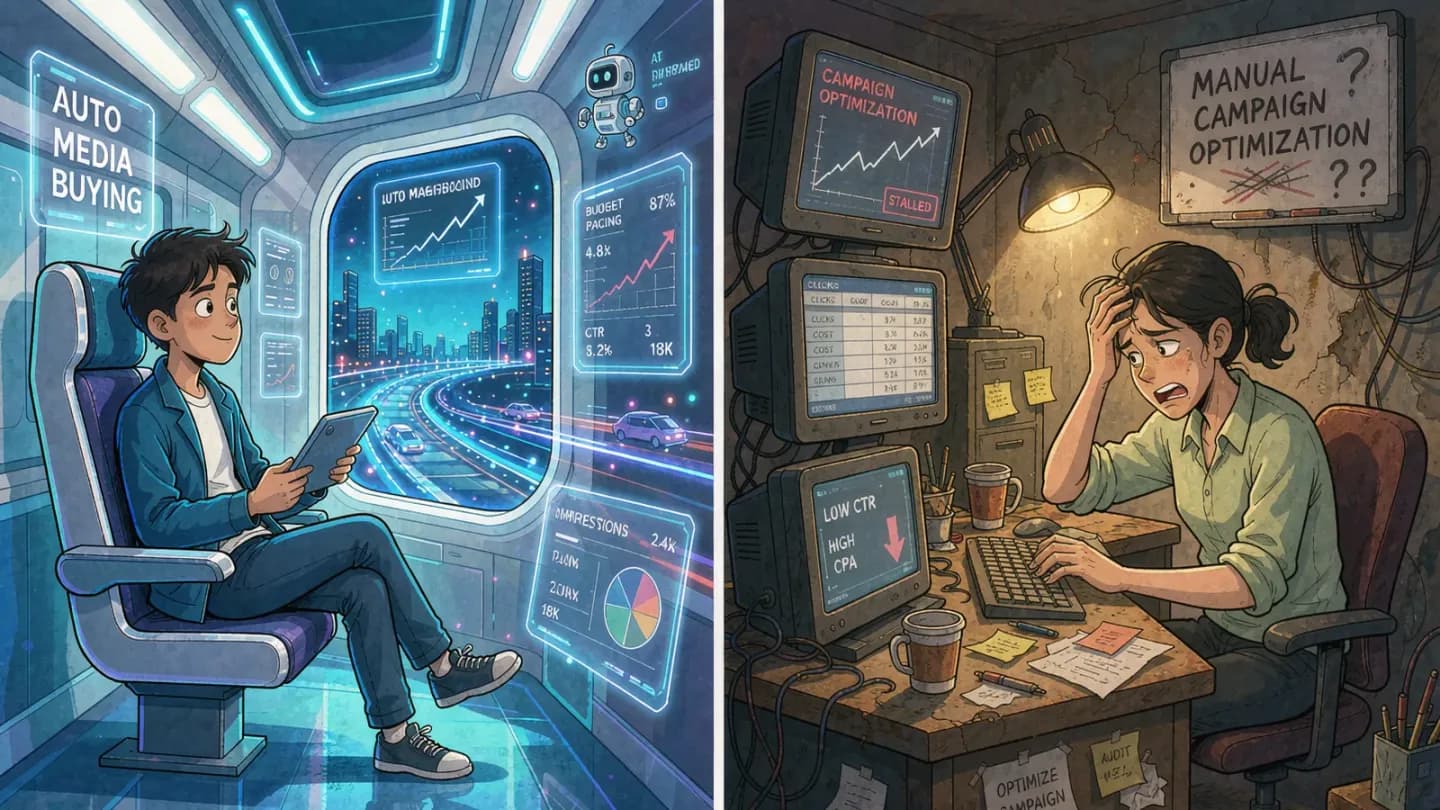
The contrast is stark — even as campaign optimization stalls, agentic AI in video media buying has already reached the buy side, with most digital-video buyers piloting or running autonomous purchasing.
The 2026 Priority: From Pilots to Operating Infrastructure
Closing the activation gap is how teams escape {{link}}, where AI adoption climbs while reported return flattens. The fix is not another pilot. It is the unglamorous work of unifying data, defining who owns the optimization decision, and setting a hard iteration cap so generation and tuning do not run forever without a human sign-off on the budget. That ownership question matters more than the tooling: the 8% of CMOs running autonomous campaigns did not get there by buying more software, they got there by naming who decides.
The 2026 data frames the shift plainly: the bottleneck is ability, not willingness. Teams that move from isolated AI experiments to an end-to-end data architecture — one that activates insight the moment performance moves — will be the ones whose AI spend actually shows up in ROAS. Everyone else will keep generating more creative and optimizing it by hand, wondering why the stack never paid for itself. Optimization is the rare AI use case where the upside is immediate and the barrier is internal, which is exactly why closing the gap is the highest-leverage move a video or ad team can make this year. The teams that treat it as plumbing rather than magic will be the ones still standing when the next model wave arrives and the advantage resets again.
Closing the activation gap is how teams escape the 2026 ROI reversal, where AI adoption climbs while reported return flattens.
Put the framework into production
These related pages connect the article’s planning advice to a specific commercial scope.
References
- Supermetrics 2026 Marketing Data ReportSupermetrics / TechEdge AI
Only 17% of 400+ marketers use AI for campaign optimization while 70% prioritize optimizing spend; top barriers are talent shortage (38%), infrastructure gaps (30%), and unclear ROI (27%).
- 2026 Benchmark Study: Marketing's AI Inflection PointEpsilon
100% of 250+ marketers use AI, but 71% use it mainly for productivity and only 9% for revenue, while 45% cite data quality as their top challenge.
- Moving the Agentic Marketing Transformation from Illusion to RealityBoston Consulting Group
BCG's 2026 survey of 300 CMOs: 96% say AI drives end-to-end transformation, 42% use GenAI only as an assistant, and just 8% run autonomous multi-agent campaigns.
- 2026 IAB Digital Video Ad Spend & Strategy ReportIAB
US digital video ad spend surpasses $80B in 2026; nearly all buyers see a role for agentic AI, with two-thirds live, testing, or planning it, though governance consensus is lacking.