
AI newsroom production is already live: the audience moved first
AI newsroom production is no longer a pilot. At IBC 2026 in Amsterdam, vendors demonstrated AI agents running an entire broadcast chain inside one system, from incoming wire copy through graphics and prompter script to a live gallery. That matters well beyond journalism. Newsrooms are the first place generative video met a deadline it could not miss, and the constraints they solved are the ones brand video teams are about to hit.
The demand side moved first. The Reuters Institute's Digital News Report 2026, drawn from 97,520 respondents across 48 markets, found that 77% of people now watch online news video in a typical week, the first year a majority did so in every market surveyed. In 45 of those 48 markets, more people watch online news video than watch broadcast television news.
Distribution moved away from the publishers at the same time. Social media and video networks reached 54% as a source of news, overtaking television news at 52% and publishers' own sites and apps at 51% for the first time in the series. Watching news video on a publisher's own site or app fell to 23%, down five points year on year, even as consumption of news video overall kept rising.
The trust numbers moved the other way. Overall trust in news fell to 37%, the lowest level the report has recorded, and 42% of respondents say they sometimes or often avoid news. That combination is the real brief for anyone producing video at scale in 2026: more appetite for the format, less patience for the institution behind it.
The full broadcast chain now runs as one system
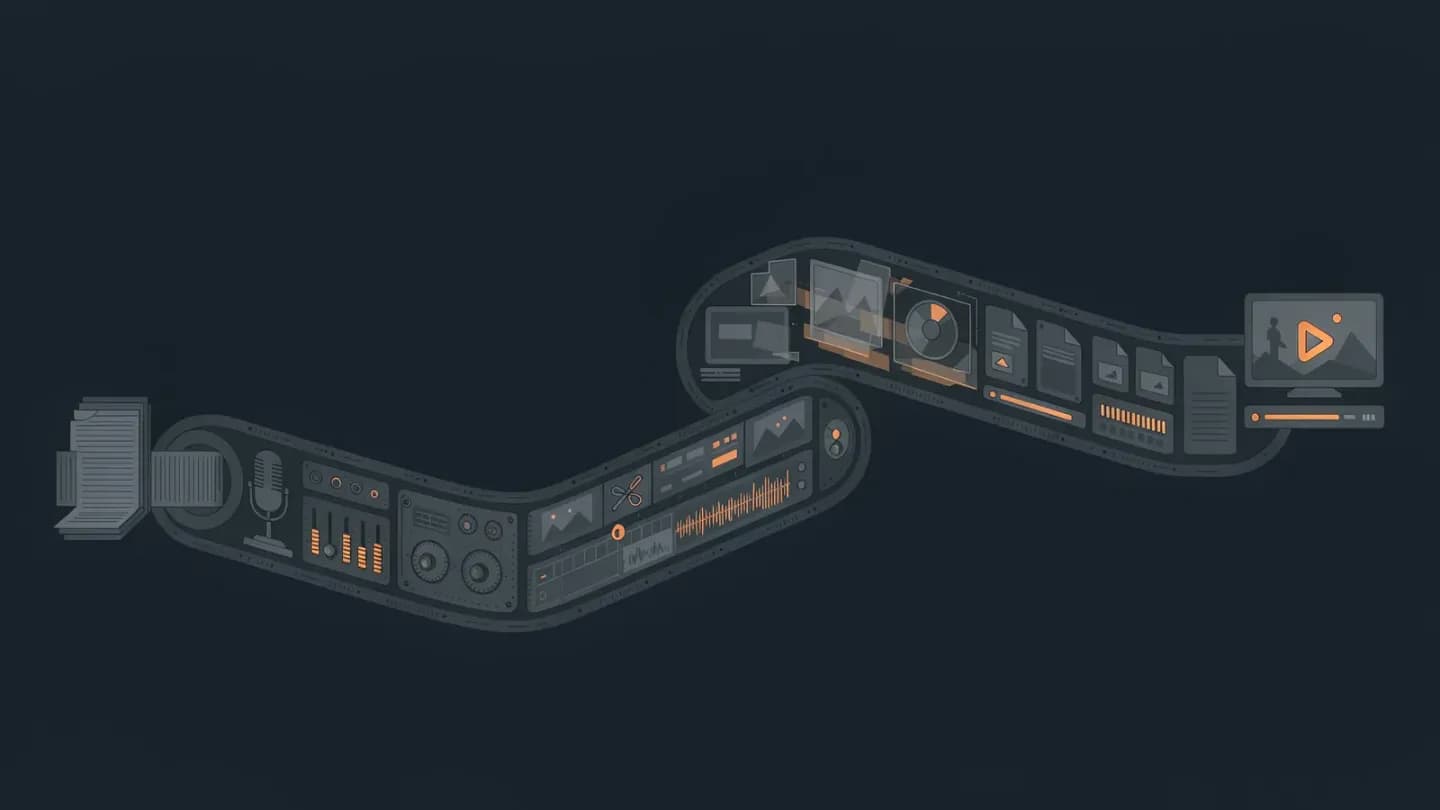
nxtedition used IBC 2026 to show AI agents working an entire production chain inside a single system. Content arrives from partner Reuters. An agent develops the story, pulls the relevant video out of the media store, populates and applies graphics templates to that video, and assembles a running script complete with prompter text, VTs and graphics. The show is recorded in the studio and runs in the gallery.
The detail that matters is what does not happen. Nothing is exported to another product at any stage. No media is re-linked after a round trip through an editing application, no graphics file is re-imported, no running order is rebuilt by hand in a second tool. In a conventional newsroom those transfers are where the time goes, and they are also where the errors accumulate.
That is the same reason production pipelines in advertising slow down. Every additional system in the chain adds a hand-off, and every hand-off adds a queue, a conversion and a fresh chance for the approved version to stop being the approved version. The {{link}} argument is that owning the pipeline, not renting it, is what sets how fast a team can move.
The AI video production in-housing argument is that owning the pipeline, not renting it, is what sets how fast a team can move.
An agent is only as capable as the pipeline you own
nxtedition's creative director, Adam Leah, puts the constraint in one line. "AI needs a body," he said. "A model on its own can write you a paragraph. It can't cut a VT, fill a graphic, build a running order or drive a gallery. We own the whole of our back end, so we can give the AI a body to work within. Everyone else needs a vendor just to connect their other vendors before the AI can touch anything at all."
The back end in question is not abstract: storage, compute, transcode, the newsroom system, media and production asset management, rundowns, gallery control and publishing. The vendor's own summary is the honest version of the claim, that an agent is only as capable as the tools it can use. Hand a model a text box and it writes paragraphs. Hand it the media store, the transcoder and the rundown and it can assemble a show.
The same approach is already carrying live news. Collective Newsroom's production operation for BBC India, built with the BBC and nxtedition, runs nine languages with transcription and translation processed on the broadcaster's own hardware, and was a finalist in the Content Creation category of the IBC2026 Innovation Awards. Live transcription subtitles and tags content as it is ingested, flags sections for automatic clipping, and shortens the delay between something happening and that material becoming usable somewhere else.
What makes that possible is worth naming: on-premises GPUs, no per-query cost, and nothing leaving the building. The {{link}} does not disappear when the models improve, because it sits in the stack rather than in the model.
The render queue bottleneck does not disappear when the models improve, because it sits in the stack rather than in the model.

Editorial control has to be structural, not a policy
Both vendors were careful to describe automation as the removal of mechanical work rather than the removal of judgement. At nxtedition, the AI proposes angles, new stories and breaking news to journalists in the newsroom; journalists and the director review and edit every script and every video before it goes anywhere. The company's framing is exact: the goal is removing the mechanical steps between editorial decisions, not automating the decisions themselves.
Leah's second point is the one brand teams will find harder. "The worry about AI in a newsroom isn't only accuracy," he said. "It's transparency, so that everyone can see what it did. Every step it takes shows up in the story-centric planning and rundown, so a journalist, producer and director can change it or throw it away. The system doing the work is the same one showing its steps, not some safeguard bolted on afterwards."
x-dream-media describes the same division of labour from the other direction. The company says its Social First workflow puts AI-assisted research, metadata enrichment, cross-media adaptation, translation, transcription and optical character recognition into one newsroom environment, alongside conversational archive search, AI-generated editorial summaries and AI-supported story structuring that proposes arcs from selected footage and text. The integrations include Avid Media Composer and Adobe Premiere.
Editorial staff keep judgement, creative decisions and final approval. "Social is increasingly where the audience journey begins, but the content still needs to work across the entire media ecosystem," said managing director Stefan Pfütze. The {{link}} applies directly here, because what gets validated is the handover between two systems rather than either system alone.
The stack-validation finding applies directly here, because what gets validated is the handover between two systems rather than either system alone.
The disclosure record is the next piece of the pipeline
Reuters Institute data shows why this layer is not optional. 62% of respondents worry about telling real news from fake, and trust in news delivered by AI chatbots sits at 20%. When a synthetic voice, a re-created frame or an AI-assembled cut reaches an audience that is already sceptical, the question is no longer whether the work is good. It is whether anyone can show where it came from.
The C2PA, the coalition behind Content Credentials, describes its standard as a way for publishers, creators and consumers to establish the origin and edits of digital content, and likens it to a nutrition label for a file. Attach that record when the asset is generated rather than when it is distributed and the clip carries its own history: what produced it, what was altered afterwards, and who signed it off.
For a commercial team this is the difference between a clip and a deliverable. A provenance record is cheap to create at the point of generation and close to impossible to reconstruct six months later, when a client asks who approved the version that actually ran.
Regulation is arriving on the same axis. Under the EU's AI Act, providers of generative AI have to ensure that AI-generated content is identifiable, and certain outputs, deep fakes among them, should be clearly and visibly labelled, with the transparency rules taking effect in August 2026. A signed asset record answers that requirement at the file level rather than in a caption.

What brand video teams should take from the newsroom
Three things transfer, and none of them require a newsroom. First, the chain matters more than the model: the value came from wiring the media store, the transcoder, the rundown and the gallery to the same agent, not from a better generator. Second, control has to live inside the workflow, because an approval step that sits in a separate system from the production step will be skipped under deadline. Third, the record has to be produced by the system that does the work.
The uncomfortable implication is that the newsroom did not get here by buying better tools. It got here because it owned its infrastructure and could therefore give automation somewhere to act. A brand team running four subscriptions and a shared drive is not held back by model quality. It is held back by the number of manual transfers between the things it already pays for.
The {{link}} is the reason to start with the pipeline and not with the subscription. Audit the hand-offs first, decide which of them a system could own end to end, and only then choose what generates the pixels. The newsroom ran that order in reverse and paid for it with a decade of lost audience. Commercial teams have the advantage of watching the result.
The capability gap this research keeps measuring is the reason to start with the pipeline and not with the subscription.
Put the framework into production
These related pages connect the article’s planning advice to a specific commercial scope.
References
- From broadcast news to streaming and platforms: The changing landscape of news videoReuters Institute for the Study of Journalism
77% of respondents across 48 markets watch online news video weekly; in 45 of 48 markets more people watch online news video than broadcast television news; consumption of news video on publishers' own websites and apps fell to 23%, down five points year on year.
- nxtedition takes agentic AI from newswire to gallery at IBC2026nxtedition
AI agents run the entire production chain inside one system, from Reuters wire copy through story development, video retrieval and graphics to a running script and gallery, with nothing exported to another product; "AI needs a body"; the agents' tools are storage, compute, transcode, the newsroom system, asset management, rundowns, gallery control and publishing; Collective Newsroom's BBC India operation runs nine languages on the broadcaster's own hardware and was an IBC2026 Innovation Awards finalist.
- Regulatory framework for AIEuropean Commission, Directorate-General for Communications Networks, Content and Technology
Providers of generative AI have to ensure that AI-generated content is identifiable; certain AI-generated content should be clearly and visibly labelled, namely deep fakes and text published to inform the public on matters of public interest; and the transparency rules of the AI Act will come into effect in August 2026.
- C2PA: Verifying Media Content SourcesCoalition for Content Provenance and Authenticity
The C2PA provides an open technical standard, called Content Credentials, for publishers, creators and consumers to establish the origin and edits of digital content, and describes it as functioning like a nutrition label for digital content.