
What the California AI Transparency Act requires
The California AI Transparency Act, operative since August 2, 2026, changes the compliance math for any team shipping AI-generated video into the US market. The law targets scale rather than intent: a covered provider is any generative-AI system with more than one million monthly California users that is publicly accessible in the state. For a commercial video team, 'in scope' is not about whether you meant to comply - it is about which model generated the frames.
The statute, codified at Cal. Bus. & Prof. Code §§ 22757 through 22757.6, imposes three obligations on those providers. First, they must offer a free, public AI detection tool that anyone can use to check whether their system created or altered a piece of content. Second, they must give users the option of a visible manifest disclosure. Third, and most important for commercial work, they must embed a latent, machine-readable disclosure inside every AI-generated image, video, or audio file they produce.
The latent-disclosure mandate is the provision that reaches your workflow. It must carry the provider's name, the generative system's name and version, the creation timestamp, and a unique identifier. It must be detectable by the provider's own detection tool and consistent with widely accepted industry standards such as C2PA content credentials. Enforcement is civil, brought by the Attorney General, a city attorney, or county counsel, at up to $5,000 per violation for each day a provider remains out of compliance.

Why latent disclosure beats an on-screen label
A manifest disclosure is the visible 'AI-generated' badge a viewer can see on the creative. A latent disclosure is the invisible metadata beneath it - embedded in the file itself, written to be permanent or extraordinarily hard to strip out. The Act makes the latent layer mandatory and the visible label merely optional, which tells you exactly where the real enforcement weight sits.
For commercial teams, that distinction is operational, not cosmetic. A visible watermark can be cropped, blurred, screenshotted, or simply covered by a platform UI; a C2PA-style content credential lives inside the encoded file, so it survives re-uploads, platform transcodes, aspect-ratio reframes, and the format conversions that would destroy any overlay. Detection tools read the latent layer, not the pixels, which means the disclosure keeps working after the asset has been cut, dubbed, and redistributed across a dozen channels.
This is why the provenance step belongs in production rather than in a publishing checklist. Once the latent record is embedded at the source, every downstream derivative carries the same provenance chain; if you wait until launch to think about disclosure, you are asking a media library to reconstruct history it never recorded, and the result is a file no detection tool can trust.

The platform detection layer is now live
The detection tool is the Act's enforcement hinge. Covered providers must ship a free, public checker that accepts either a file upload or a URL and reports whether their system created or altered the content, surfacing any system provenance data it finds while never exposing personal provenance. Google already embeds machine-readable SynthID and C2PA signals in its own AI outputs, and a {{link}} shows platforms are turning detection into a serving-time control rather than a post-hoc audit.
Large online platforms receive the next deadline. Starting January 1, 2027, they must disclose and allow inspection of provenance data for AI-generated content they distribute. In practice, that means the video you ship into California can be inspected for provenance whether or not you ever placed a visible label on it - the file itself becomes the thing regulators and platforms examine, not the creative brief behind it.
Capture-device manufacturers get a later milestone: from January 1, 2028, they must provide an option for latent disclosures in captured content. The phased schedule gives teams time, but the direction is unambiguous - provenance inspection moves from a nice-to-have to a standing capability across the entire content supply chain, from camera to feed.
Google already embeds machine-readable SynthID and C2PA signals in its own AI outputs, and a platform AI-labeling rules shows platforms are turning detection into a serving-time control rather than a post-hoc audit.
Embedding provenance at export, not after
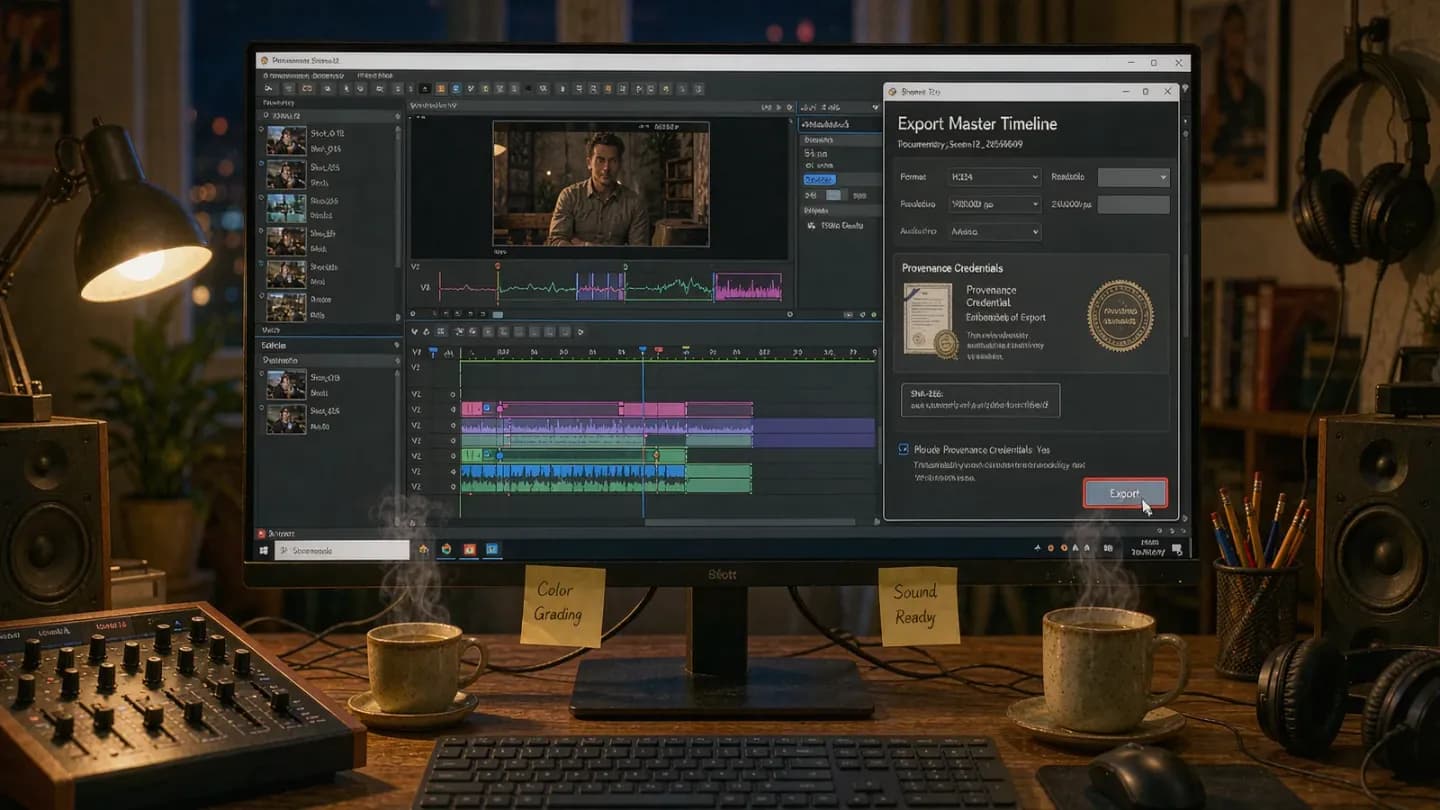
The cheapest place to satisfy the latent-disclosure rule is the moment the master file leaves your pipeline. If your generation or editing tool already emits C2PA content credentials, the disclosure is embedded before anyone touches the asset; if it does not, you are relying on a downstream step that may never run and a file that may already be in market by the time someone notices.
The export-time workflow commercial teams already run for answer-engine retrieval is now the {{link}} California's latent-disclosure rule expects. Tag the asset once, at export, and every derivative cut inherits the provenance record instead of losing it on the way to the media library. Treat the credential like a render setting, not a compliance afterthought bolted on before launch.
This is also where the licensing obligations flow through. If you license a generative engine from a covered provider, your contract already requires you to preserve its disclosure capability; stripping or disabling it is a statutory trigger that can force the provider to revoke the license within 96 hours. The safe path is to keep provenance on by default and let individual assets opt out only with a documented, reviewed reason.
The export-time workflow commercial teams already run for answer-engine retrieval is now the asset-level disclosure metadata California's latent-disclosure rule expects.
Where this collides with your disclosure and QC gates
Most teams still treat AI disclosure as a labeling checkbox owned by legal or handled automatically by the ad platform. California reframes it as a production-step property of the file itself, which means it has to be verified where the file is built, not where it is published to a campaign.
A {{link}} now has to check for embedded provenance before a cut ships, not just for creative quality or brand safety. If the latent layer is missing, the asset is non-compliant the instant a covered provider's detection tool can read it - long before any regulator sees your campaign. The QC gate that used to live at the end of the workflow now has a provenance checkpoint wired into the export step.
The practical change is small but structural: the person who exports the master becomes the person who attests the file carries its provenance. That is a different owner than the one who writes the platform disclosure, and the two checks have to agree or the campaign ships with a hole no one noticed until a detection tool flagged it.
A trust-QC gate for AI video now has to check for embedded provenance before a cut ships, not just for creative quality or brand safety.
A buy-side governance gap is opening
The Act lands inside a wider shift in how the industry treats AI creative. The {{link}} already frames provenance as a buy-side requirement that travels through the insertion order, and California just made it statutory rather than advisory. That gap is the same {{link}} where the bottleneck in AI video has moved from generation to human review and approvals.
For commercial video teams, the takeaway is less 'add a label' and more 'prove the file'. Digital video ad spend is set to surpass $80 billion in 2026, and buyers increasingly rank accountability and trust alongside reach when they allocate budget. Embedding verifiable provenance at export is the single step that satisfies the new law, the platforms, and the buy side at once - and it is far cheaper to do once at render than to retrofit across a live campaign.
The teams that treat latent disclosure as a default export setting, not a per-market exception, will be ready when the January 2027 platform-inspection deadline arrives. Everyone else will be editing provenance back into assets they already shipped, one takedown request at a time.
The IAB AI Transparency Framework already frames provenance as a buy-side requirement that travels through the insertion order, and California just made it statutory rather than advisory.
That gap is the same production bottleneck shift where the bottleneck in AI video has moved from generation to human review and approvals.
Put the framework into production
These related pages connect the article’s planning advice to a specific commercial scope.
References
- California's AI Transparency Act: What Businesses Using GenAI Need to Know NowApricity Law
Operative August 2, 2026; Cal. Bus. & Prof. Code §§ 22757-22757.6; mandatory latent disclosure carrying provider, system, timestamp, and unique ID; detectable and C2PA-consistent; $5,000 per violation per day; licensees must preserve disclosure or be revoked within 96 hours.
- C2PA Content Credentials - the open provenance standardCoalition for Content Provenance and Authenticity
Content Credentials are an open standard that records the origin and edit history of digital content as machine-readable metadata embedded in the file, the practical path to satisfying a 'widely accepted industry standard' latent disclosure.
- AI transparency in ads (Google)Google
Google embeds machine-readable metadata (SynthID and C2PA) in every image and video its own generative AI tools produce, and gives advertisers an AI-label setting across Search, YouTube, and Discover.
- 2026 IAB Digital Video Ad Spend & Strategy ReportIAB
US digital video ad spend will surpass $80 billion in 2026; nearly all buyers see a role for agentic AI but the industry lacks consensus on governance, explainability, and human oversight.