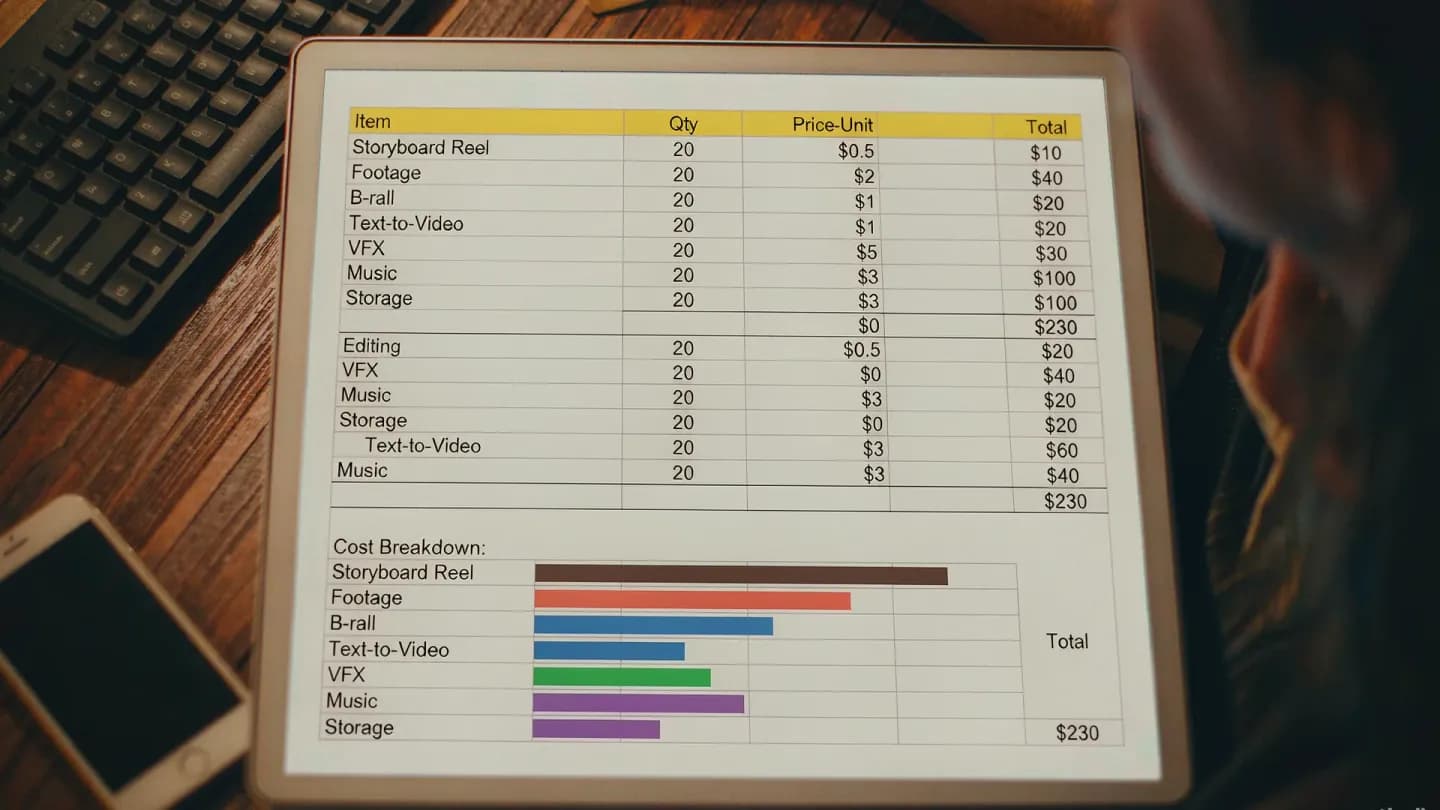
The regeneration tax no price tag shows
The single number that decides your AI video budget is cost per usable clip — total generation spend divided by the clips you actually ship. Most teams still plan by per-asset sticker price or subscription seats, which hides the regeneration tax that drives real cost.
Published {{link}} still focus on per-asset price tags, which understate what you pay once discarded generations enter the math. A 30-variant social campaign that costs $17,000 to $29,000 with a traditional crew runs $180 to $320 in AI compute, but that floor assumes every generation ships — it does not. Real production also pays for iteration: a rejected take on a shoot means a reshoot, while a rejected generation only costs compute, yet the volume of generations still adds up. The budget is clearly moving toward this model: IAB projects U.S. digital video ad spend past $80B in 2026 with AI now present in every stage of the value chain, and two-thirds of buyers are live, testing, or planning agentic AI for video. Serviceplan's CMO Barometer finds 68% of 805 marketing leaders across 15 countries call AI the defining 2026 topic, and only 12% expect agencies to lead on AI skills — so brands are building this capability in-house and need a cost model that survives contact with reality.
Published traditional vs AI video production cost tiers still focus on per-asset price tags, which understate what you pay once discarded generations enter the math.
What cost per usable clip really measures
Cost per usable clip is total compute divided by the clips you keep. You generate several takes, pick the best, discard the rest, and the rejects are not free — they are the bulk of the bill. A realistic hit rate for a well-briefed prompt on a directable model is one usable clip per two to three generations, so budget with that multiplier rather than the raw price.
The math is concrete: if a brief takes five generations on a model that follows direction poorly, your cost per usable clip is five times the sticker; a better-directed model that lands it in two tries is cheaper even at a higher per-generation rate, because the denominator is what moves the number. The wider {{link}} means most generated clips never become shippable assets, so the usable-clip denominator is what moves cost. The practical move is to generate cheaply, judge, then only spend hero-tier compute on the winner — and to treat the hit rate as a number you can improve with a tighter brief, not a fixed tax you simply pay. Teams that track this number stop celebrating low per-clip rates and start celebrating high hit rates, because the rate is irrelevant once the denominator is known.
The wider creative yield gap means most generated clips never become shippable assets, so the usable-clip denominator is what moves cost.
Draft cheap, finish expensive: the 2026 model routing
The 2026 model wave makes the routing math actually work. Alibaba's Wan 2.7 suite shipped under Apache 2.0 at about $0.10 per second and is commercially usable without a platform subscription; MiniMax H3 is open-source and built for AI-native post-production; ByteDance's Seedance 2.5 extends single shots to 30 seconds with multi-round identity locking.
On a credit-priced canvas, Veo 3.1 Lite starts at 17 credits and Wan 2.5 at 65, while full Veo 3.1 runs 112 credits for an 8-second 4K hero shot. The pattern is consistent: draft on the cheap tier, lock the shot, then generate the hero version on the top model. Directability is the hidden lever here — a model that follows a detailed brief in two tries beats a cheaper model that needs five, because the usable-clip cost is set by generations, not by the per-clip rate. A five-second social clip on Kling 2.6 Pro is about 47 credits; a finished 15 to 30 second UGC ad, counting the generations it takes to get a usable cut, typically lands at $1 to $5 in compute. Cheap drafts, expensive finishes is not penny-pinning — it is the only way the multiplier stays low. The open-weight releases matter most for high-volume teams: self-hosting Wan 2.5 removes even the 65-credit line item, turning the draft tier into a fixed infrastructure cost instead of a per-generation bill.

Sublinear scaling and the brand-block dividend
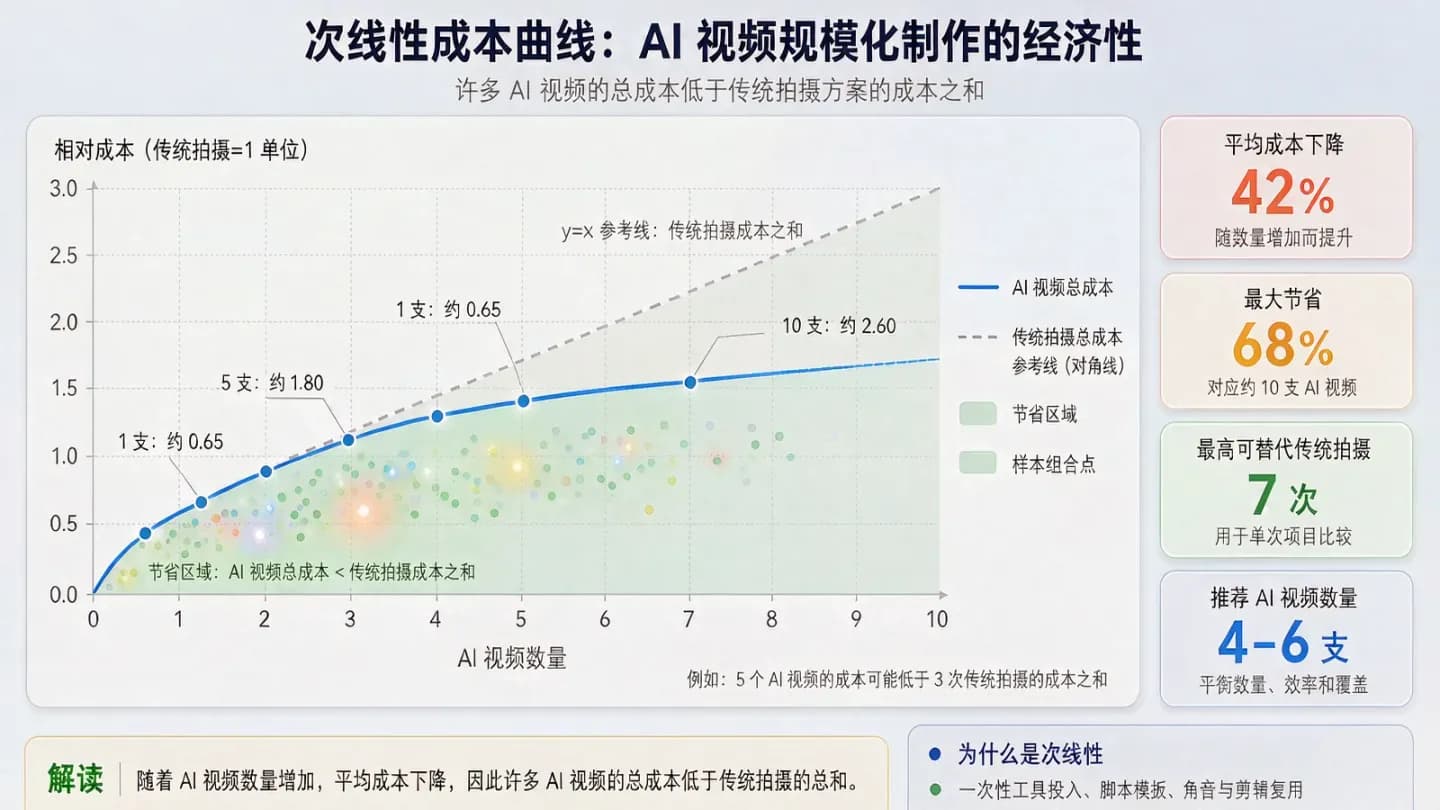
Traditional production scales linearly: ten videos cost roughly ten times one. AI-generative production scales sublinearly, because once brand elements exist, the eleventh video's marginal cost is compute plus review time rather than a new shoot. The EU AI Act (Article 50) requires machine-readable marking of AI-generated content, so provenance handling becomes a default per-clip line item rather than a manual post-production cost — and the gap widens with every variant, format, and language the campaign needs.
Localization shows the dividend most clearly: a traditional shoot needs a new crew or a dub per market, while a generated project produces multiple languages from the same source. The dividend comes from reusable brand blocks — a defined spokesperson, product, palette, and logo saved once and reused across the library so the eighth training module looks like the first. Consistency work is the single biggest cost lever in studio pricing, which is exactly why locking it early, before generation, compounds across the whole program instead of being re-solved per clip. The brands that win on cost are not the ones with the cheapest generator but the ones with the deepest reusable asset library.
How the budget risk profile changes
That shift rewrites your {{link}}: spend becomes variable and volume-driven instead of locked into crew and location. A traditional shoot commits fixed crew, travel, and studio cost before a frame is shot; AI compute commits only when you generate, so it scales with launches and drops between them. The trade is new: you now manage a regeneration multiplier and a queue of rejected takes instead of a call sheet, and the subscription-guilt problem appears when a flat monthly fee is spread across too few videos.
Budget scenarios from a credit-priced canvas put a solo creator at $30 to $60 of compute a month for 20 to 40 social clips, a brand team at $150 to $400 for a 30-variant calendar plus a hero film or two, and an agency at $500 to $2,000 across clients — output that would have cost $20,000 plus traditionally. The risk moves from 'can we afford the shoot' to 'are we generating efficiently enough to keep the usable-clip cost down.' Finance teams adapt fastest when they model AI video as a variable cost of goods sold rather than a capitalized production asset, because the spend truly follows volume.
That shift rewrites your budget risk profile: spend becomes variable and volume-driven instead of locked into crew and location.

A disciplined loop protects cost and quality
Each regeneration also multiplies drift risk, so a disciplined {{link}} protects both quality and cost. More takes means more chances for a character's wardrobe to shift, a product to morph, or a light to drift between shots, and every fix generation is another line in the usable-clip denominator.
The defense is structural: lock a reference shot and a style block before generating, change one variable per iteration, and review in sequence rather than in isolation, because consistency failures are invisible in a single clip and obvious in a cut. The planning rule follows directly — stop budgeting AI video by monthly subscription seats and budget it by output volume times a realistic generation multiplier at the per-clip price of the model each job needs. Draft cheap, finish expensive, and let the usable-clip number — not the sticker — tell you what the work actually cost. What gets measured gets managed: a one-line column for usable-clip cost turns a vague 'AI is cheap' claim into a number you can defend in a budget review.
Each regeneration also multiplies drift risk, so a disciplined editing pass protects both quality and cost.
Put the framework into production
These related pages connect the article’s planning advice to a specific commercial scope.
References
- U.S. Digital Video Ad Spend to Surpass $80B in 2026IAB
U.S. digital video ad spend projected to surpass $80B in 2026, up 11% YoY; targeting (+10 pts YoY) overtook content quality as the top TV/video buy criterion; two-thirds of buyers are live, testing, or planning agentic AI for digital video, with AI now in every stage of the value chain.
- CMO Barometer 2026: What Global CMOs Want in 2026Serviceplan Group
Among 805 marketing leaders across 15 countries, 68% call AI the defining topic of 2026 and only 12% expect agencies to lead on AI-specific skills, indicating brands are building AI capability in-house.
- How Much Does AI Video Cost in 2026?8frame
Cost per usable clip = total compute divided by clips shipped; realistic hit rate is one usable clip per two to three generations. Credit rates: Veo 3.1 Lite from 17, Wan 2.5 at 65, full Veo 3.1 at 112 per clip. Monthly compute: solo $30 to $60, brand team $150 to $400, agency $500 to $2,000 plus.
- EU AI Act Article 50: marking and disclosure of AI-generated contentEuropean Commission (EU AI Act)
Article 50 requires providers to ensure AI-generated content is marked in a machine-readable format and declared as artificially generated, making provenance handling a default per-clip compliance step rather than a manual post-production cost.