
Why museum AI video is the hardest accuracy brief in generative production
Museum AI video is where generative production meets its least forgiving client. A brand can survive a stylized product shot; a museum cannot survive a wrong dynasty. Across 2026, Chinese institutions turned that constraint into a production discipline - expert review gates, structured source distillation and anti-hallucination standardization - and the result is the clearest accuracy playbook generative video has produced so far.
Three projects define the shift. In January, Shanghai Museum and Shanghai Media Group launched China's first AIGC artifact micro-drama series. In May, Shaanxi's provincial heritage authorities premiered an AI animated series built around a Tang dynasty mural. In July, broadcaster BestTV and Shanghai Museum shipped a five-part AI companion series for a major Americas-archaeology exhibition.
Each project treats the same problem from a different angle: when facts are the product, accuracy stops being a style preference and becomes the deliverable. The governance stack these teams built is the part other producers should study, because it transfers to any category where being wrong costs more than being slow.
Shanghai Museum's 50-artifact experiment: rigor as the creative brief
The series, titled Exploring Shanghai Museum: A Hundred Objects, Seeing China - Born of AI, went live on January 31, 2026 across Dragon TV, the Kandongfang app, Kankan News and the museum's own channels. Shanghai Museum co-produced it with Shanghai Media Group; SMG's Kandongfang team, its converged media center, Shanghai Oriental Media Technology and Huanwei Digital handled the build.
The format is disciplined rather than spectacular: fifty objects from the collection, one per episode, three minutes each, spanning bronzes, ceramics, painting and craft. Every object received bespoke creative copy and a dedicated visual plan. The museum positioned the whole series as an experimental project - an explicit test of whether generative AI can carry museum-grade communication.
The production team described the core obstacle precisely: a structural contradiction between precise narrative requirements and the randomness of generative technology. Their answer was to narrow the degrees of freedom. Museum experts acted as the academic backbone, and the creative team worked out each artifact's story, humor and visual treatment inside those expert-set boundaries rather than around them.
That division of labor is the first lesson. The museum did not ask the model to be a scholar; it kept scholarship human and let generation work only inside a verified frame. The result plays like youth-oriented social content while every historical claim stays answerable to a curator.
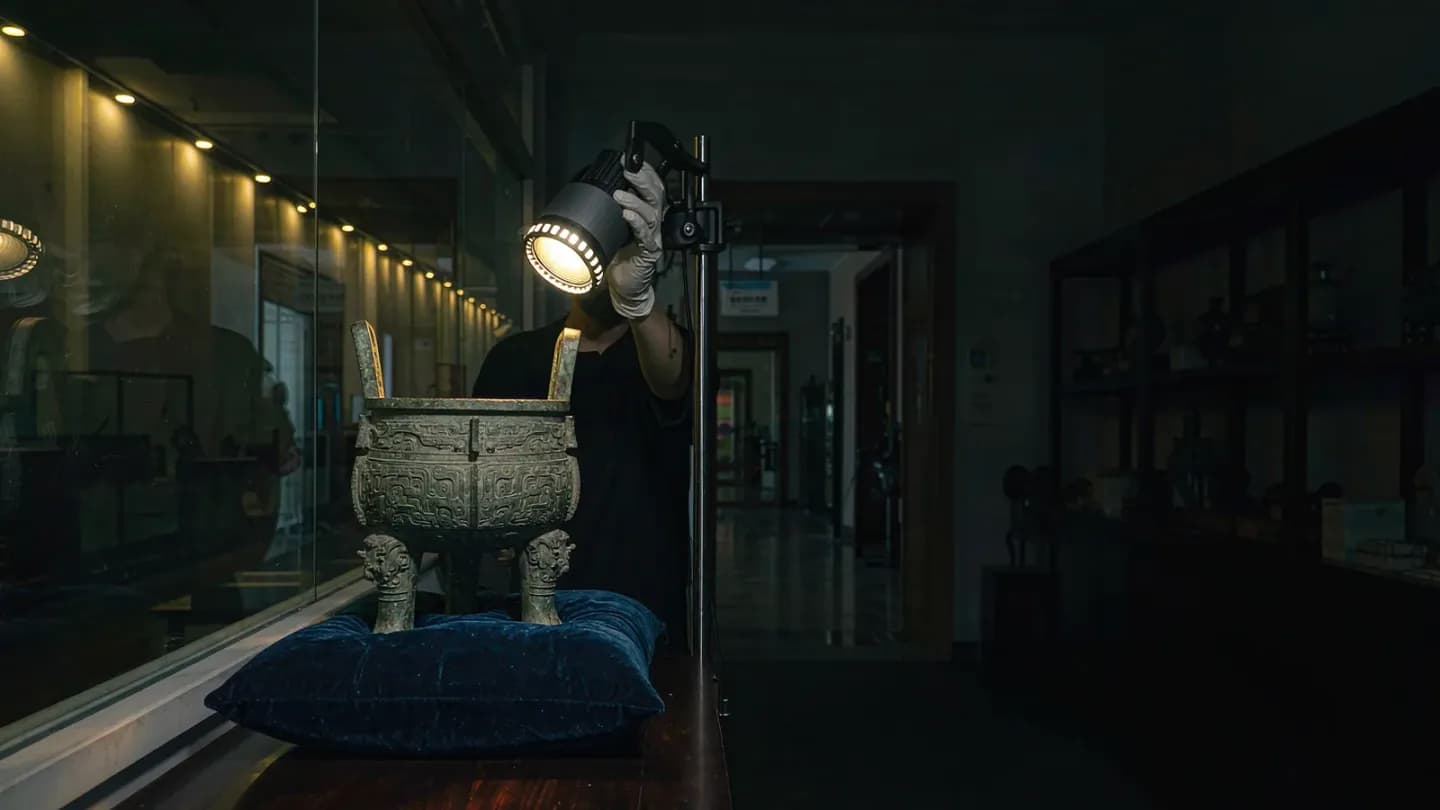
Fact governance at scale: the exhibition pipeline that doubled output
Scale arrived in July. BestTV and Shanghai Museum built a five-part AI series for the Summit of the World Tree exhibition on the ancient civilizations of the Americas, which opened on July 9 with 1,129 groups of artifacts - nearly 3,000 objects. The shorts went live on July 17 and run across BestTV's IPTV, internet TV and new-media matrix plus the museum's channels.
Production ran on BestTV's in-house Wenxin Diaolong AI creation platform, which chains AI image and text generation, video generation, 4K and 8K upscaling and intelligent dubbing into one script-to-score workflow. The company reports production efficiency roughly double that of a traditional documentary of comparable scope.
The governance layer is what makes that claim credible. The platform enforces a triple standardization system across content, expression, visual treatment and production, with the stated purpose of avoiding AI hallucination and pseudo-historical visual distortion. The team performed structured distillation of primary archaeological documents from Mexico and Peru plus authoritative histories, and museum experts co-reviewed every script to set hard creative boundaries before generation started.
Look closely and this is {{link}} applied to archaeology: every generated scene starts from verified material rather than imagination, and the reference layer sits upstream of the model, not downstream of it. The triple standardization is equally familiar - it is the museum version of the {{link}} commercial teams now use to enforce process, log decisions and keep output reproducible.
The loop closes offline. A holographic interactive cabin in the exhibition's retail area hosts more than ten civilization figures for visitors to question, so the same governed content powers the online preview, the in-gallery visit and the rewatch. Marketing and scholarship run on one pipeline instead of two.
Look closely and this is reference-first consistency workflows applied to archaeology: every generated scene starts from verified material rather than imagination, and the reference layer sits upstream of the model, not downstream of it.
The triple standardization is equally familiar - it is the museum version of the production management systems commercial teams now use to enforce process, log decisions and keep output reproducible.

When the artifact is the protagonist: Shaanxi's mural drama
Shaanxi's contribution proved the template works for storytelling, not just explainers. Ahead of International Museum Day in May 2026, the provincial cultural heritage administration premiered the province's first museum-themed AI animated series. Its story originates from the Pavilion and Procession mural in the Shaanxi History Museum collection, and the production was coordinated across that museum, the Xi'an Beilin Museum and the Emperor Qinshihuang's Mausoleum Site Museum.
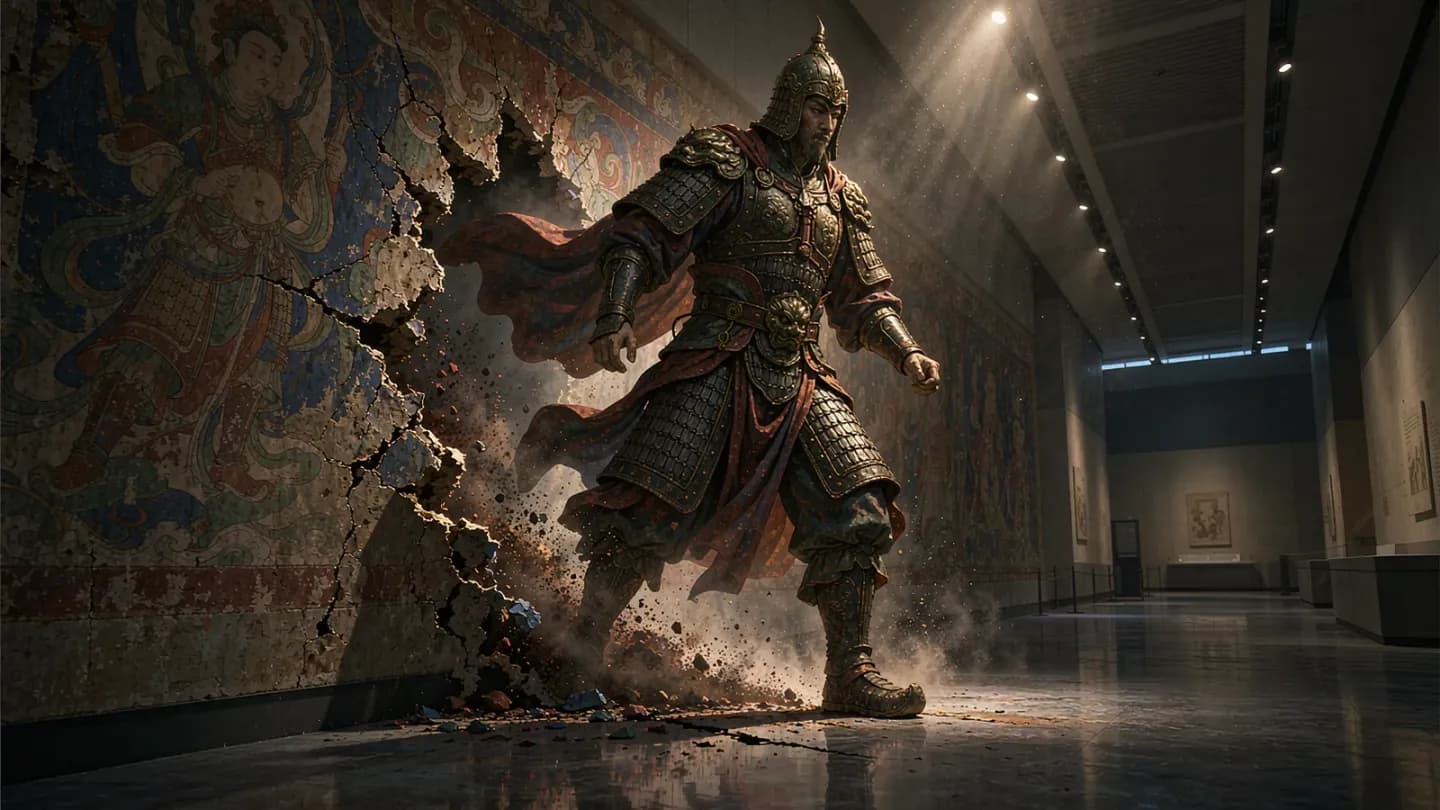
The premise is pure comedy: a Tang dynasty general steps out of the mural into a 2026 museum, loses his blade and mistakes a conservator for a sorcerer. Four episodes carry him through the Beilin Museum's epitaphs and out to the terracotta army, and along the way the script smuggles in real specialist knowledge - mural restoration practice, epitaph conventions, the rank features that distinguish a general's figure.
The mechanism worth copying is the knowledge card. Every episode ends with a short factual postscript, from why tomb murals keep their pigment for a millennium to how Tang epitaphs were formed. Verification is built into the format itself: the audience receives the correction in the same sitting as the fiction, so drama never has to carry the accuracy load alone.
The visual result also depended on {{link}} rather than prompt luck, with camera logic and pacing copied from documentary craft so the generated footage reads as filmed, not rolled. Governance sets what may be shown; direction sets how it is shown. The two layers do different jobs and both are non-negotiable.
The visual result also depended on deliberate shot direction rather than prompt luck, with camera logic and pacing copied from documentary craft so the generated footage reads as filmed, not rolled.
The template travels: what brand teams should copy
Strip away the jade and the murals and three controls remain. First, source distillation before generation: approved facts are collected, structured and turned into the material the model works from. Second, expert review as a hard gate on claims, not a courtesy read after the fact. Third, standardization across content, visual and production decisions so the model's randomness operates inside a governed frame.
Museums are effectively running {{link}} at zero tolerance: nothing ships unless the history survives review, and the threshold is enforced before generation rather than after export. Brands in finance, health or any regulated category face the same asymmetry between creative freedom and factual liability, and most have looser gates than a provincial museum.
The efficiency record also rebuts the assumption that governance taxes speed. BestTV reports the opposite on its exhibition series: the standardized pipeline is what allowed documentary-grade output at double the traditional rate. Review gates cost hours; re-shooting credibility costs campaigns.
For brand teams the mapping is direct. Replace the curator with a compliance or product expert, replace the archaeological record with the approved claim library, and keep the same order of operations: verify the source, bound the generation, gate the result. The museum stack is simply the strictest public version of a workflow every accuracy-sensitive producer needs this year.
Museums are effectively running commercial quality thresholds at zero tolerance: nothing ships unless the history survives review, and the threshold is enforced before generation rather than after export.
The accuracy premium: where museum-grade governance goes next
As generated footage saturates every feed, verifiable accuracy is becoming a differentiator rather than a cost center. Institutional buyers already behave this way: a broadcaster will not schedule a historical short it cannot defend, and that procurement logic is gradually spreading to categories where audiences punish fabrication.
Watch two developments. Longer formats are coming - the museum teams have shown the pipeline holds across a fifty-episode slate, which removes the excuse that governance only works at short-form scale. And interactive extensions are already live, from the exhibition's holographic cabin to episodic knowledge cards, which means the same verified content layer now serves formats the original pipeline never planned for.
The hardest brief produced the clearest playbook. Museums had no choice about being right, so they built the machinery to be right at generation speed. Any team shipping AI video where a factual error is expensive should treat that machinery as the benchmark - and notice that the institutions with the least tolerance for hallucination became the ones proving how fast governed production can move.
Put the framework into production
These related pages connect the article’s planning advice to a specific commercial scope.
References
- BestTV and Shanghai Museum launch AI series for the ancient Americas exhibitionChina Daily
For the Summit of the World Tree exhibition (opened July 9, 2026; 1,129 groups, nearly 3,000 artifacts), BestTV and Shanghai Museum launched a five-part AI short series on July 17 across IPTV and new-media channels. Production ran on BestTV's Wenxin Diaolong AI platform (AI text/image generation, video generation, 4K/8K upscaling, intelligent dubbing) with production efficiency about double a traditional documentary. A triple standardization system across content, expression, visual and production aims to avoid AI hallucination and pseudo-historical distortion; scripts were co-reviewed by museum experts after structured distillation of primary archaeological documents from Mexico and Peru. A holographic interactive cabin with ten-plus figures operates in the exhibition area.
- Shaanxi's first museum-themed AI animated series brings millennia-old artifacts to lifeXi'an Daily via China News Service Shaanxi
Ahead of International Museum Day 2026, the Shaanxi provincial cultural heritage administration premiered the province's first museum-themed AI animated series, originating from the Pavilion and Procession mural held by the Shaanxi History Museum and coordinated across that museum, the Xi'an Beilin Museum and the Emperor Qinshihuang's Mausoleum Site Museum. A Tang dynasty general steps out of the mural into a modern museum; episodes weave in mural restoration, epitaph and figurine-rank knowledge, and each episode closes with a knowledge tips section.