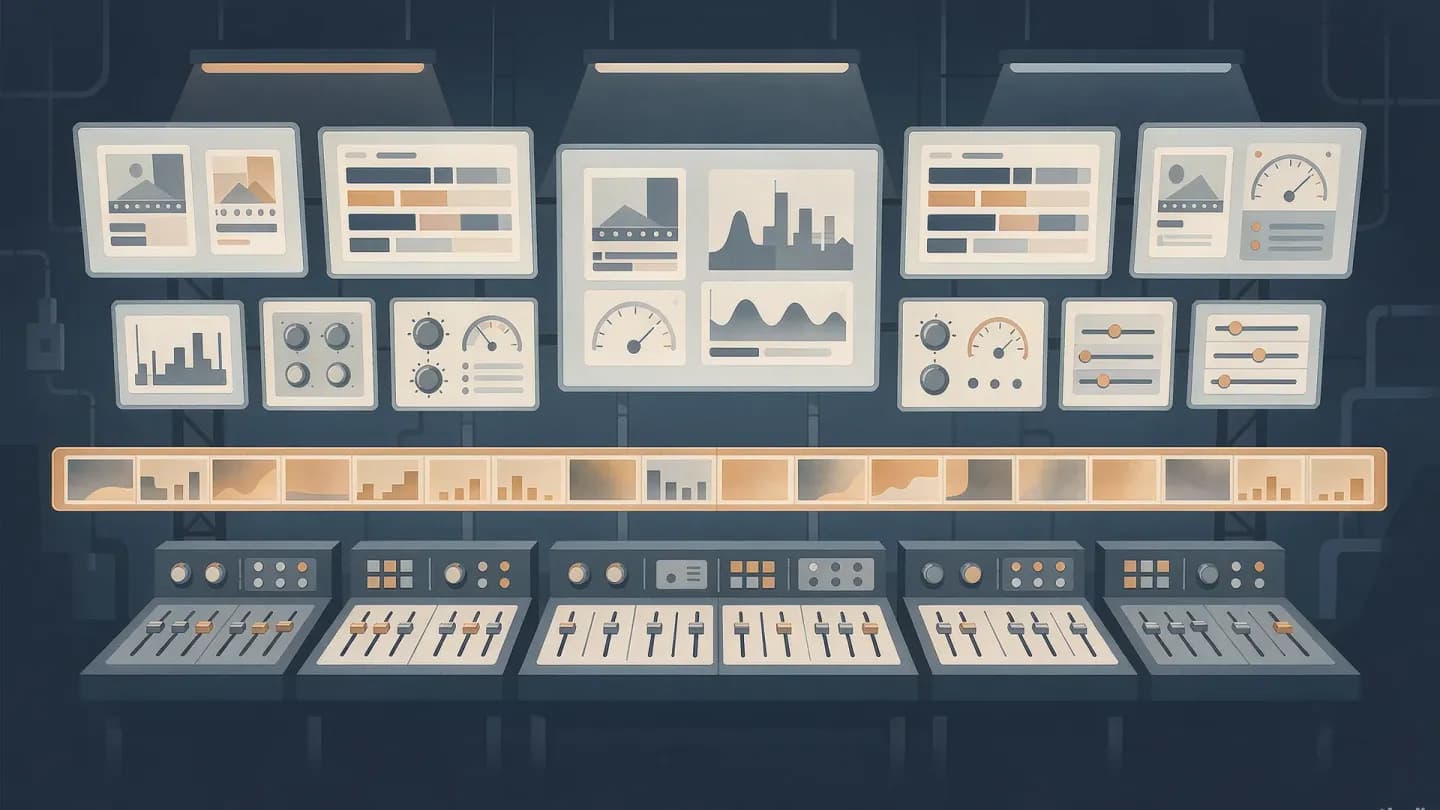
Why AI video production management, not model quality, is now the constraint
AI video production management is the layer that now decides who ships commercial work, not who owns the best model. Every model in production in 2026 can generate an acceptable shot; almost none of them can tell a studio which take is version seven, what it cost, who approved it, or why last month's approved look cannot be reproduced. That gap is a management problem, and in September 2026 it finally became a product category.
Generation quality stopped being the differentiator in 2025. What separates a team that delivers forty finished spots a month from one that delivers four is rarely the engine. It is whether anyone can say, six weeks later, which take was approved, against which brief, at what cost, and with which reference locked to which face. Those are records, and records need a system. Teams that adopt a management layer usually discover the hard ceiling is {{link}}, not the prompt library.
That is why the framing inside the new platforms is deliberately unglamorous. When Huijing Digital Media and Entertainment Group, the Alibaba unit that runs Youku, launched its film production platform in September, its CTO put the argument in operational rather than creative terms: the genuinely scarce thing is no longer a strong generation model, it is a team's ability to deliver complete work on a stable, explainable and predictable budget. Nothing in that sentence is a model claim.
Teams that adopt a management layer usually discover the hard ceiling is the AI video render queue bottleneck, not the prompt library.
What the September 2026 platforms actually sell: control items, not models
Jingrui AI (鲸锐 AI) was announced on 22 September 2026 at the Yunqi Conference, and its internal beta opens in October to professional film creators and production teams. The group positions it less as a generator and more as an operating system for film production, in which models raise the ceiling of what can be generated while the production system is what makes a project deliverable, explainable and on budget.
The specification list is the interesting part, because none of it is about image quality. Five control suites cover scene, character performance, camera, virtual set and lighting. The camera module exposes more than 40 lens and rig parameters. There are more than 250 combined scene edits, 49 basic expression controls and over 100 character pose placeholders. The stated purpose is to convert part of a director's or cinematographer's craft knowledge into selectable, reusable controls, so intent can be expressed directly instead of being re-rolled through a prompt lottery.
On the management side, projects are organised by episode, scene and character; digital assets, prompts, skills and workflows are pooled centrally; progress, resource consumption and effective finished minutes are tracked together. For long-form work that needs writers, directors, art departments and post in the same room, that layer matters more than any single generation, which is why the same operational instinct that pushed {{link}} now applies to scheduling, versioning and cost attribution.
For long-form work that needs writers, directors, art departments and post in the same room, that layer matters more than any single generation, which is why the same operational instinct that pushed brands bringing AI video production in house now applies to scheduling, versioning and cost attribution.

The audit trail is the product: prompt parameters, model, operator, version
A second platform shows the same thesis from the delivery side. Western Film Group opened the internal beta of Yingpu AI (影谱 AI) on 20 August 2026 as an industrial-grade AIGC film production platform. It runs nine production stages inside one workflow, carries 12 standard crew role permission tiers with layered approval, and centralises character, scene and prop assets so that a full iteration history is kept rather than scattered across machines. The node canvas stores snapshots and supports version comparison.
Its project operations and delivery module is the clearest statement of what production teams are now buying. Progress boards, tiered permissions, AI generation quota approval, resource-consumption statistics, unified archiving, batch script evaluation and task logs all sit in one system. Underneath them, every creative action is logged with its prompt parameters, the model used and the operator who ran it, and those records are searchable, reviewable and reusable. The vendor frames that as satisfying standardised archiving, project retrospectives and copyright provenance.
That is a commercial argument, not an archival one. A management system only earns its place when the output survives {{link}}, where the buyer asks whether the work is finished rather than whether it was generated. Provenance records answer a question that sits inside the contract: which model version, which reference, which approval, on which date. If the answer is a folder of unsorted exports, the deliverable is not auditable no matter how good the shot looks.
A management system only earns its place when the output survives the shift into an AI video delivery era, where the buyer asks whether the work is finished rather than whether it was generated.

Scale stopped being the argument: 220,000 AI titles in six months
Any remaining doubt that AI production is industrial rather than experimental was settled by the volume data published this quarter. DataEye's research puts new AI short drama titles on Chinese platforms at more than 220,000 in the first half of 2026, with over 1,200 going live on an average day. AI micro-dramas now account for more than 95% of that output. The broader AI short drama market passed RMB 11 billion in the first half and is projected above RMB 35 billion for the full year.
The tooling that grew up around that volume is management software, not generation software. ShortsCrew, launched in August 2026, is explicitly a collaboration and management platform for AI drama teams. It exists to fix runaway compute cost, chaotic multi-project progress, scattered assets, weak cross-role collaboration and unmeasurable per-person productivity. Its dashboards break compute consumption down by project, by person and by episode, so a team can calculate the real cost of one drama rather than the sticker price of one render.
The adoption numbers make the point sharper than any cost claim. As of August 2026, 213 released dramas had been produced through the platform, with more than 280,000 assets generated per day by 108 creative teams. At that throughput the marginal cost of generation is not the constraint. What constrains a studio is knowing which asset belongs to which production and what it cost to make. The industrial appetite behind {{link}} is what pushed film studios, not advertisers, to productise the management layer first.
The industrial appetite behind China's AI video commercialisation is what pushed film studios, not advertisers, to productise the management layer first.

Tool convergence is not production management — the four records you must own
It is worth separating two things that get conflated. Tool convergence means one suite can generate, edit and store assets without exporting to three other applications. Production management means the work has a defined state at every moment. A converged suite with no version discipline simply produces the same chaos faster.
Four records decide whether a layer is real. First, version identity: a stable identifier for the approved shot, plus who signed it off and against which brief. Second, cost per finished minute, including the takes that were discarded, not just the credits that were spent. Third, asset lineage: which locked reference produced which character, product or location across every cut. Fourth, reproducibility: the model identity, parameters and seed behind an approved frame, so that a model update or retirement does not silently invalidate a library the team has already paid for.
The buy side has already normalised this kind of discipline. IAB's 2026 video research describes AI becoming part of every stage of the video value chain where it measurably improves planning, buying and measurement, with two in three digital video buyers now live, testing or planning agentic systems. When the buying stack runs on recorded state, the production stack has to expose the same records or it cannot be reconciled against it.
One caveat belongs in any honest assessment. None of the platforms above has public evidence yet. The reporting around Jingrui AI notes directly that as a product still short of open beta, its real generation quality, its compatibility with other models and existing production software, and its collaboration and cost control at large-team scale all remain to be tested in live projects. Treat the capability list as a roadmap and the audit-trail requirement as the durable part.
How to evaluate the layer before you buy or build it
If you are assessing a platform, ask six questions. Does it record model name and version alongside every approved output? Does it compute cost per finished minute, inclusive of discarded takes? Does it hold an asset lineage that survives a model swap? Can a reviewer see who approved a shot, when, and against which brief? Does it export in formats your existing finishing pipeline accepts, or does it hold your work hostage? And can it be applied to the projects you already have in flight rather than only to new ones?
If you are not buying, build the minimum viable version by hand. Keep a shot ledger with a stable naming convention, pin the model version used for anything approved, add a cost column that includes retries, and record the reference image that locked each character and product. Four columns in a shared table will outperform an elaborate folder structure, because the failure mode here is never that the work is missing; it is that nobody can prove which version of it was approved.
The commercial case for the layer is that it is the only part of the stack that gets more valuable as models get cheaper. Generation keeps commoditising, and every price cut increases the number of takes a team can afford to discard. What does not commoditise is the record of which take survived, what it cost, and who said yes. Studios in September 2026 started selling exactly that, and the teams that adopt it earliest will be the ones whose output stays auditable when the engine underneath them changes.
Put the framework into production
These related pages connect the article’s planning advice to a specific commercial scope.
References
- Huijing Entertainment launches Jingrui AI, targeting AI video collaboration and delivery problemsGeekPark
Huijing Digital Media and Entertainment Group launched the AI film production and management platform Jingrui AI on 22 September 2026 at the Yunqi Conference, with an internal beta opening in October 2026. The platform bundles five control suites and exposes more than 40 camera parameters, more than 250 combined scene edits, 49 basic expression controls and over 100 character pose placeholders, and it tracks project progress, resource consumption and effective finished minutes while pooling digital assets, prompts, skills and workflows.
- Internal beta open: Yingpu AI, industrial-grade AIGC film production platformWestern Film Group (Yingpu AI)
Yingpu AI runs nine production stages in one workflow with 12 standard crew role permission tiers, keeps full iteration history on character, scene and prop assets, and logs every creative action with its prompt parameters, the model chosen and the operator, so that records are searchable, reviewable and reusable for standardised archiving, project retrospectives and copyright provenance.
- ShortsCrew launches: the industrialisation of AI film teamsChina Daily
DataEye data cited in the report puts new AI short drama titles at more than 220,000 in the first half of 2026 with over 1,200 launching daily and AI micro-dramas above 95% of output; ShortsCrew, a collaboration and management platform for AI drama teams, had by August 2026 produced 213 released dramas with more than 280,000 assets generated per day across 108 creative teams, and it breaks compute consumption down by project, person and episode.
- 2026 IAB Digital Video Ad Spend and Strategy ReportIAB
AI is increasingly part of every stage of the video value chain where it measurably improves planning, buying and measurement, and two in three digital video buyers are live, testing or planning to use agentic AI for digital video campaigns in 2026, with a further 28% actively investigating.