
What Fortescue needed that a normal shoot couldn't deliver
Fortescue approached PLAYE with an ambitious brand film that a normal shoot could not justify: stylised environments, fast vehicle sequences and mining infrastructure. AI-enabled video production changed the math, letting the team generate the world instead of building it. The real lesson is that AI made the idea possible, but human craft made it brand-worthy.
The brief called for highly stylised environments, fast-moving vehicle sequences, mining infrastructure and Formula E references. Delivered the traditional way, that combination would have needed a major live-action shoot, a complex CGI pipeline, location access and a budget large enough to kill the concept before it left the room. Generative production collapsed that cost and complexity into something a small expert team could actually ship.
For an enterprise brand in mining and energy, near enough is never good enough. A warped logo or a misread piece of equipment does not read as a stylistic choice — it reads as a brand error. So the interesting question was never 'can AI make a film'. It was whether AI could make a film that an enterprise brand could confidently put its name on. The Fortescue project is a clean answer to how that bar gets cleared.
The wider pattern is that generative production is moving from novelty to default. Enterprise brands are no longer asking whether to use AI video but how to keep it on-brand at scale. Fortescue is a useful specimen because the brand is technical, regulated-adjacent and unforgiving of errors — exactly the conditions where a weak quality gate fails first, and where a strong one proves its worth.
The storyboard became the creative anchor
One of the biggest takeaways from the project is that AI does not reduce the need for planning — it makes planning more important. PLAYE treated the storyboard as the creative anchor for the entire piece, locking sequence, camera movement, rhythm and visual logic before a single frame was generated. Changing the storyboard early, as Senior Creative Director Paul Mansfield put it, is like changing an architect's drawing before construction begins.
A disciplined {{link}} held the generation on rail when the model had no reference for Fortescue's niche mining hardware. The storyboard defined what 'right' looked like so the team could reject everything that drifted. Without that anchor, generation drifts toward the generic and the plausible, and a brand with specific equipment and specific marks ends up with footage that looks almost correct and is actually wrong.
References — mood boards, product shots and brand marks — did the job that a live shoot would have done through art direction, giving the model something real to aim at. That planning paid off in volume. The team generated around 1,200 images for the project — not as a sign of inefficiency, but as a quality-control step. Generating enough options let them find the strongest frames, then refine, reject and rebuild until the work felt cohesive. AI supplied the range; the creative process supplied the judgement. The storyboard is what kept the two pointed at the same target.
A disciplined reference-driven control for AI video held the generation on rail when the model had no reference for Fortescue's niche mining hardware.

Why AI-enabled video production still needs a human quality gate
Generative models are extraordinary at the imaginative and weak at the specific. A generic race car is easy; the exact car with the right logos in the right places is hard. A generic plug is easy; a specialised mining charging plug is hard. As PLAYE founder Mitch Brown puts it, 'AI might give you a B+, and you need to then take it to an A+.' The more niche the subject, the more the model guesses — and when it guesses, it gets brand details wrong.
That is why teams pair generation with a {{link}} before any frame ships to a client. Brand-safe production also means provenance. C2PA's Content Credentials mark generative assets with a verifiable history, and the EU AI Act now requires providers of AI systems that generate synthetic video to tag outputs in a machine-readable format detectable as artificially generated. Disclosure and traceability are becoming part of the production spec, not an afterthought a brand bolts on at launch.
The guardrails lesson is the same one Mansfield repeats: give the model too much room and it guesses, and its guess is not based on reality. For enterprise brands, the fix is not less AI — it is more direction. A clear brief, locked references and a human reviewer who owns the final result turn a plausible generation into a brand-accurate frame.
That is why teams pair generation with a character-consistency workflow for AI video before any frame ships to a client.
Quality control is where the craft lives
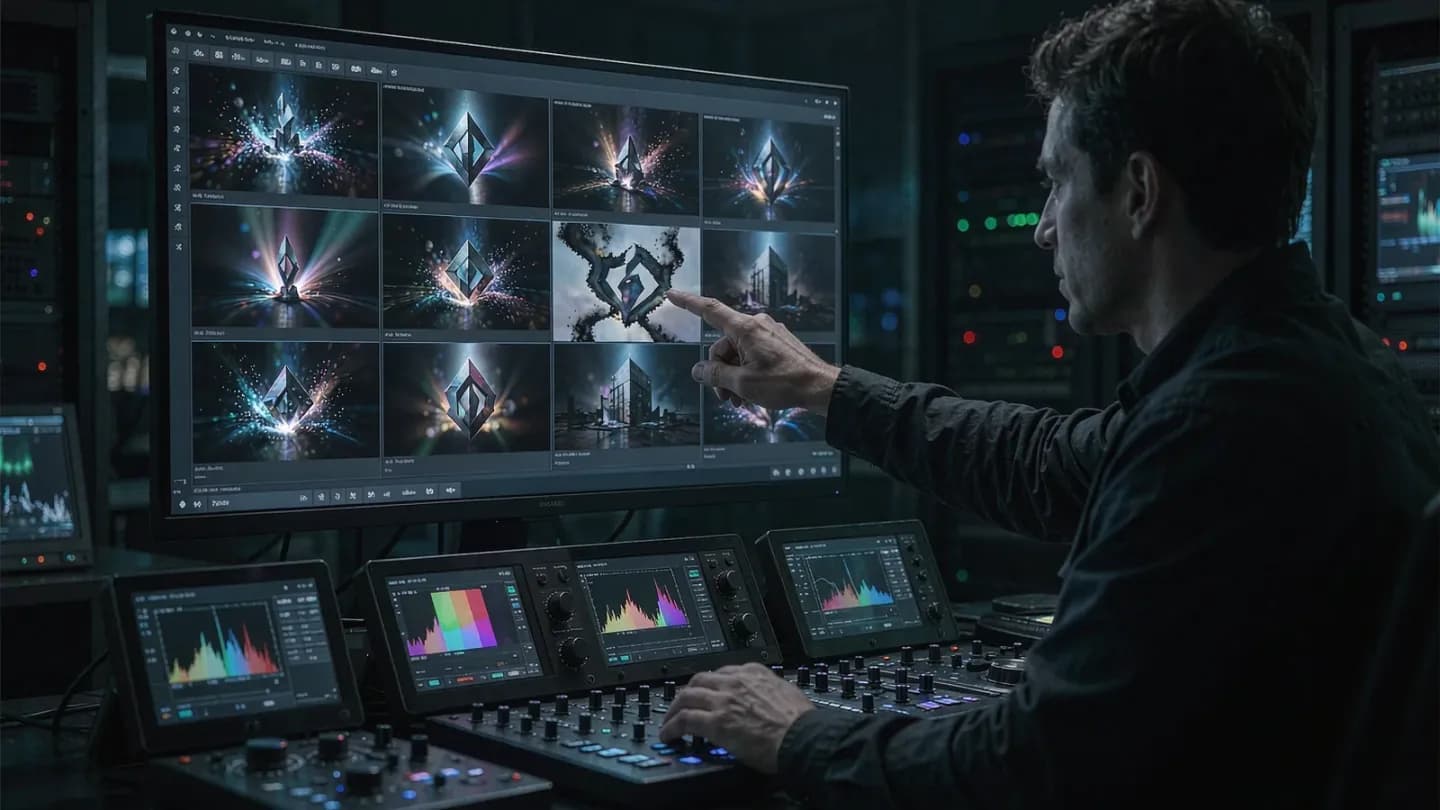
PLAYE's team reviewed every element for visual inaccuracies and inconsistencies, applying a different kind of attention to detail than a traditional shoot demands. Creative Partner Keir Crighton describes needing to watch for 'literally everything that could not be quite right' — logos that morph, lighting that feels off, movement that does not obey physics. Each output was checked against the storyboard and Fortescue's brand requirements before it advanced.
PLAYE's frame-by-frame review is a practical {{link}} any studio can copy. The point is not to slow generation down but to treat QC as a stage, not a hope. In a workflow where credits, time and iteration all carry cost, catching an error at frame 200 is far cheaper than discovering it in the final cut, when the asset has already been edited, scored and graded.
This is also where 'AI slop' gets defined. The risk for brands is not that audiences will always know something was made with AI. The risk is that the work feels careless, cheap or disposable — errors missed, logos morphed, sound design failing to elevate the piece, nobody taking responsibility for the result. QC is the discipline that separates a generation from a finished, brand-worthy production.
PLAYE's frame-by-frame review is a practical AI video artifact-fix playbook any studio can copy.
The market is flooding with GenAI video — craft is the differentiator
The context makes the Fortescue discipline matter more, not less. IAB's 2026 Digital Video Ad Spend & Strategy Full Report finds nearly two-in-three buyers now use GenAI for digital video creative, up from half in 2025, with that share projected to reach 43% of ad assets by 2027. Half of small and mid-size spenders say they strongly want humans in the loop, and most are not yet satisfied with the quality of GenAI creative they can produce.
In a feed full of synthetic volume, a deliberate {{link}} is what keeps enterprise brands credible. When everyone can generate something, the work that wins is the work that has been shaped, checked and refined. The gap between disposable AI content and brand-worthy creative is no longer the model — it is the craft around it, and the craft is the part competitors cannot download.
The buyers who want humans in the loop are not Luddites; they are the ones who have seen GenAI creative miss the brief. Retaining human direction is what turns volume into brand equity instead of noise, and it is quickly becoming a client expectation rather than an internal safeguard.
In a feed full of synthetic volume, a deliberate pro-human AI video creative approach is what keeps enterprise brands credible.

What commercial teams can steal from the Fortescue workflow
The Fortescue project is interesting less for the AI and more for the operating model. Treat AI as a production capability, not a gimmick: it unlocks ideas that a shoot or CGI would have priced out, but the quality still comes from the people around the tools. Anchor every generation with a storyboard, bake QC and provenance into the spec, and keep human creative direction in the loop from first frame to final grade.
For commercial teams, the practical takeaway is to move value toward the roles that direct the tools, control the output and spot the errors. Anyone can generate something. Not everyone can make it brand-worthy — and in a market filling with AI slop, that difference is the only one left that compounds. The Fortescue film was not a demo of what a model can do. It was a demo of what a team can do when it treats AI as the raw material and craft as the product.
Put the framework into production
These related pages connect the article’s planning advice to a specific commercial scope.
References
- AI did not replace the creative process. It made a new one possible.PLAYE
PLAYE generated around 1,200 images for Fortescue's AI-enabled brand film and treated the storyboard as the production anchor; founder Mitch Brown says 'AI might give you a B+, and you need to then take it to an A+'.
- Content Credentials — C2PAC2PA
C2PA's Content Credentials provide an open standard that marks generative assets with provenance, functioning as a 'nutrition label' for digital content so origin and edits are verifiable.
- Article 50 — Transparency Obligations for Providers and Deployers of Certain AI SystemsEuropean Commission
EU AI Act Article 50 requires providers of AI systems generating synthetic video to mark outputs in a machine-readable format detectable as artificially generated or manipulated.
- Business Outcomes Are Just the Beginning, According to IAB Digital Video Ad Spend & Strategy Full ReportIAB
IAB's 2026 full report finds nearly two-in-three buyers now use GenAI for digital video creative (up from half in 2025, projected to 43% of ad assets by 2027) and that half of small and mid-size spenders strongly want humans in the loop.