
What Real-Time AI Video Generation Actually Means
Real-time AI video generation is the ability to produce video frames as they are needed, streaming output to a screen instead of waiting for a whole clip to finish rendering. Rather than submitting a prompt and collecting a finished file minutes later, a real-time system returns the first frame in about a second and keeps generating in response to new input. For production teams, that shift turns generation from a one-shot render into a live, interactive process.
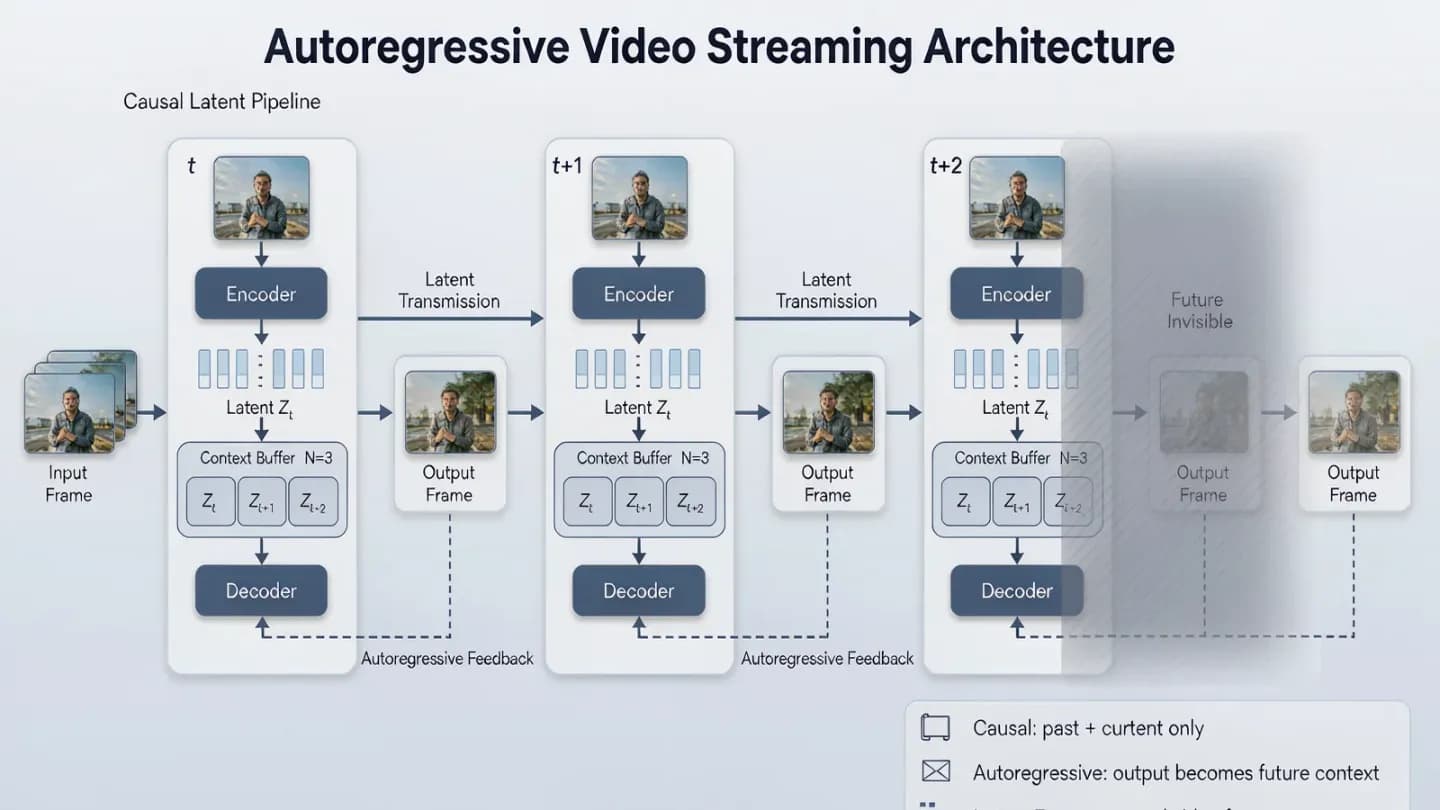
The distinction is architectural, not just faster. Most production video models still use latent diffusion: they denoise every frame of a clip together, then hand back a completed file. Nothing reaches the viewer until the last frame is finished. Real-time systems instead generate frames one after another, conditioned on what came before, and push each frame to the screen the moment it is ready.
That difference matters because it changes what a video model is for. A batch model is a factory that ships a finished asset. A real-time model is closer to a camera operator who responds to direction while the shot is live. The same model can now sit inside an interactive experience, a live broadcast, or a customer-facing agent rather than only inside an edit timeline. For a commercial video team, the practical upshot is that generation can finally happen inside the moment of decision, not just after it.
The Models Shipping Live Generation in 2026
The capability is no longer theoretical. In late August 2026, fal.ai released MiniMax H3 Max, a post-trained variant of the open-weight MiniMax H3 built for speed: a five-second 768p clip renders in under three seconds, fast enough to feed a continuous stream. Early community experiments have already wired it into perpetual livestreams where viewer prompts reshape the next scene.
The move toward continuous output also shows up in {{link}}, where systems assemble longer sequences without a full re-render.
Research is converging on the same idea from the architecture side. Apple's STARFlow-V, presented at CVPR 2026, replaces diffusion with causal normalizing flows so a model can roll out frames autoregressively while keeping error accumulation under control. The explicit goal is streaming and interactive use, not just higher fidelity on a fixed clip.
OpenAI's Sora 2 and the broader Videos API show the same pressure from the product side, even as the company has scheduled that API for deprecation in late September 2026. The volatility itself is the signal: real-time and near-real-time video is now a contested front, and the providers shipping it are iterating on latency as aggressively as on resolution.
The move toward continuous output also shows up in autonomous AI video generation, where systems assemble longer sequences without a full re-render.
Latency Versus Quality: The Core Tradeoff
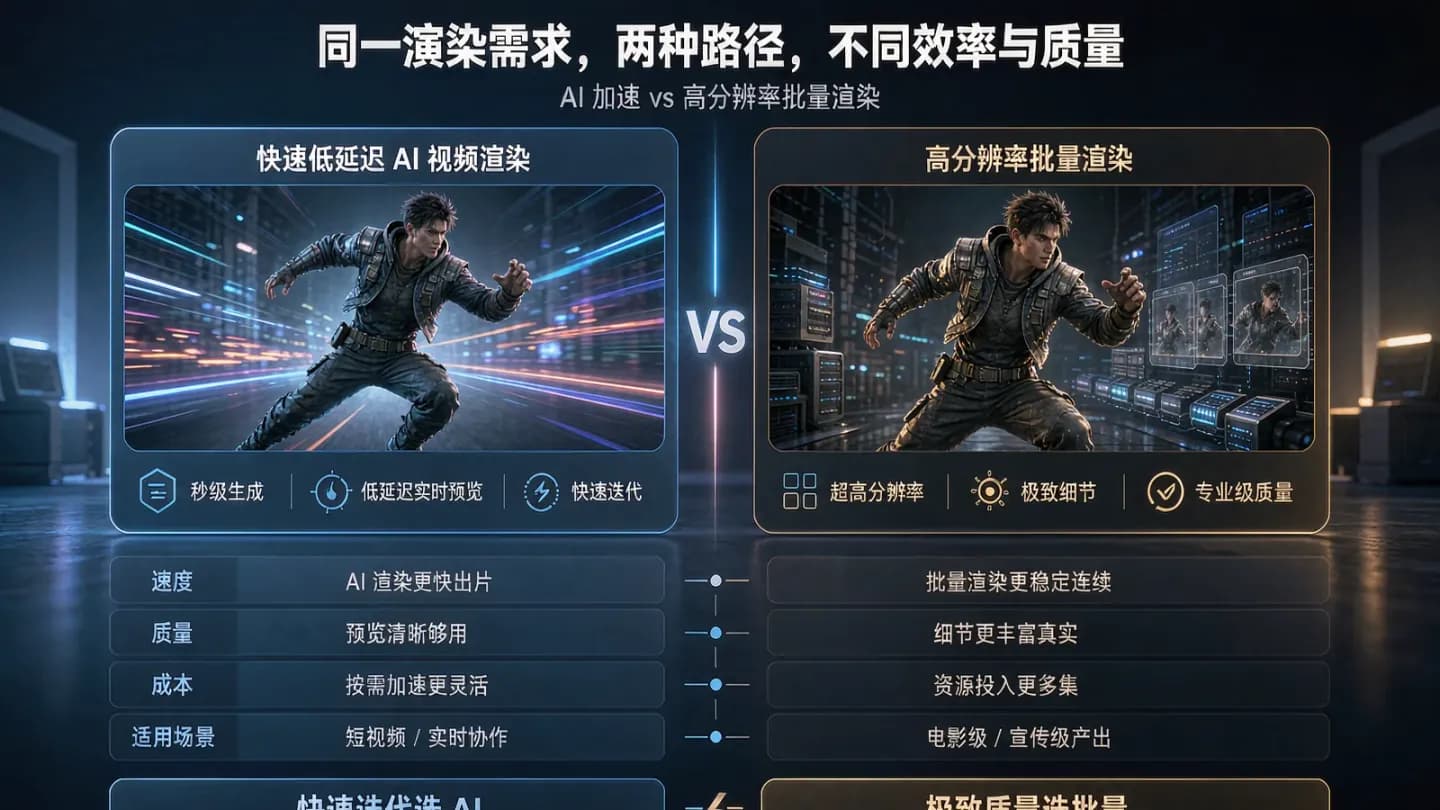
Real-time generation is not free. Streaming models trade resolution and per-frame polish for speed, and the fastest systems today top out well below the 2K and 4K that batch models reach. A clip that arrives in a second is good enough for live direction and rough cuts, but it is usually not the master you would ship for a brand film.
The economic question is not just speed but yield: a {{link}} reframes the decision around usable seconds per dollar rather than peak resolution.
That reframing is useful for planning. If a team needs to test fifty motion directions before a client call, a fast 768p render that costs pennies per attempt beats a slow 2K render that costs dollars, even if the slower clip looks better. Real-time generation wins when the job is exploration, iteration, and interaction; batch generation still wins when the job is a finished, high-resolution deliverable. Planning which model handles which step is now part of the creative brief, not a separate post-production decision.
The practical pattern is to use real-time models for the loop and batch models for the hero shot. Generate options live, pick the winner, then re-render that one at full quality. Treating the two as competitors misses the point: they are different tools for different points in the same workflow.
The economic question is not just speed but yield: a cost per usable clip reframes the decision around usable seconds per dollar rather than peak resolution.
Where Real-Time Video Fits in a Production Pipeline
The easiest mistake is to treat real-time video as a replacement for editing. It is not. A streaming model produces frames on demand; it does not give you a frame-accurate timeline, multi-clip assembly, or the layered mastering a finished video needs. Those still belong to the production tool, and the real-time layer should feed it rather than replace it.
Teams that already run an {{link}} can slot live generation into the same review and approval steps.
Concretely, real-time generation is strongest at three pipeline moments: pre-visualization, where a director iterates on camera and composition before any shoot; interactive prototyping, where a stakeholder steers a scene during a meeting; and live personalization, where a stream adapts to viewer input. None of these require the model to produce the final master.
The integration work is mostly plumbing: capturing the stream, indexing the good takes, and moving them into the edit. The teams that benefit most are the ones that already treat generation as one stage among many, not a magic button that outputs a publishable video by itself.
Teams that already run an AI-native creative pipeline can slot live generation into the same review and approval steps.
Artifact and Consistency Risks at Low Latency
Speed has a cost in quality control. Autoregressive generation accumulates small errors across frames, so a long real-time stream can drift in lighting, morph a face, or drop a hand that a full-clip diffusion model would have held steady. The faster the generation, the less headroom there is to catch those defects before they reach the screen.
When low-latency output does introduce drift or broken frames, treating it with {{link}} gives you a repeatable way to clean them up before delivery.
The mitigation is the same one batch pipelines already use: generate with a reference frame or a locked character, keep the stream short, and run a repair pass on the segments you actually ship. Real-time video does not remove the need for quality control; it moves that control earlier and makes it continuous.
For brand-sensitive work, the safest design is a hybrid: let the model run live for exploration and interaction, then re-render the chosen moments at higher latency where consistency actually has to hold. The live layer earns its keep on speed; the batch layer earns its keep on trust.
When low-latency output does introduce drift or broken frames, treating it with AI video post-production repair gives you a repeatable way to clean them up before delivery.
Disclosure and Provenance for Synthetic Video
Live synthetic video is easy to mistake for a real feed, which makes disclosure a harder problem than it is for a clearly labeled clip. A stream that responds to prompts in real time sits in the same visual space as a webcam or a broadcast, so viewers may not realize it is generated at all. That raises the bar for marking it.
Because live synthetic video is easy to mistake for a real feed, the case for {{link}} is about proving trust and reach, not counting raw views.
Two standards matter here. C2PA's Content Credentials attach verifiable origin and edit history to a file, so a generated stream can carry proof of where it came from. The EU AI Act goes further: Article 50 requires providers to mark synthetic video as artificially generated in a machine-readable format, and that obligation applies to output shipped inside the EU.
For production teams, the move is to treat provenance as part of the render, not an afterthought. If a real-time system is generating customer-facing video, the watermark or credential should travel with the stream from the first frame, because a live feed has no convenient export moment to stamp it. Building that stamp into the generation call is cheaper than retrofitting disclosure once a stream is already public.
Because live synthetic video is easy to mistake for a real feed, the case for AI video measurement is about proving trust and reach, not counting raw views.

Put the framework into production
These related pages connect the article’s planning advice to a specific commercial scope.
References
- STARFlow-V: End-to-End Video Generative Modeling with Normalizing FlowsarXiv (Apple)
Apple's STARFlow-V (CVPR 2026) uses a causal normalizing-flow architecture to enable streaming, autoregressive video generation instead of full-clip diffusion, keeping error accumulation under control for interactive use.
- MiniMax H3 and H3 Max on fal.aifal.ai
fal.ai states MiniMax H3 Max is its post-trained variant of the open-weight H3, rendering a five-second 768p clip in under three seconds for faster-than-real-time video generation.
- C2PA Content CredentialsC2PA
C2PA's Content Credentials open standard records the origin and edit history of digital content, letting synthetic video carry verifiable provenance.
- EU AI Act Article 50 - Transparency ObligationsEuropean Commission (artificialintelligenceact.eu)
Article 50 of the EU AI Act requires providers to mark synthetic video as artificially generated in a machine-readable format.