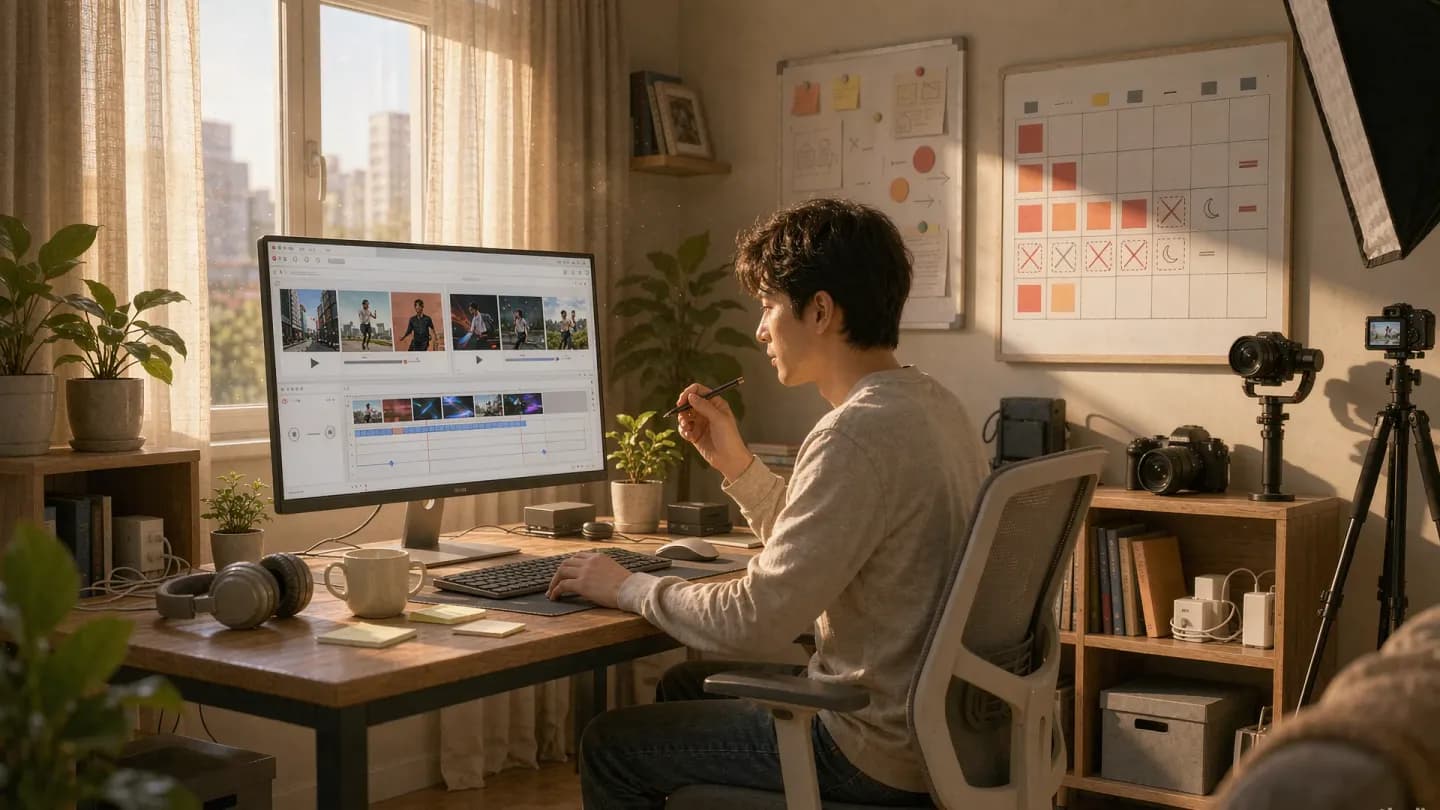
Why AI Video Teams Burn Out Before the Pipeline Does
Sustainable AI video production is an operating rhythm, not a software purchase: a small team ships a steady weekly volume by batching work and letting AI handle the mechanical parts, instead of generating every asset by hand under daily pressure.
2026 made the human cost of always-on content impossible to ignore. CreatorBlade's burnout framework reports that burnout, not the algorithm, ends 60% of creator careers within three years, and that the single biggest predictor of long-term survival is two full days a week with no audience-facing work. The pressure is structural: one person is expected to be strategist, shooter, editor, and community manager at once, while platforms punish any gap with falling reach.
Commercial video teams face the same trap at larger scale. Agencies and in-house studios that chase daily output discover that render time was never the bottleneck — attention was. When the people who steer creative tone are exhausted, the work drifts: off-brand cuts ship, reviews slip, and the speed win evaporates into rework. The cost shows up in review cycles: tired reviewers approve the safe option, not the distinctive one, and the brand's point of view erodes one quiet compromise at a time. The fix is not more tooling; it is a calmer production system that protects that point of view by giving the people who hold it room to think.

Building Sustainable AI Video Production Habits
The batch-and-route rhythm splits the week into single-mode days so the brain is never juggling discovery, shooting, and editing at once. Metricool's 2026 Social Media Well-Being Report, drawn from 927 professionals worldwide, found that 73% work outside normal business hours, 75% feel they wear too many hats, and 44% cannot fully disconnect after the workday — all symptoms of a system with no boundaries rather than a discipline problem.
Concretely, a weekly idea bank session writes two to three weeks of topics in thirty minutes. A separate capture day shoots five to eight videos back to back from that list. A dedicated edit day cuts them all in one sitting, and publishing is automated. CreatorBlade's 4-day production week builds on the same logic: plan and shoot early, edit mid-week, then protect Friday through Sunday as genuinely off. One excellent weekly piece outperforms five mediocre ones on every metric the platforms reward.
Front-loading the idea bank also unlocks {{link}}, because a planned week of topics means the capture day is pure execution, not discovery.
Front-loading the idea bank also unlocks pre-production acceleration, because a planned week of topics means the capture day is pure execution, not discovery.

AI Takes the Mechanical 80%, Humans Keep the Voice
The practical rule is simple: route AI to mechanical, repeatable work — caption editing, transcript extraction, title variations, resizing, and scheduling — and keep the idea, the personal anecdote, and final approval with a human. AI can produce a draft, but it cannot imitate real experience, and audiences notice the difference over time. The distinction is whether a task carries your voice or merely handles logistics.
Generation works best as a {{link}} that produces first drafts, leaving the final creative calls to people. That framing matters because platform AI does not understand brand boundaries; left unchecked it dilutes tone and positioning. Use AI for speed, but keep a human in the loop on anything a viewer would read as the brand speaking.
This is also where disclosure discipline lives. When AI writes the captions and the transcript but a person owns the story, the team can stand behind every claim and label synthetic elements honestly — the creative voice and the compliance gate are the same human decision, not two separate handoffs.
Energy management matters more than time management here. Most people have only 90 to 120 minutes of true creative focus per day; protect those hours for the work only a human can do — the angle, the story, the final call — and let AI absorb the rest. The batch system exists to defend that focus, not to fill the calendar with more drafts.
Generation works best as a content engine that produces first drafts, leaving the final creative calls to people.
Repurposing Turns One Shoot Into a Week of Assets
Repurposing is the highest-leverage habit in the system. Re-cutting a single long-form piece into three or four platform-specific formats takes far less time than producing new content from scratch, and retelling the same idea in a different format is still a first encounter for most of the audience. A single hour-long recording can yield five or six short clips plus quote graphics and a newsletter paragraph.
The cadence data backs it up. Buffer's 2026 creator research found that creators who posted in 20 or more weeks out of 26 saw roughly 450% more engagement per post than those who posted in only four weeks — consistency across weeks, not daily heroics. Promote's burnout guide adds that 7 in 10 business owners have felt burnt out by content creation and 68% have taken a posting break, which a content buffer is designed to prevent.
Build a buffer of two to four weeks of batched content so a bad week never becomes a missed week and a vacation never means radio silence. Set a minimum viable cadence — often two to three posts a week for a solo team — and treat it as a floor you never drop below, not a target you strain to exceed. Track weekly average reach and your own energy level rather than daily reach; three consecutive weeks of declining energy is a clearer warning signal than any single underperforming post.
Creative Volume Still Wins — So Systematize It
None of this means making less. On creative-first platforms the volume case is stronger than ever: Sod's 2026 paid-ads framework notes that Meta and TikTok now reward creative variation over micro-targeting, and recommends launching each moment with three to six primary creative variations across two to four distinct angles. Creative volume beats the perfect single hero asset.
The same logic that makes a {{link}} pay off — fresh variants beating a single hero asset — is exactly what a batch system is built to feed. A capture day that produces eight raw clips becomes the raw material for a month of tested variations, and AI acceleration turns one approved concept into many placements without re-shooting.
The winning model stays human-led: people define the concept and the angle, AI accelerates production and variation. AI is a multiplier, not a replacement, and the batch system is what makes that multiplier sustainable instead of exhausting — it converts a chaotic daily grind into a predictable weekly plan the team can actually keep. Teams that systematize this early look like they called it early; teams that wait are copying a move competitors already made, and paying for it in attrition.
The same logic that makes a creative refresh cadence pay off — fresh variants beating a single hero asset — is exactly what a batch system is built to feed.
A Sustainable Production Checklist for 2026
Start with five moves. Run a weekly idea bank and a single capture day. Route captions, transcripts, titles, and resizing to AI. Repurpose every shoot into three or four formats and keep a two-to-four-week buffer. Then protect two full days a week with no audience-facing work. Systems, not willpower, are what separate teams that last from teams that flame out.
Before adding autonomous steps, close the gaps in {{link}} so the system routes work instead of inventing it. Governance and data quality are what let a batch-and-route rhythm scale safely; without them, speed just ships more inconsistent drafts faster.
The creators and commercial teams still standing in 2031 will not be the ones who posted hardest in 2026. They will be the ones who built a schedule they could keep — and who treated their own attention, sleep, and curiosity as the most valuable assets in the business, because in sustainable AI video production, the human is the bottleneck worth protecting.
Before adding autonomous steps, close the gaps in agentic data readiness so the system routes work instead of inventing it.
Put the framework into production
These related pages connect the article’s planning advice to a specific commercial scope.
References
- Creator Burnout in 2026: How to Build a Sustainable Content ScheduleCreatorBlade
Burnout ends 60% of creator careers within three years; the top survival predictor is two full off days per week. Recommends a 4-day production week (idea bank, capture day, edit day) and a '1 Big, 2 Medium, 5 Small' weekly rule.
- How Do You Prevent Creator Burnout? (Metricool 2026 Well-Being Report)Woyable (citing Metricool)
Metricool's 2026 Social Media Well-Being Report (927 professionals worldwide): 73% work outside normal hours, 75% feel they wear too many hats, 44% cannot fully disconnect. Advocates batch production (idea bank / capture day / edit day) and routing AI to mechanical tasks while protecting human voice.
- Creator Burnout: Signs, Data, and Recovery Plan (2026)Promote
52-90% of creators report burnout; 7 in 10 business owners feel burnt out by content creation and 68% have taken a posting break. Buffer 2026 data: posting in 20+ of 26 weeks yields ~450% more engagement per post than 4 weeks. Repurposing one video into 3-4 formats multiplies output without more shoots.
- The 2026 Paid Ads Calendar Guide for MarketersSod
Meta and TikTok are now creative-first platforms; launch each moment with 3-6 primary creative variations across 2-4 angles. Creative volume beats perfect creative. AI is a speed multiplier, not a strategy replacement; humans define concept and angle.