
Why Holiday AI Video Is a Commerce Problem, Not a Creative One
The 2026 holiday AI video playbook starts in September, not November. Seasonal retail video only wins when a brand produces dozens of platform-specific cuts at low cost, then refreshes them faster than competitors — because AI generation turns one holiday concept into a variant tree that would have been impossible to shoot by hand.
Holiday commerce is won on volume and timing. U.S. holiday sales are projected to clear $1 trillion for the first time in 2026, and connected-TV ad spend is set to reach $37.95 billion — yet the brands that capture that spend are the ones whose creative systems ship early and iterate cheaply, not the ones with the single most beautiful film. CPG and retail brands are already winning the 2026 {{link}} by treating generative video as a performance channel.
The takeaway for a commerce team is blunt: seasonal video is an inventory and operations problem. You are managing a catalog of cuts across platforms, audiences, and offer dates, and AI is the only production method cheap enough to keep that catalog fresh through the entire Q4 window.
Starting early also de-risks the creative. If a holiday concept flops in early November, there is still time to remake it; if it flops on Black Friday weekend, there is not. The calendar, not the camera, is what protects the brand from a wasted Q4, and AI production only pays off when the team has the runway to act on what the data shows.
CPG and retail brands are already winning the 2026 AI video advertising shift by treating generative video as a performance channel.
The Q4 Math: Volume Only Pays If It Converts
More creative does not automatically mean more revenue. The 2026 AI video ROI reversal shows reported ROI slipping even as adoption climbs, because cheaper generation bought more assets rather than better ones. Seasonal peaks exaggerate this: when every retailer floods the same auction, CPMs spike 30–60% above normal, and only the cuts with strong engagement earn the platform’s cheaper distribution.
With the {{link}} squeezing reported returns, seasonal volume has to convert rather than just fill the feed. A single hero asset reused everywhere loses to a portfolio of variants each tuned to a platform, an audience, and a deal date, because the portfolio finds the winning cut through testing instead of guessing.
Measurement discipline matters more in Q4 than in any other quarter. With large-scale advertisers raising holiday ad spend about 9% year over year — and pet supplies, wearables, and electronics growing far faster than saturated apparel — the brands that win are the ones tying each variant to a real conversion event, not a vanity view.
Channel mix compounds the pressure. In 2026, social captures about 68% of seasonal media budget, Performance TV and CTV about 54%, and online video about 44%, so a seasonal plan has to feed multiple formats with their own cut lengths and aspect ratios from the same variant tree. One master concept, many downstream specs — that is the only way to cover the calendar without a studio.
With the AI video ROI reversal squeezing reported returns, seasonal volume has to convert rather than just fill the feed.
Hooks, Volume, and the First-Three-Seconds Test
A strong {{link}} still decides whether a seasonal cut survives the first three seconds of a muted feed. The holiday version of that rule is stricter: gift guides and deal teasers compete against every other brand’s urgency creative at once, so the opening beat has to earn the scroll immediately.
Volume is what makes the hook testable. When one concept becomes seventy-odd platform-specific cuts, you can A/B the first three seconds across audiences and let the data keep the winners. That is the structural advantage AI production gives a seasonal campaign: not a better film, but a cheaper laboratory for finding the hook that holds.
The practical target from 2026 holiday testing is a 3-second hook-retention rate above roughly 35%, with two or three new concepts shipped every week to stay ahead of fatigue. Treat the hook as a variable you optimize, not a line you write once.
Do not over-engineer the hook. The highest-performing 2026 holiday cuts lead with emotion in the first three seconds — nostalgia, humor, or a moment of recognition — then let the product resolve it. A manufactured spectacle loses to a relatable beat the viewer feels before they read a word.
A strong short-form video hook still decides whether a seasonal cut survives the first three seconds of a muted feed.
Beat Fatigue With a Refresh Cadence, Not More Spend
Creative fatigue accelerates in Q4 because consumers are bombarded from every direction at once. Holiday fatigue makes your {{link}} the single biggest lever on paid-social ROAS. Brands that refresh creative every seven days have measured a roughly 40% lower customer-acquisition cost than those running the same static assets for a month.
This is where AI changes the economics. Hand-producing a fresh cut every week for every product is impossible; generating one is trivial. The constraint shifts from production capacity to a publishing calendar disciplined enough to actually rotate the assets before the audience tunes them out.
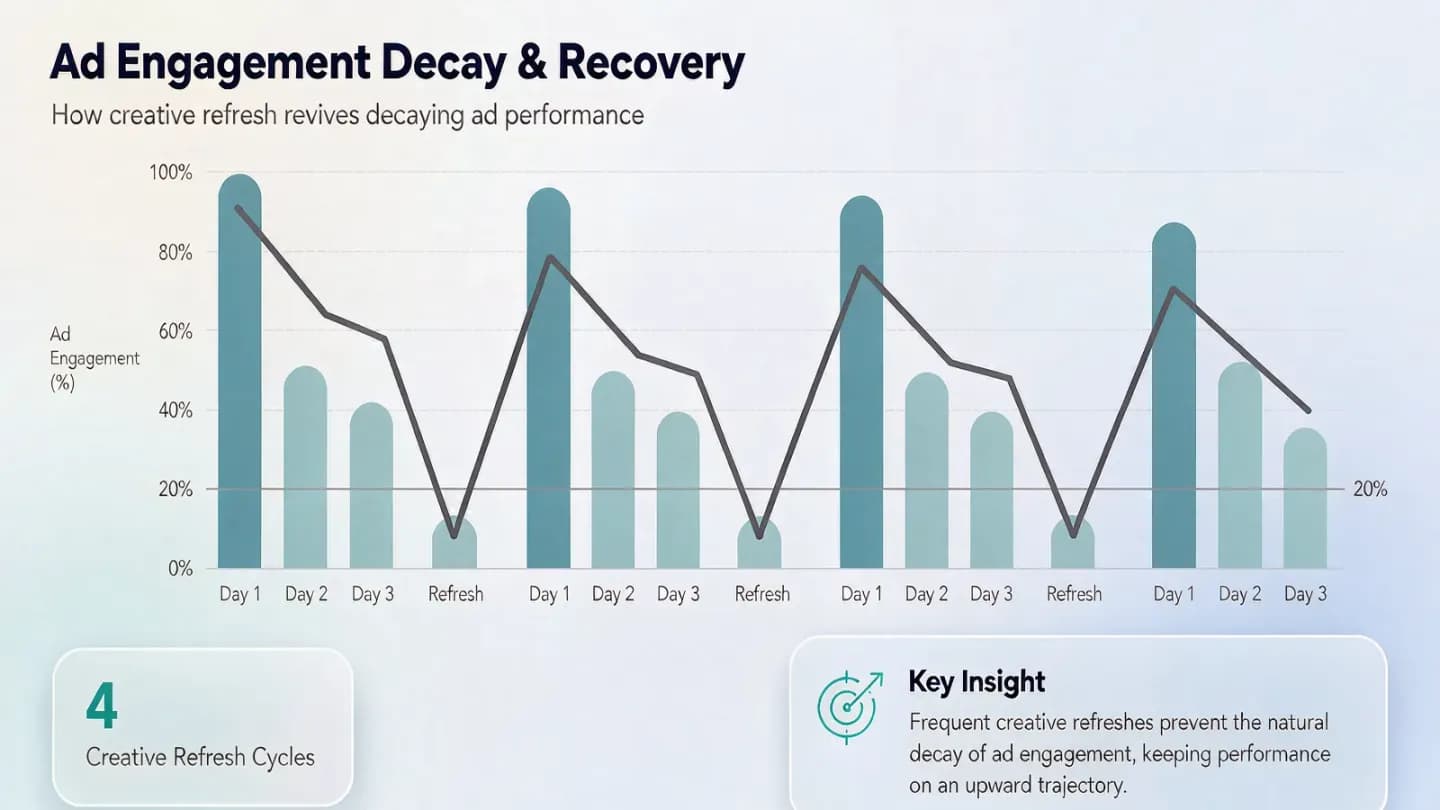
A useful mental model is a fatigue curve: engagement decays as a single creative ages, then jumps back up each time a new variant enters the auction. The job of the commerce team is to keep that curve climbing by scheduling refreshes, not by hoping one hero film survives the whole season.
Holiday fatigue makes your creative refresh cadence the single biggest lever on paid-social ROAS.
Build a Variant Tree, Not a Hero Film
The AI-era seasonal structure inverts the old one-film-plus-cutdowns approach. Start from one core concept, then branch it across products, audience angles, platforms, and hooks until a single idea becomes dozens of assets. A typical tree — four products times three audience angles times three platforms times two hooks — yields seventy-two cuts from one creative seed.
Lock a seasonal visual system first: a consistent grade, lighting language, and prop vocabulary used as a reusable suffix so all seventy-two assets read as one campaign. Use reference-to-video for every product shot so the actual item, label and all, appears in each variant rather than a festive approximation. Then build the tree as reusable workflows and let batch generation ship it.
The offer lives in overlays, not in the footage. Produce brand and product layers early, then design every asset so the discount, date, and code sit in text overlays and end cards you can swap in minutes. Offer-agnostic masters plus late-binding offer overlays are the whole trick that lets a September shoot serve a December deadline.
Keep the human in the loop where it counts. AI generates the volume, but a reviewer should own brand-safety, claim substantiation, and the seasonal art direction that keeps seventy-two cuts feeling like one campaign rather than a content farm. Automation scales the output; judgment keeps it on-brand.

The September-to-January Calendar That Actually Ships
The calendar is the real differentiator. Teams that start in September are the only ones not paying the Q4 production premium, which runs 20–40% above normal exactly when volume is highest. Early assets cost less per result because they accumulate performance data on cheap CPMs instead of peaking on Black Friday.
Map the year-end window as connected moments, not one weekend. October Prime Day already runs about 250% above daily ad spend, Black Friday and Cyber Monday about 87–88% above, and the holiday stretch from November to December carries roughly 24% of seasonal budget. Plan distinct creative beats for each — wishlist seeding, value tease, urgency strike, then post-holiday retention — so the message matches the shopper’s mindset.
Close the loop into January. The New Year reset is the second-most-profitable window for many niches, and the creative system built for gifting can pivot to ‘treat yourself’ and returns-friendly messaging without a new production cycle. Ship the calendar once; let the variant tree refill it all quarter.
Budget the refresh, not just the build. The teams that beat fatigue treat the weekly new-cut quota as a fixed line item funded before the season starts, so the publishing calendar never starves when Q4 gets busy. Volume without a funding commitment quietly collapses into the same three reused assets by mid-December.
Put the framework into production
These related pages connect the article’s planning advice to a specific commercial scope.
References
- Your 2026 Guide to Q4 CTV CreativeMNTN Research
U.S. holiday sales are projected to pass $1 trillion for the first time in 2026, and U.S. CTV ad spend is set to reach $37.95 billion; streaming accounted for 47.5% of TV viewing in December 2025.
- 2026 Holiday & Seasonal Shopping Trends ReporttvScientific by Pinterest
81% of marketers plan to run ads on Performance TV for the 2026 holiday season; social (68%), Performance TV/CTV (54%) and online video (44%) take the largest shares of seasonal media budget; October Prime Day spend ran 250% above daily average.
- Holiday Season Ad Spend in Apparel to Grow 2%WWD / Sensor Tower
Sensor Tower forecasts 2026 holiday ad-spend growth of +64% for pet supplies, +52% wearables, +48% electronics, but only +2% for apparel; Facebook accounts for about 65% of channel spend across shopping subcategories.
- Brands raise festive quick-commerce ad budgets 25-35%Storyboard18
Brands are raising festive quick-commerce ad budgets 25–35% YoY in 2026, with quick commerce taking 20–30% of ecommerce and retail-media budgets and well-executed campaigns returning 4–6X ROAS.