
What the 2026 short-form video duration paradox shows in the data
The short-form video duration paradox is not a guess. Socialinsider's 2026 cross-platform study of 69 million TikTok, Reels, and Shorts videos puts average engagement at 2.60% on TikTok, down from 3.70% in 2025, 0.45% on Instagram Reels, and 0.30% on YouTube Shorts. Engagement is softening across the board as feed volume rises, but the shape of the curve by length is what actually matters for planning.
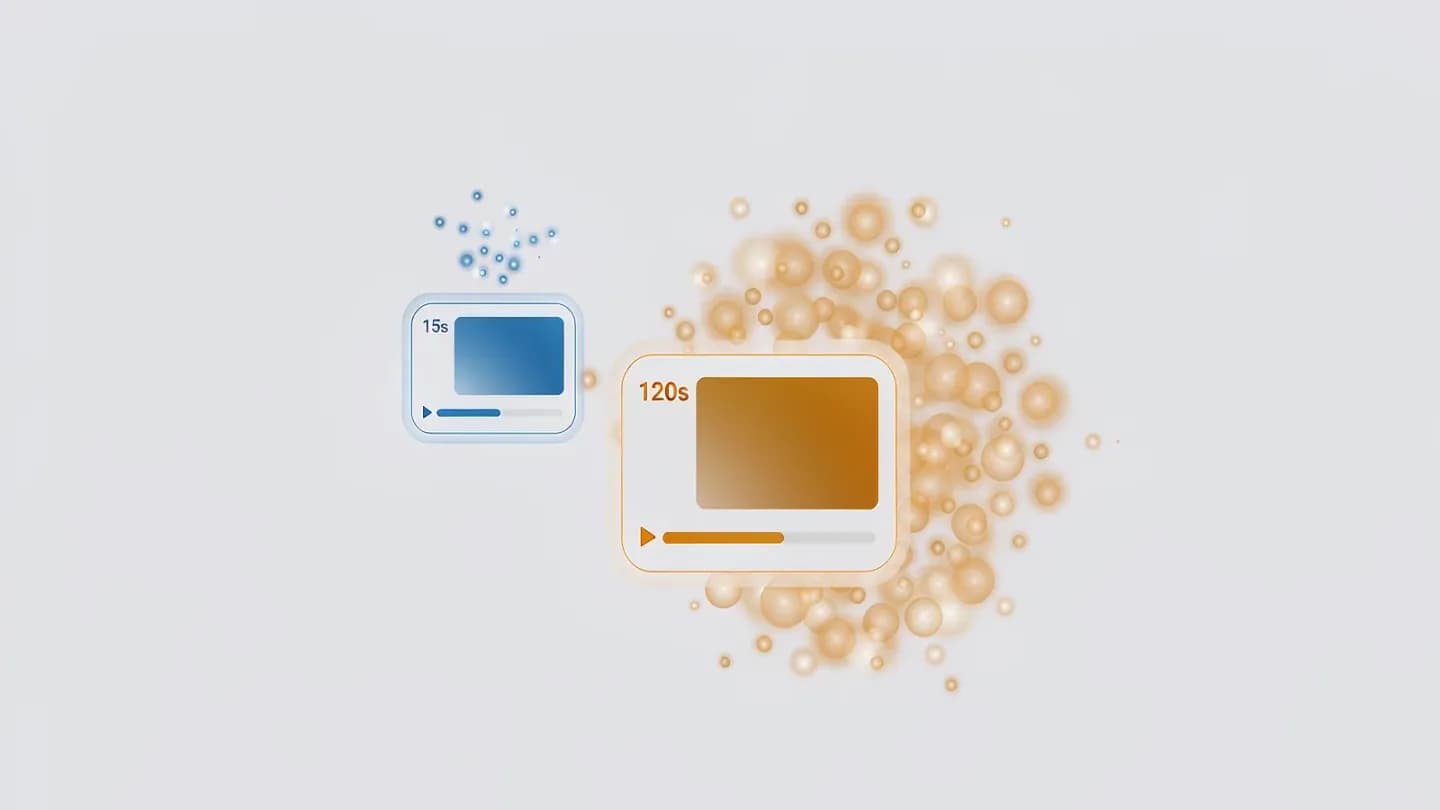
Within TikTok, the shortest winning clips are also the most engaging. Videos of 15 to 30 seconds earn the highest engagement rate at 6.00%, more than double the platform average. Yet the same study shows 120 to 180 second videos earn the most median views at 11,136, about 11 times the median of the shortest clips. High engagement and high reach sit at opposite ends of the length axis, and that is the whole paradox in one sentence.
Completion data tells the same story from the other side. A short clip is almost certain to be finished; a longer one leaks a large share of its audience before the end, which is exactly why completion rate and view count move in opposite directions as length rises. But the longer clip that survives still reaches a far larger absolute crowd, because watch time is what the recommendation systems reward with distribution. Audience expectation points the same way: Wyzowl's 2026 State of Video Marketing survey found 71% of respondents believe videos between 30 seconds and two minutes are the most effective length, a range that spans both ends of the paradox rather than resolving it.
Engagement rate carries a second trap worth naming. The same cross-platform study reports average comments per video of 50 on TikTok, 20 on Reels and 10 on Shorts, which matters because TikTok's higher engagement rate is partly a more conversational audience, not only a friendlier denominator. Any team that benchmarks its own engagement rate against a platform average without checking the comment baseline will misread whether the gap is content or context, and will chase the wrong fix.
Engagement and reach are not the same goal
The mistake is treating 'performance' as one number. Engagement rate measures how a smaller, already-watching audience reacts: likes, comments, and shares per view. Reach, approximated by median views, measures how many distinct people the algorithm pushed the video to. A 15-second clip can post a 6% engagement rate among a few thousand viewers; a three-minute clip can post a 1% rate among hundreds of thousands. Both are 'working,' for different jobs.
This is why copying the highest-engagement benchmark for every video backfires. If your objective is a comment spike, a save, or a share that signals brand warmth, the short punchy cut wins. If your objective is discovery, top-of-funnel awareness, or a narrative that needs time to land, the longer cut wins on raw people reached. The short-form video duration paradox is really a goal-selection problem wearing a length problem's clothes.
Context makes the reach side matter more than ever. Short-form video now takes 58% of all time spent on social media, and US digital video ad spend passes $80 billion in 2026, continuing to outpace the broader ad market. With that much inventory and budget flowing through short formats, the gap between a clip seen by thousands and one seen by hundreds of thousands is no longer a vanity metric. It is the campaign result.
The practical takeaway is to name the job before naming the length. A save-driving tip and a reach-driving story are different videos, and pretending one duration serves both is how teams end up reporting a strong engagement rate on a video nobody outside their followers ever saw.

Why the paradox exists: the algorithm and the attention curve
The mechanism is mechanical. Short clips complete at a high rate, which sends a strong engagement signal, so the platform serves them to a responsive but bounded audience. Longer short-form clips accumulate watch time, which the recommendation engine reads as a reason to broaden distribution. Engagement and reach pull in opposite directions because they are fed by different signals: completion versus total minutes watched.
The practical ceiling is the attention curve. A clip under 20 seconds almost always finishes, but it has no room to build a story. A 120 to 180 second clip can carry a premise, a turn, and a payoff, which is exactly what earns the broad recommendation, but it sacrifices the completion rate that shorter cuts take for granted. You trade certainty of finish for scale of audience, and the trade is dictated by length.
Generative tooling makes the tradeoff cheaper to explore. Wyzowl's 2026 research finds 89% of businesses now use video as a marketing tool and 63% of video marketers use AI tools to create or edit, up from 51% the year before. When producing ten lengths costs little more than producing one, the rational move is to stop arguing about the single perfect duration and start testing both ends of the curve. The constraint moves from production budget to review speed.

How to choose the right length for your goal
Start from the metric you report on. If the team is measured on engagement, saves, and shares, ship 15 to 30 second cuts with the payoff in the first three seconds. If the team is measured on reach, watch time, or mid-funnel narrative, ship 60 to 180 second cuts and accept a lower completion rate as the price of distribution. The length is a consequence of the scoreboard, not the other way around.
Instagram needs its own row on the chart. Socialinsider's 2026 video statistics put the Reels sweet spot at 45 to 60 seconds, the only band where engagement (0.35%) and median views (10,374) both peak, so a TikTok-first 15-second cut is not automatically the right Reels length. Treat each platform's own band as the default and let your account data override it, instead of porting one duration across every feed you publish to.
Match the length to the channel using {{link}}, because the same duration performs differently on TikTok, Reels, and Shorts, and the platform you lead on should set the length you lead with. A cut that wins on TikTok can be nearly invisible on Shorts, where completion and recommendation mechanics differ enough to flip the result.
Whatever length you choose, front-load the payoff with {{link}} built for muted, algorithmic feeds, since most social video is watched without sound and the scroll stops only if the first frames earn it. The hook is not optional at any duration; it is the tax you pay for the next second of attention, and a weak open wastes a strong body regardless of how long the clip runs.
Pair the length decision with a read of the attention curve from the prior section. A 20-second cut and a two-minute cut are not rivals; they are two instruments tuned to two different signals, and the team that treats them as a menu rather than a debate is the one that stops leaving reach or engagement on the table.
Match the length to the channel using short-form video platform benchmarks, because the same duration performs differently on TikTok, Reels, and Shorts, and the platform you lead on should set the length you lead with.
Whatever length you choose, front-load the payoff with short-form video hook design built for muted, algorithmic feeds, since most social video is watched without sound and the scroll stops only if the first frames earn it.
The mistake most teams make in 2026
The most common failure is uniform length. Teams see that 15 to 30 second clips post the highest engagement rate and make every video short, then wonder why reach plateaus. Or they hear that longer clips earn more views and stretch everything past two minutes, then watch completion collapse below half. Neither extreme is a strategy; both are reflexes borrowed from one benchmark line.
And remember that a clip built only for the hook still has to earn recall, which is why {{link}} matters once the scroll stops: a high-engagement, low-recall short can win the minute and lose the brand. Length should serve the memory goal, not just the engagement chart, because a clip nobody remembers is a clip that has to be paid for again next week.
The fix is to run length as a variable, not a default. With 63% of video marketers now using AI tools, generating a 20-second and a 120-second version of the same brief is a same-day decision, not a budget debate. Read the signal each length earns, keep the winner's neighbors in rotation, and let the goal, not the trend, pick the next cut. The 2026 short-form video duration paradox stops being a trap the moment you stop optimizing one number and start optimizing the one your campaign is actually scored on.
And remember that a clip built only for the hook still has to earn recall, which is why short-form video memory illusion matters once the scroll stops: a high-engagement, low-recall short can win the minute and lose the brand.
Put the framework into production
These related pages connect the article’s planning advice to a specific commercial scope.
References
- Short-Form Video Benchmarks 2026: TikTok vs Reels vs ShortsFastLane (reporting Socialinsider 2026 cross-platform study, 69M videos)
Socialinsider's 2026 study of 69M TikTok/Reels/Shorts videos (Jan 2025-Jul 2026): TikTok avg engagement 2.60% (down from 3.70% in 2025), Reels 0.45%, Shorts 0.30%; comments per video 50 / 20 / 10; 15-30s TikTok clips earn the highest engagement at 6.00%; 120-180s clips earn the most median views at 11,136 (~11x the shortest clips); Reels sweet spot is 45-60s (0.35% engagement, 10,374 median views).
- Video Marketing Statistics 2026 (State of Video Marketing)Wyzowl
Wyzowl 2026 State of Video Marketing: 89% of businesses use video as a marketing tool; 82% of marketers report good ROI (down from a 93% all-time high); 63% of video marketers use AI tools to create or edit (up from 51% the prior year); 71% of respondents say videos of 30 seconds to 2 minutes are the most effective length.
- 60+ Short-Form Video Statistics for 2026 (Every Stat Sourced)Vidico (citing DataReportal Digital 2026 / We Are Social)
DataReportal Digital 2026: short-form video accounts for 58% of all time spent on social media.
- 2026 IAB Digital Video Ad Spend & Strategy ReportIAB
IAB's 2026 report (published 5 May 2026): US digital video ad spend will surpass $80B in 2026, continuing to outpace the broader ad market; nearly all buyers see a role for agentic AI while the industry lacks consensus on governance and human oversight.