
Why social commerce AI video needs a content engine, not one-off clips
Social commerce AI video works best in 2026 as a complementary layer that runs alongside creator content inside one continuous content engine, not as a standalone replacement for human-made clips. The clearest proof is BONCEPT, where AI-generated video reached close to 10% of the brand's Vietnam e-commerce GMV while creators kept ownership of trust and storytelling.
The economics of AI generation make the volume plausible, but volume without structure is simply noise. A content engine is a system that identifies what the audience cares about, generates video from those signals, distributes it across channels, measures performance, and feeds the learning back into the next cycle. That loop is what turns one-off clips into a compounding asset. The shift toward {{link}} shows why a single generated clip can no longer carry a campaign on its own, because the channel rewards consistency over isolated hero pieces.
This is the structural reason so many 2025 experiments failed to scale. Teams generated a few impressive clips, posted them, and watched the novelty fade. Without a workflow that converts performance data into the next batch of assets, the production advantage of AI evaporates almost immediately, leaving behind a folder of demo reels and no durable reach to show for the effort.
The shift toward AI video templates as brand co-creation engines shows why a single generated clip can no longer carry a campaign on its own, because the channel rewards consistency over isolated hero pieces.
The complementary-layer model: AI video beside creator content
AnyMind Group's June 2026 launch of AnyAI Video makes the model concrete. Rather than framing AI as a replacement for creators, the platform treats generated video as a complementary layer that runs alongside influencer content and live commerce inside one social-commerce ecosystem. Creator content still carries awareness, storytelling, and trust, while AI video carries the repetitive, high-volume work of product education, comparison, and conversion-oriented explainers that would otherwise drain a creative team's calendar and stall the publishing rhythm. The result is a fuller funnel without forcing creators to produce throwaway cuts they would never put their own name on.
That division of labor matters because it respects what each format does best. Treating generated clips as a supporting layer, not the whole asset, is the same logic behind {{link}} that brands now vet for rights and provenance, since a generated clip used at scale multiplies every rights and disclosure question. The AI layer scales consistency and speed, and the human layer scales credibility, and the two are not interchangeable.
AnyMind's own positioning reinforces this split. The company describes AI-generated content as a complementary enhancement to creator-generated content, explicitly not a substitute, and wraps it in a stack that includes influencer management, human-led and AI-led livestreaming, and multi-channel commerce operations. The point is integration, not displacement, and the launch followed the company's June 2026 establishment of an AI research and development hub in Hangzhou, China, to deepen the capability.
Treating generated clips as a supporting layer, not the whole asset, is the same logic behind licensable AI video platforms that brands now vet for rights and provenance, since a generated clip used at scale multiplies every rights and disclosure question.

The BONCEPT proof point: 50 assets a month, 10% of GMV
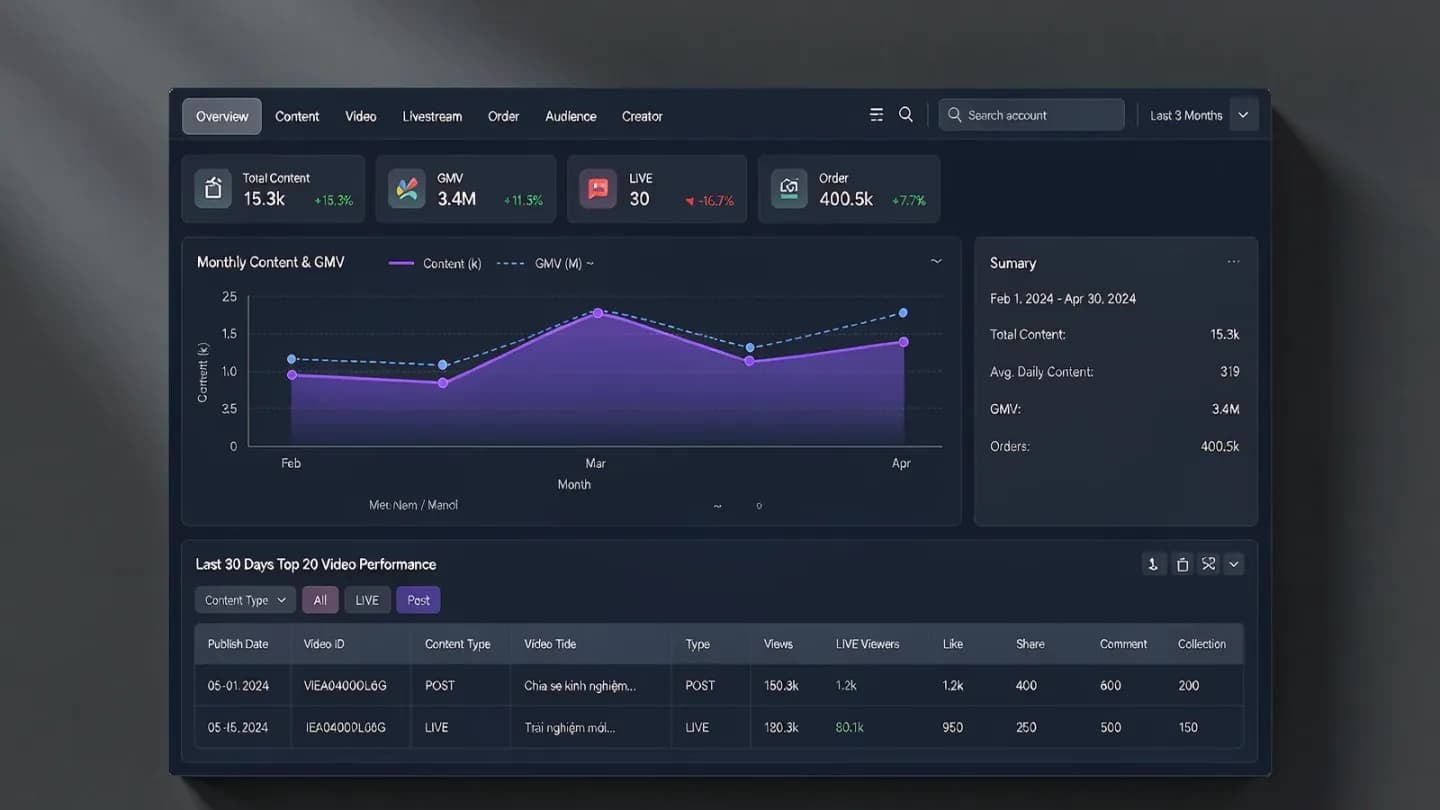
The clearest evidence comes from BONCEPT, a TONYMOLY skincare brand operating in Vietnam. Using AnyAI Video, the team combined creator-led content, AI-generated videos, and livestreaming to keep a constant TikTok-native presence across the consumer journey. The system produced an average of 50 content assets per month while holding production cost and resource load manageable, a cadence that would have required a far larger in-house or agency team under a traditional shoot model with weekly reshoots.
The number that matters to commerce teams is the revenue line. AI-generated video contributed close to 10% of BONCEPT's e-commerce GMV in Vietnam for the month in which the campaign ran. That is not a vanity metric. It is a measurable share of attributable sales traced to the AI layer of the content mix, and it sits on top of the creator and live-commerce layers rather than replacing them, which is the entire point of the complementary design and the reason the result is worth copying.
BONCEPT's TikTok-native cadence worked because, as {{link}} show, 15 to 30 second clips earn the highest engagement on the platform, so a steady stream of short, native assets out-performs the occasional polished film. The AI layer did not replace creators. It filled the daily volume that creator content alone could not sustain at that frequency.
BONCEPT's TikTok-native cadence worked because, as short-form video platform benchmarks show, 15 to 30 second clips earn the highest engagement on the platform, so a steady stream of short, native assets out-performs the occasional polished film.
What the broader 2026 data says about scaling AI content
BONCEPT is one brand, but the surrounding data explains why the model is spreading. Jasper's 2026 State of AI in Marketing survey of 1,400 marketers found 91% of teams now use AI, up from 63% a year earlier, and the dominant objective has shifted from experimentation toward scaling content operations and pipelines. Scale, not access, is now the constraint that separates the teams pulling ahead from the teams still treating AI as a novelty. When the tool itself is universal, the differentiator is the operating system wrapped around it, and a content engine is exactly that operating system for video.
The same operational discipline shows up in {{link}}, where product-page video is treated as a pipeline rather than a one-off deliverable, and the lesson transfers directly to social commerce: the asset that compounds is the one produced inside a system. Jasper reports that governance, meaning legal, compliance, and brand-review blockers, rose 3.4x year over year to become the top scaling constraint, while only 41% of marketers can confidently prove AI ROI. For teams that track it, 60% report at least a 2x return.
A content engine is precisely the structure that absorbs that review load at volume. When generation, distribution, measurement, and governance live in one workflow, the cost of adding another variant drops to near zero, and the bottleneck moves from whether we can make it to which version we should ship. That is the right kind of problem to have, and it is the line between a team that merely tests AI and a team that actually runs it as infrastructure.
The same operational discipline shows up in retail media AI video builders, where product-page video is treated as a pipeline rather than a one-off deliverable, and the lesson transfers directly to social commerce: the asset that compounds is the one produced inside a system.
Building your own complementary content engine
The takeaway for commercial video teams is practical. Start by mapping the customer journey into layers: creator content for trust, AI video for repeatable education and conversion, and live commerce for the real-time close. Generate AI clips from the same platform insights that inform your creator briefs, so the two formats reinforce one message instead of competing for attention and fragmenting the brand voice across the feed.
Then close the loop. Measure which assets actually drive GMV, not just views, and feed that signal back into the next generation cycle so the library gets sharper each month. The brands pulling ahead in 2026 are not the ones generating the most video. They are the ones running AI and creator content as one continuous, measurable engine with a clear owner and a governance checkpoint baked in, so quality does not collapse the moment volume climbs past what a single editor can review by hand.

Where AI video should not lead
The complementary model also draws a clear line. AI video should lead on the high-volume, lower-stakes formats, the explainers, comparisons, FAQs, and always-on social cuts, where speed and consistency beat bespoke craft. It should not lead on the brand-defining moments that set tone and earn trust.
BONCEPT's result came precisely because the AI layer supported creator and live content rather than standing in for it. Teams that invert that order, generating the hero film with AI and treating creators as filler, tend to produce the generic output that 2026 audiences and platforms are increasingly trained to skip. The complementary layer earns its keep by doing the volume work, not by auditioning for the hero shot that only a human-led idea should own.
Put the framework into production
These related pages connect the article’s planning advice to a specific commercial scope.
References
- AnyMind Group launches AnyAI Video to help brands combine AI-generated content and creator content across social commerceAnyMind Group
AnyAI Video (launched June 2026) combines AI-generated video, creator/influencer content, and livestreaming into one social-commerce content engine, treating AI as a complementary layer to creators; BONCEPT (TONYMOLY skincare, Vietnam) produced ~50 content assets/month with AI video contributing close to 10% of e-commerce GMV.
- New Research: The State of AI in Marketing 2026Jasper
Survey of 1,400 marketers: 91% of teams now use AI (up from 63% a year earlier); governance/legal/compliance/brand-review blockers rose 3.4x year over year as the top scaling constraint; 41% can confidently prove AI ROI (down from 49%); 60% who track it report at least 2x return.
- Short-Form Video Benchmarks 2026: TikTok vs Reels vs ShortsFastlane
Socialinsider 2026 study of 69M videos: TikTok average engagement 2.60%, Instagram Reels 0.45%, YouTube Shorts 0.30%; 15 to 30 second TikTok clips earn the highest engagement rate at 6.00%; Buffer data shows 2 to 5 TikToks per week yield up to 17% more views per post.