
What Amazon's Creative Agent builds
Retail media AI video is moving from experiment to infrastructure: Amazon's Creative Agent now builds end-to-end video ads from a product page, and Conair's Cuisinart test shows the payoff in hard on-shelf numbers. This is the moment retail media networks start shipping generative video as a self-serve building block rather than a bespoke agency service.
Creative Agent is an Amazon Ads tool, previewed at the unBoxed conference in November 2025, that takes a creative brief and a product page and returns a finished 15-second video ad. It drafts the script, generates the visual, adds a voiceover, and exports the aspect ratios a retail campaign needs, all without booking a shoot, a crew, or a studio. For a brand that simply lacks a video for a core product, that removes the single biggest bottleneck in commerce creative and turns a backlog into a sprint.
The strategic point is the surface, not the model. Amazon's tool is the retail-media counterpart to the social-platform-native generators {{link}} that TikTok and Meta already ship inside their ad consoles. Those live where attention is rented; a retail-media builder lives where the product already converts, so the video and the cart share a page and the creative never has to be re-pointed at the listing.
The comparison to traditional production is stark. A conventional retail video can sit in a queue for months before a single frame is approved, while a builder returns a draft the same day the brief is written. The speed is not cosmetic; it changes which products ever get a video at all, because the economics finally favour the long tail.
Amazon's tool is the retail-media counterpart to the social-platform-native generators platform-native AI video ads that TikTok and Meta already ship inside their ad consoles.
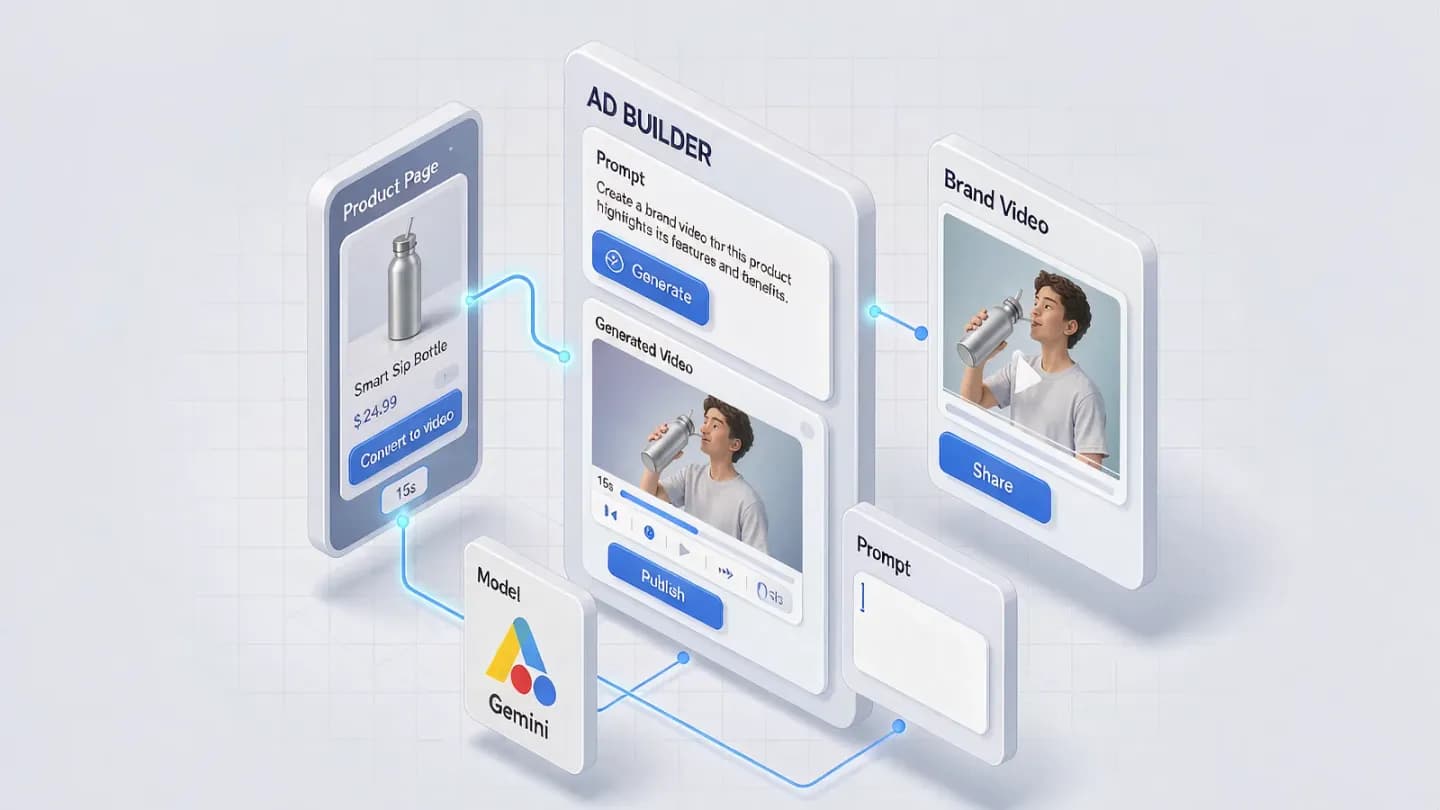
The Conair Cuisinart test in numbers
Conair's e-commerce team ran a 30-day test in April and May 2026, asking Creative Agent to produce a 15-second spot for subsidiary Cuisinart's food processor. The AI-assisted video earned 18% higher detail page views and 14% lower cost per detail page view than a conventional brand-produced video, while cutting production time from three to six months down to roughly four weeks.
Creative Agent generated about 80% of the video concept; agency Global Overview fed detailed briefs into multiple prompts and handled the remaining 20% to protect brand standards. The Cuisinart result is now one of the clearer {{link}} because it reports on-shelf performance, not just production speed. Conair says it now plans to scale the workflow across more products once it settles prioritisation and workflow details.
The test also reframes the build-versus-buy math for commerce teams. A food processor is a quiet hero product, not a marquee launch, yet it still justified a video once the cost and timeline fell within a single sprint. When a video stops costing a five-figure shoot, the long tail of un-videoed SKUs becomes reachable for the first time, and the catalog stops apologising for missing creative.
The Cuisinart result is now one of the clearer commerce AI video KPI cases because it reports on-shelf performance, not just production speed.

Why retail media AI video fits commerce
Retail media is the right home for AI video because the asset and the conversion live in the same place. A short product video on a detail page does not need a media plan to earn its keep; it shortens the last meter between intent and cart. The broader CPG retail ad shift {{link}} toward generative production is what makes a self-serve retail builder viable at brand scale rather than as a one-off experiment with no pipeline behind it.
Shoppers already watch short-form video inside commerce environments, and engagement with that format on e-commerce platforms is climbing fast. When the generator is wired directly to the catalog, a brand can spin variants for different specs, audiences, and seasons without rebooking a crew or rebuilding a storyboard from scratch each time the promotion changes.
That catalog connection is the real unlock. Social-native generators export a file and hand the distribution problem back to the brand; a retail-media builder closes the loop because the video, the product, and the buy button sit on one surface. The asset becomes a living part of the listing instead of a separate campaign that has to be pointed at it, which is why the format compounds as the catalog grows.
There is also a measurement advantage. Because the video lives on the same surface as the purchase, the team can read detail page views and cost per view directly, instead of inferring creative quality from a separate funnel. That feedback loop is what lets a retail builder improve week over week rather than campaign over campaign, and it keeps the spend honest.
The broader CPG retail ad shift CPG retail AI video ad shift toward generative production is what makes a self-serve retail builder viable at brand scale rather than as a one-off experiment with no pipeline behind it.
The 20 percent humans still own
Speed did not remove the need for judgment. Global Overview still corrected logos, colours, and spec numbers by hand, because the model can drift on exactly the brand-sensitive details that shoppers notice. A pre-publish trust and QC gate {{link}} is what stops an AI clip from shipping with a warped logo or a wrong spec number that a human would have caught in seconds.
The failure modes are specific and expensive when missed: a generation can quietly mutate a brand mark, transpose a measurement, or render text that reads as gibberish on a legal super. Conair's team estimates roughly 20% of effort stays manual, concentrated on the elements that define the brand and carry the claim, which is where a generic output becomes either an asset or a liability depending on who reviews it.
That 80-20 split is the realistic ceiling for self-serve retail video. The tool absorbs the volume and the iteration; humans defend the last mile of accuracy, brand fit, and compliance. Teams that treat the human step as optional are the ones that end up with a fast video nobody can publish, because the one wrong frame is the frame a customer screenshots.
Governance should be built into the brief, not bolted on after the render. Brands that load logo files, approved colours, and banned claims into the builder upfront get fewer surprises, which is why the human 20% shrinks as the guardrails get sharper. The review becomes exception-handling, not line-by-line repair, and the pipeline scales without the quality slipping.
A pre-publish trust and QC gate AI video trust and QC gate is what stops an AI clip from shipping with a warped logo or a wrong spec number that a human would have caught in seconds.

What commerce teams should do next
For commerce teams, the takeaway is to treat retail media AI video as a pipeline, not a one-off trick. Start with a core product that lacks a video, brief it tightly, and let the builder produce the variants you would never shoot. The metric that matters is {{link}}, not the sticker price of the generation tool, because most drafts still need a human pass before they are shippable and only shippable clips count.
Pair the builder with a disclosure and provenance step so synthetic clips are labeled honestly from the start, and keep a human review on logos, numbers, and product claims. An open provenance standard such as C2PA's Content Credentials gives retail teams a consistent way to mark AI-generated creative, which matters as platforms and regulators tighten synthetic-media rules and shoppers learn to read the labels.
The brands that win this cycle will be the ones that ship more usable video per week, not the ones that generate the most. Retail media rewards volume that is also accurate, on-brand, and tied to the listing. A self-serve builder makes the volume possible; disciplined review is what keeps it sellable, and the two together are the actual competitive moat.
The metric that matters is cost per usable clip, not the sticker price of the generation tool, because most drafts still need a human pass before they are shippable and only shippable clips count.
Put the framework into production
These related pages connect the article’s planning advice to a specific commercial scope.
References
- Video Marketing Statistics 2026Wyzowl
63% of video marketers used AI video tools to create or edit marketing videos in 2026, up from 51% in 2025, and 91% of businesses use video as a marketing tool.
- C2PA - Verifying Media Content SourcesC2PA
C2PA's Content Credentials provide an open provenance standard that acts like a nutrition label for digital content, labeling AI-generated and edited media so origin and edits are visible.
- Conair turns to Amazon AI to speed up video ads after Cuisinart testComplete AI Training
Conair's AI-generated Cuisinart video earned 18% higher detail page views and 14% lower cost per view than a conventional video, cutting production from 3-6 months to about 4 weeks.
- Video Marketing Statistics 2026: ROI, Short-Form, AI & Conversion DataLoopex Digital
US digital video ad spend reached $72.4B in 2026, up 14% year over year, and 49% of marketers rank short-form video as the top ROI format.