
The First AI-Generated Super Bowl Ad, By the Numbers
Svedka's 'Shake Your Bots Off' was the first primarily AI-generated Super Bowl ad, airing during Super Bowl LX on February 8, 2026. It proved a generative video could survive the most scrutinized advertising stage on earth, but the backlash that followed taught brand teams more about trust than technology ever could.
The vodka brand worked with Silverside AI, the studio behind Coca-Cola's earlier AI holiday spots, and spent roughly four months reconstructing its Fembot mascot and training the model to mimic facial expressions and body movement for a single 30-second spot. Sazerac, Svedka's parent, paid about eight million dollars for the media slot alone, standard Super Bowl math but a striking sum for a creative that humans mostly conceptualized while AI handled the visual execution. Notably, the studio described the result as 'primarily' rather than fully AI-generated, a hedge that acknowledges how much human art direction still sits between a prompt and a broadcast-ready frame.
The moment was bigger than one brand. Reporting identified roughly 15 of the 66 spots that year as AI-focused, either selling an AI product or produced with AI, about 23 percent of the broadcast. More telling, industry estimates put generative AI in the production of 50 percent or more of the night's ads, concentrated in pre-production and almost never disclosed. The first AI-generated Super Bowl ad was the visible tip of a far larger shift.
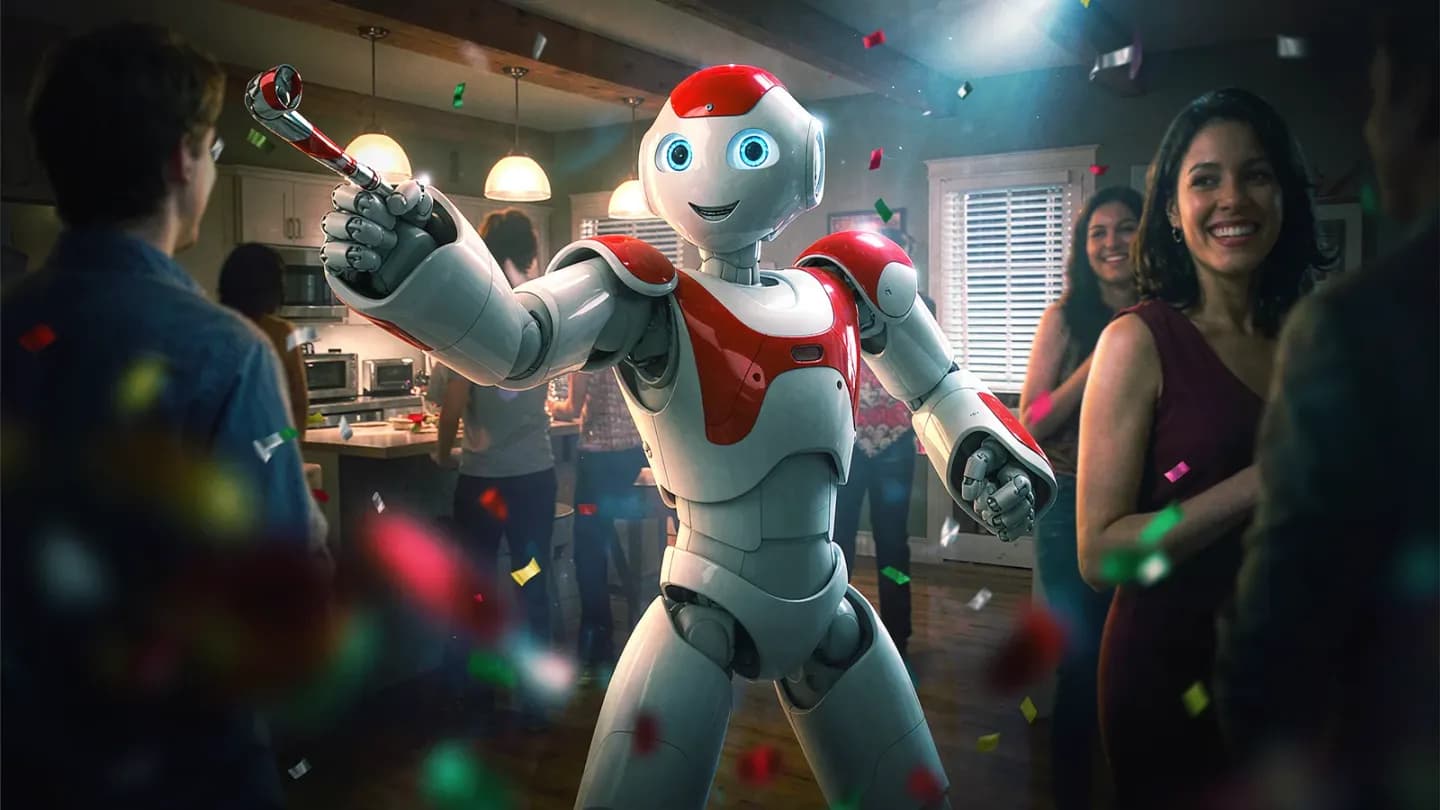
Why the First AI-Generated Super Bowl Ad Backfired
The spot told viewers to disconnect from technology, mute their notifications, and prize human connection, yet it was made almost entirely by AI. That irony is what turned a creative choice into a credibility problem. Critics dismissed it as 'soulless slop,' and a closer look revealed why: the new Brobot character's cocktail spilled through the bottom of its jaw because the model had never been given an esophagus to respect anatomy. Moments like that are not mere glitches; they are visible proof that the synthetic characters lacked the physical logic a human animator would never forget.
The sharper critique was not about quality but honesty. Audiences did not reject the technology; they rejected the contradiction. A brand messaging human warmth had outsourced that warmth to algorithms, and the disconnect read as a shortcut dressed up as innovation. The lesson is uncomfortable but useful: the real risk in AI creative is rarely the renderer. It is the story you tell about why you used it.
Compare the landing. Meta's AI-glasses spot featured real athletes and creators wearing the tech, so the AI was the subject rather than a hidden hand. Wix presented its AI builder as a democratizing partner that lets non-designers ship sites. Both were transparent about the role of AI and came away stronger, while Svedka's attempt to make the AI invisible inside an anti-tech message backfired. The variable was framing, not fidelity.

Authenticity Is a Framing Problem, Not a Technology Problem
Once you separate the tool from the narrative, the pattern is clear: audiences accept AI when it serves the brand story and resent it when it contradicts that story. Positioning AI as a creative partner, with human direction over concept, tone, and judgment, reads as ambition. Positioning it as a labor replacement for a message about human connection reads as a betrayal of the very value being sold. The difference shows in the work itself: a partner model leaves human taste in the loop, while a replacement model removes the human whose warmth the message depends on.
That distinction should be decided before production begins, not after a spot draws fire. A simple pressure-test helps: write one sentence that starts 'We're using AI because.' If that sentence conflicts with what the campaign claims to stand for, stop. If it reinforces the brand's promise, proceed and say so openly. The goal is not to hide the method but to make the method legible and intentional.
This is also where craft discipline matters. AI can generate form, images, motion, and voice, but it cannot generate taste, point of view, or cultural resonance. Keeping human judgment visible in the decisions that shape meaning is what separates a spot that feels authored from one that feels assembled. The brands that thrive with AI in 2026 are the ones treating it as infrastructure for creativity, not a substitute for it.
The Invisible Majority: AI Already Runs Pre-Production
The Svedka spotlight obscures the more important trend. Across the industry, generative AI has already moved into storyboards, mood frames, previz, concept exploration, and cleanup, layers the audience never sees as 'AI.' Moving storyboards and previz to AI is the heart of {{link}}.
Because this work happens upstream of the camera, it carries almost none of the disclosure or brand-safety risk of on-screen generation. A team that uses AI to plan a shoot is not the same as a team that uses AI to replace one. For most brands, the pragmatic entry point is exactly here: adopt AI where it accelerates thinking and exploration, and keep humans unmistakably in charge of what reaches the screen.
The cost economics reinforce the shift. When a 30-second media buy runs near eight million dollars, shaving production cost barely moves the total. The real leverage is one tier down, where mid-market brands with no eight-figure production war chest can now put broadcast-quality creative on air. AI as pre-production infrastructure democratizes who gets to look polished, which is why adoption quietly outpaces the visible debate. For a challenger brand, the ability to test five visual directions in the time it once took to storyboard one changes the economics of experimentation, not just production.
Moving storyboards and previz to AI is the heart of AI-native creative pipeline.
Disclosure Is Becoming the Default, Not the Exception
For the on-screen AI that does reach viewers, transparency is hardening from courtesy into expectation. The safe posture is proactive transparency, the same principle behind {{link}}.
Technically, standards like C2PA's Content Credentials let creators attach provenance metadata describing who made a clip and which tools were used, so platforms and viewers can see whether media was AI-generated or edited. A content-credentials label functions like a nutrition label for digital media, a peek at a file's history available to anyone, at any time. Adopting it turns disclosure from a defensive chore into a default property of the asset. When the label travels with the file, disclosure stops being a footnote added after the fact and becomes part of the media itself.
Legally, the ground is shifting too. The EU AI Act requires providers of systems that generate or manipulate content to mark it as artificially generated and disclose its synthetic origin, establishing a legal default for labeling of synthetic media in advertising. Brands operating across markets should assume that what is optional today becomes mandatory tomorrow, and build disclosure into the pipeline now rather than retrofitting it under pressure.
The safe posture is proactive transparency, the same principle behind IAB AI transparency framework.

What Brand Teams Should Do in 2026
Start with the brief, not the model. Decide whether AI serves the brand's promise; if it contradicts that promise, reach for it sparingly or not at all. Keeping a mascot recognizable across dozens of AI-generated cutdowns is the same problem solved by {{link}}.
Treat the production method as a governed decision, following a {{link}}. Before anything ships, {{link}} catches anatomy glitches like the robot's missing esophagus.
Finally, make AI visibility a deliberate choice. If AI is central to your story, claim it as a competitive advantage; if it contradicts your values, keep it in pre-production where it adds speed without undermining trust. The question for every brand team in 2026 is no longer whether to use AI. It is whether you will use it in a way that strengthens the story or quietly weakens it, and that answer, more than any renderer, is what audiences remember. Svedka did not fail because the technology was immature; it failed because the choice was presented as innovation while the execution contradicted the message. That is a strategy problem with a strategy fix.
Keeping a mascot recognizable across dozens of AI-generated cutdowns is the same problem solved by reference-driven control for AI video.
Treat the production method as a governed decision, following a creative audit trail for AI video.
Before anything ships, editing of AI-generated video catches anatomy glitches like the robot's missing esophagus.
Put the framework into production
These related pages connect the article’s planning advice to a specific commercial scope.
References
- AI in Super Bowl LX Ads: Who Used It and How8frame
Svedka aired the first primarily AI-generated national Super Bowl spot, built over roughly four months with Silverside AI; industry estimates put generative AI in 50 percent or more of the night's spots, and about 15 of 66 (~23 percent) were AI-focused.
- Svedka's AI-Generated Super Bowl Spot Sparks Creative Authenticity DebateSquareMatters
Audiences rejected Svedka's AI ad not because it was AI-made but because an anti-technology message felt dishonest when produced almost entirely by AI; brands framing AI as a partner such as Meta and Wix landed differently.
- C2PA | Verifying Media Content SourcesC2PA
C2PA's Content Credentials attach provenance metadata describing who created a piece of media and which tools were used, so viewers and platforms can see whether content was AI-generated or edited.
- The EU Artificial Intelligence ActEuropean Union
The EU AI Act requires providers of AI systems that generate or manipulate content to mark it as artificially generated and disclose its synthetic origin, establishing a legal default for disclosure of synthetic media in advertising.